- Plants
- ›Vascular Plants
- ›flowering plants
- ›Dicots
- ›Legumes, Milkworts, and Allies
- ›Legumes
- ›Faboideae
- ›Mirbelieae
- ›Gompholobium
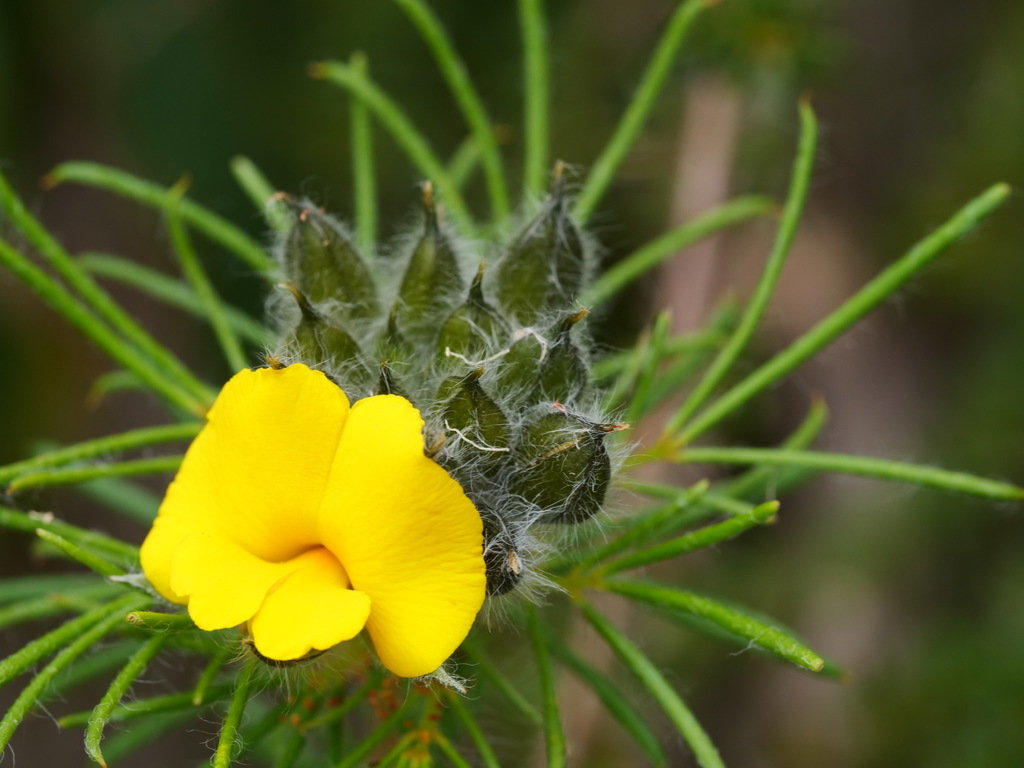
Gompholobium capitatum
Gompholobium capitatum, commonly known as yellow pea, is a species of flowering plant in the family Fabaceae and is endemic to the south-west of Western Australia. It a slender, erect or ascending shrub with pinnate leaves and yellow flowers.
From the article Gompholobium capitatum on Wikipedia (CC BY-SA), quoted section by section
Description
Gompholobium capitatum is a slender, erect or spreading shrub that typically grows to a height of 0.2–1 m (7.9 in – 3 ft 3.4 in). It has pinnate leaves with five to seven cylindrical leaflets, each 7–22 mm (0.28–0.87 in) long and 0.7–1.7 mm (0.028–0.067 in) wide with a stipule 2–3 mm (0.079–0.118 in) long at the base of the leaf. Each flowers is borne on a hairy pedicel 3–5 mm (0.12–0.20 in) long with hairy sepals 9–13 mm (0.35–0.51 in) long. The flowers are uniformly yellow, the standard petal 13–14 mm (0.51–0.55 in) long, the wings 9–13 mm (0.35–0.51 in) long and the keel 10.2–11.5 mm (0.40–0.45 in) long. Flowering occurs from September to December and the fruit is a flattened pod.
Range & habitat
Yellow pea grows in sandy soil in heath and forest in the Esperance Plains, Jarrah Forest, Swan Coastal Plain and Warren biogeographic regions of south-western Western Australia.
Wikipedia: “Distribution and habitat”
Where it lives
Recorded sightings
—
geo-referenced records in GBIF, from museums, herbaria and field observers.
Drag the globe to turn it. Dots are where records exist, not a range map; darker means more records.
In the stacks
Searching the stacks…
Every page naming Gompholobium capitatum in the Biodiversity Heritage Library →
This page is assembled live from iNaturalist, GBIF, Wikipedia, the Source Library and the Internet Archive. It is not yet part of the hand-edited codex. iNaturalist taxon 1079977.