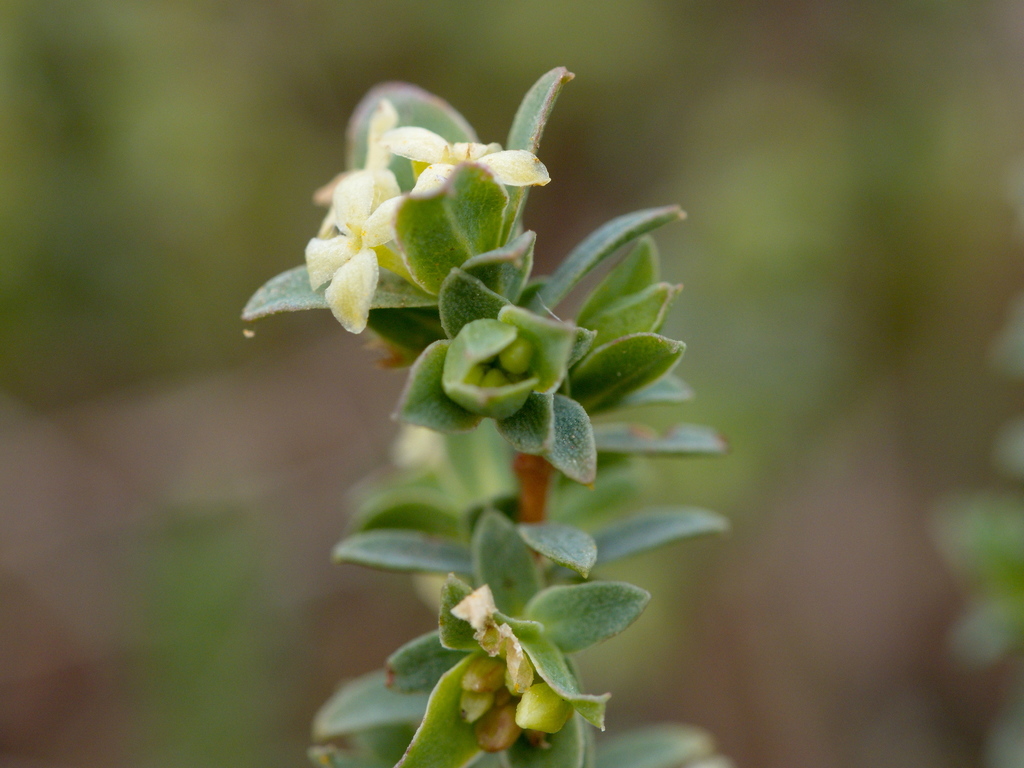
Spiny Rice-Flower
Pimelea spinescens
Pimelea spinescens, commonly known as plains rice-flower, spiny rice-flower or prickly pimelea, is a species of flowering plant in the family Thymelaeaceae and is endemic to Victoria. It is a spreading undershrub with elliptic leaves arranged in opposite pairs, and heads of white, cream-coloured or yellow flowers surrounded by 4 elliptic, leaf-like involucral bracts.
From the article Pimelea spinescens on Wikipedia (CC BY-SA), quoted section by section
Description
Pimelea spinescens is a spreading, stunted, long-lived undershrub that typically grows to a height of 5–30 cm (2.0–11.8 in). It has a deep taproot and its stems are glabrous, becoming spiny as they mature. The leaves are narrowly elliptic or elliptic, 2–10 mm (0.079–0.394 in) long and 1–3 mm (0.039–0.118 in) wide. The flowers are arranged in heads of 6 to 12 surrounded by 4 elliptic, sessile, leaf-like involucral bracts 3–7 mm (0.12–0.28 in) long and 1.5–4 mm (0.059–0.157 in) wide, male and female flowers usually on separate plants. The flowers are white, cream-coloured or yellow, the heads of male flowers erect and female heads drooping. The flower tube is 1.5–3 mm (0.059–0.118 in) long, the sepals 1–2 mm (0.039–0.079 in) long, and the stamens are shorter than the sepals. Flowering occurs in June and July.
Range & habitat
Subspecies pubiflora was thought to be extinct since it had not been collected since 1901, but was rediscovered in 1980, growing in grassy woodland in the Wimmera region of Victoria. Subspecies spinescens grows mainly in grassland and open shrubland between Melbourne, Horsham and Echuca.
Wikipedia: “Distribution and habitat”
Where it lives
Recorded sightings
—
geo-referenced records in GBIF, from museums, herbaria and field observers.
Drag the globe to turn it. Dots are where records exist, not a range map; darker means more records.
In the stacks
Searching the stacks…
Every page naming Pimelea spinescens in the Biodiversity Heritage Library →
This page is assembled live from iNaturalist, GBIF, Wikipedia, the Source Library and the Internet Archive. It is not yet part of the hand-edited codex. iNaturalist taxon 1084244.