- Fungi Including Lichens
- ›Basidiomycete Fungi
- ›Higher Basidiomycetes
- ›Mushrooms, Bracket Fungi, Puffballs, and Allies
- ›Agaricomycetidae
- ›boletes and allies
- ›boletes
- ›Boletoideae
- ›Hortiboletus
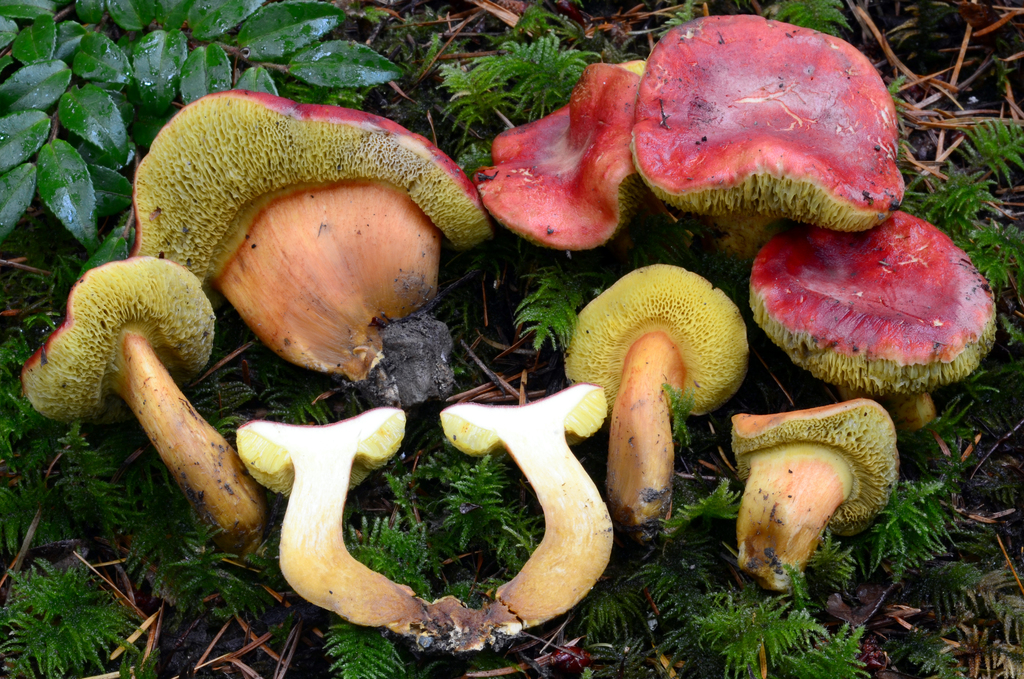
Hortiboletus coccyginus
Hortiboletus coccyginus, commonly known as the sumac-colored bolete, is a species of mushroom in the genus Hortiboletus. It is rare.
From the article Hortiboletus coccyginus on Wikipedia (CC BY-SA), quoted section by section
Description
Hortiboletus coccyginus has a rosy-colored cap that is about 2–6 cm (0.79–2.36 in) wide. Sometimes, the it cracks in older specimens. The stipe is about 1.5–7 cm (0.59–2.76 in) tall and about 0.5–2 cm (0.20–0.79 in) wide. The pores are yellow. While on younger mushrooms they do not bruise blue, older specimens occasionally stain bluish green.
Range & habitat
Hortiboletus coccyginus grows under several different types of trees, including coast live oak, tanoak, and douglas-fir. It is known to grow in mixed forests, and it is known from California and Oregon. Despite being rare, it is listed by the IUCN Red List as Least Concern.
Wikipedia: “Habitat and ecology”
Where it lives
Recorded sightings
—
geo-referenced records in GBIF, from museums, herbaria and field observers.
Drag the globe to turn it. Dots are where records exist, not a range map; darker means more records.
In the stacks
Searching the stacks…
Every page naming Hortiboletus coccyginus in the Biodiversity Heritage Library →
This page is assembled live from iNaturalist, GBIF, Wikipedia, the Source Library and the Internet Archive. It is not yet part of the hand-edited codex. iNaturalist taxon 1096243.