- Plants
- ›Vascular Plants
- ›flowering plants
- ›monocots
- ›Agaves, Orchids, Irises, and Allies
- ›Aloe family
- ›daylilies and allies
- ›Johnsonia
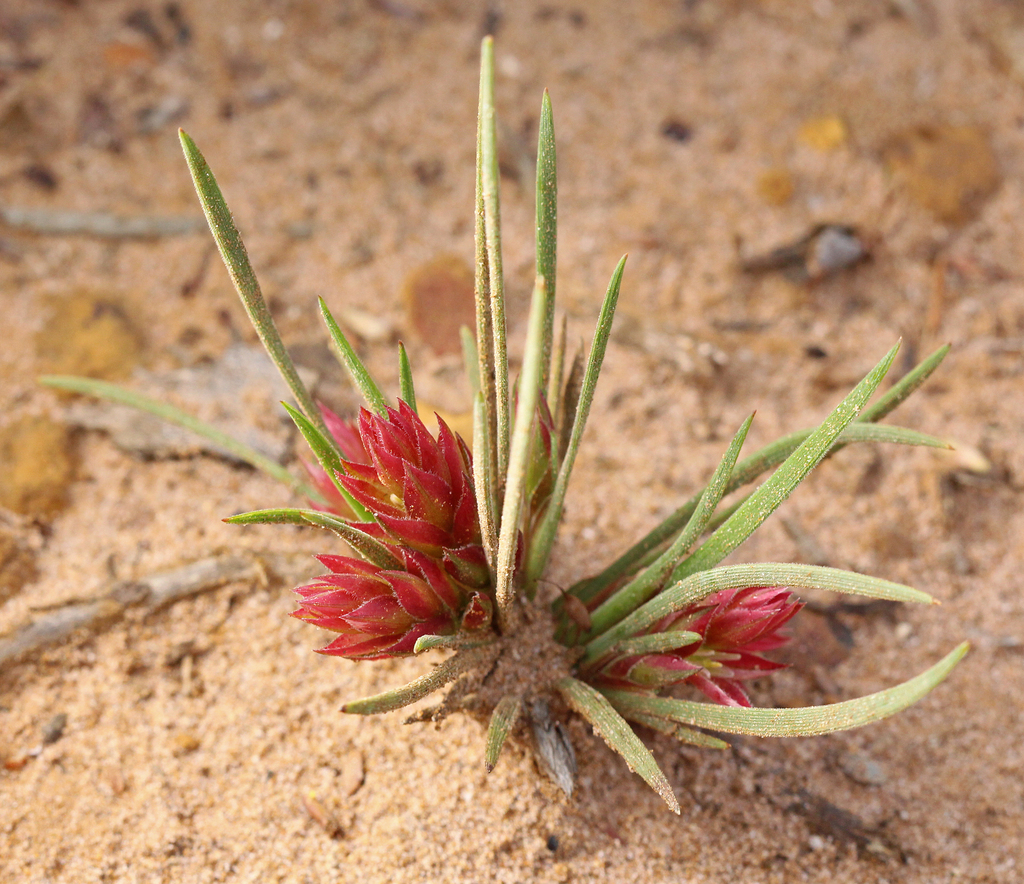
Johnsonia acaulis
Johnsonia acaulis is a plant in the family Asphodelaceae and is endemic to the south-west of Western Australia. It is a rhizomatous, tufted, or grass-like perennial with white, pink or green flowers.
From the article Johnsonia acaulis on Wikipedia (CC BY-SA), quoted section by section
Description
Johnsonia acaulis is a rhizomatous, tufted, perennial herb with grass-like leaves 55–165 mm (2.2–6.5 in) long. The flowering scape is red or green, with floral bracts 6.5–11.5 mm (0.26–0.45 in) long and 4–7 mm (0.16–0.28 in) wide. The perianth is 3–4 mm (0.12–0.16 in) long and white, pink or green, and the sepals and wider than the petals. The anthers and the style are about 2 mm (0.079 in) long. Flowering occurs from August to December and the fruit is a capsule 2–4 mm (0.079–0.157 in) long.
Range & habitat
This species occurs between Israelite Bay, Lake Grace and Perth in the Esperance Plains, Geraldton Sandplains, Jarrah Forest, Mallee, Swan Coastal Plain and Warren biogeographic regions of Western Australia. It grows in white, grey, or lateritic sand.
== References ==
Wikipedia: “Distribution and habitat”
Where it lives
Recorded sightings
—
geo-referenced records in GBIF, from museums, herbaria and field observers.
Drag the globe to turn it. Dots are where records exist, not a range map; darker means more records.
In the stacks
Searching the stacks…
Every page naming Johnsonia acaulis in the Biodiversity Heritage Library →
This page is assembled live from iNaturalist, GBIF, Wikipedia, the Source Library and the Internet Archive. It is not yet part of the hand-edited codex. iNaturalist taxon 1096702.