- Plants
- ›Vascular Plants
- ›flowering plants
- ›Dicots
- ›austrobaileya, anises, and allies
- ›anise family
- ›Kadsura
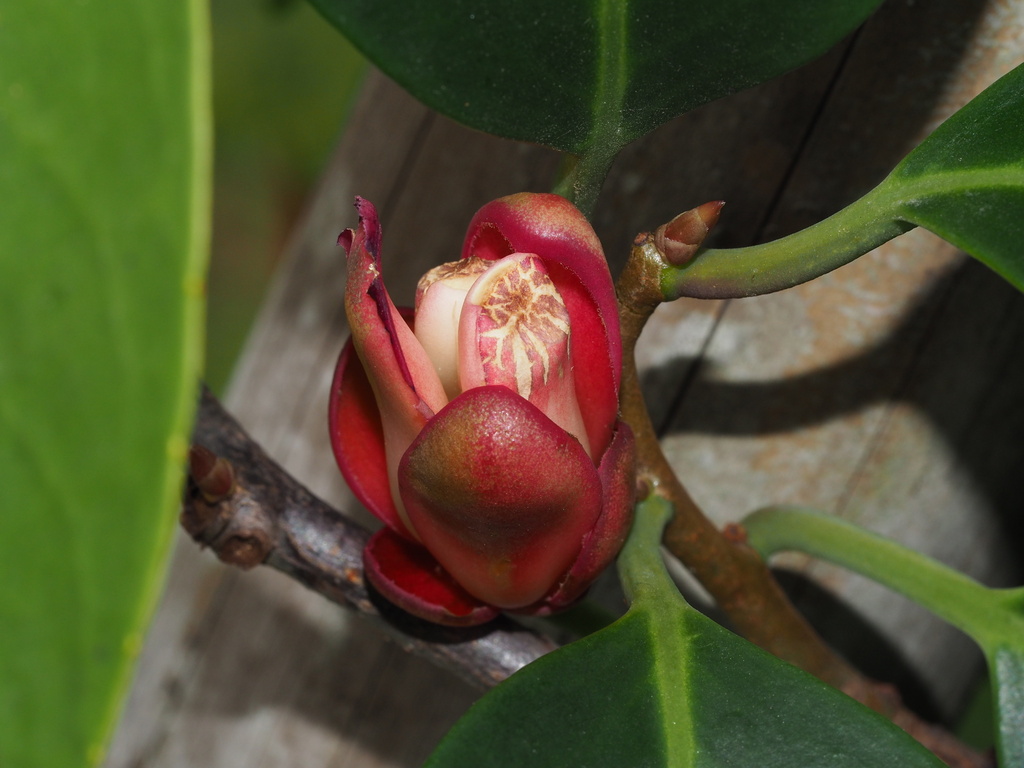
crimson kadsura
Kadsura coccinea
Kadsura coccinea, known by the common name Crimson kadsura, is a species of flowering plant in the family Schisandraceae. The species is an evergreen climber with white, red, and green flowers. It is native to south-east Asia.
Kadsura coccinea was described in 1947. It is used in medicine.
From the article Kadsura coccinea on Wikipedia (CC BY-SA), quoted section by section
Description
K. coccinea is an evergreen climbing plant. It grows to 4–8 metres (13–26 ft) high. The plants are hairless. The leaves are papery or leathery in texture, and are pointed and oval in shape. The leaves measure 7–19 centimetres (2.8–7.5 in) long, and 2.5–10 centimetres (0.98–3.94 in) wide. The leaf stems are 0.9–3 centimetres (0.35–1.18 in) long. The plant is in leaf all year round. The flowers are solitary and cup shaped. Each plant has either male or female flowers, which may be white, red, and pale green. The plants flower from May to July. Female plants develop segmented red to dark purple fruits. The fruits measure 6–10 centimetres (2.4–3.9 in) across. The fruit stems are 2.6–4.9 centimetres (1.0–1.9 in) long. Seeds ripen from August to November.
Range & habitat
Kadsura coccinea is found in the subtropical regions of south China and Indo-China, as well as Laos, Myanmar, Thailand, and Vietnam. The species is found in semi-open shrublands, forests, in ravines, and on slopes, at elevations of 1,500–2,000 metres (4,900–6,600 ft). It grows best in moist clay, loam, and sand.
Wikipedia: “Distribution”
What it does
Kadsura coccinea is a host of the fungi Pestalotiopsis maculans, Corynespora cassiicola, Alternaria alternata, and Neopestalotiopsis clavispora.
Wikipedia: “Ecology”
At the table
The fruits are edible, and have a sedative effect when roasted. The seeds have aphrodisiac and tonic effects. The Tujia people use the plant's roots to alleviate rheumatoid arthritis and gastrointestinal issues. The roots contain Sesquiterpenes, which may attenuate arthritis related inflammation.
Wikipedia: “Uses”
Where it lives
Recorded sightings
—
geo-referenced records in GBIF, from museums, herbaria and field observers.
Drag the globe to turn it. Dots are where records exist, not a range map; darker means more records.
In the stacks
Searching the stacks…
Every page naming Kadsura coccinea in the Biodiversity Heritage Library →
This page is assembled live from iNaturalist, GBIF, Wikipedia, the Source Library and the Internet Archive. It is not yet part of the hand-edited codex. iNaturalist taxon 1096801.