- Plants
- ›Vascular Plants
- ›flowering plants
- ›Dicots
- ›Legumes, Milkworts, and Allies
- ›Legumes
- ›Acacias, Mimosas, Mesquites, and Allies
- ›Acacia
- ›Plurinerves
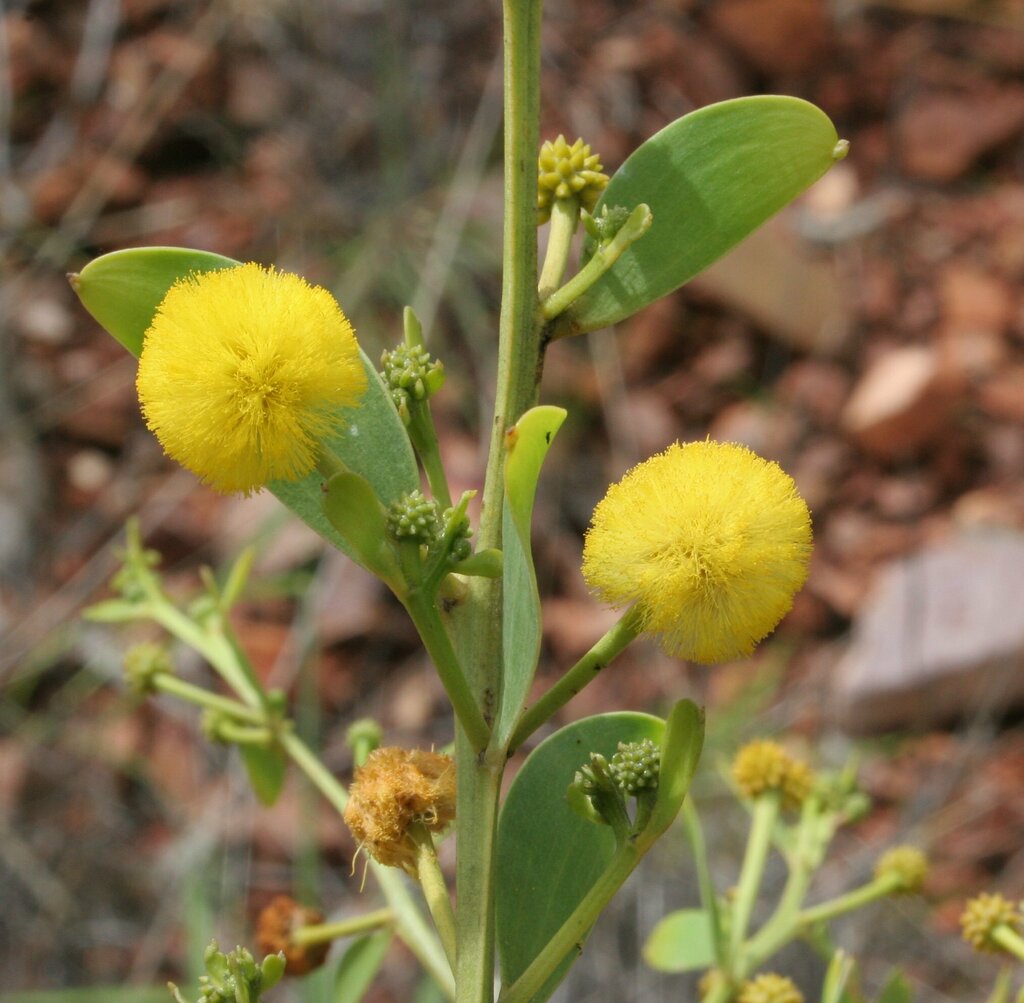
Acacia stellaticeps
Acacia stellaticeps, commonly known as the Northern star wattle, poverty bush and glistening wattle. Indigenous Australians the Nyangumarta peoples know the bush as pirrnyur or pirrinyurru and the Ngarla peoples know it as panmangu. It is a shrub of the genus Acacia and the subgenus Plurinerves.
From the article Acacia stellaticeps on Wikipedia (CC BY-SA), quoted section by section
Description
The low dense shrub typically grows to a height of 2 metres (7 ft) and to a width of around 3 m (9.8 ft). It has numerous slender main stems separating from each other at ground level that are covered in smooth or finely fissured, grey coloured bark. Like most species of Acacia it has phyllodes rather than true leaves. The dull-green to greyish green phyllodes have an asymmetrically elliptic-obovate shape and are usually slightly sigmoid. They have a length of 5 to 25 mm (0.20 to 0.98 in) and a width of 3 to 15 mm (0.12 to 0.59 in) and appear nerveless with one to three longitudinal nerves that are slightly more distinct than the others. It blooms from October to May and produces yellow flowers.
Range & habitat
It is native to an area in the Kimberley, Pilbara and northern Goldfields regions of Western Australia. It is commonly found on flats, plains and sand ridges where it grows in stony sandy or clay soils. It is mostly found from around the Exmouth Gulf in the south to around Broome in the north extending eastward into the Great Sandy Desert and the Tanami Desert in the Northern Territory. The shrub is usually found in soft spinifex communities especially those with Triodia pungens and Triodia epactia and in red sandy soils where A. stellaticeps can large, dense, pure stands.
Wikipedia: “Distribution”
Where it lives
Recorded sightings
—
geo-referenced records in GBIF, from museums, herbaria and field observers.
Drag the globe to turn it. Dots are where records exist, not a range map; darker means more records.
In the stacks
Searching the stacks…
Every page naming Acacia stellaticeps in the Biodiversity Heritage Library →
This page is assembled live from iNaturalist, GBIF, Wikipedia, the Source Library and the Internet Archive. It is not yet part of the hand-edited codex. iNaturalist taxon 1098653.