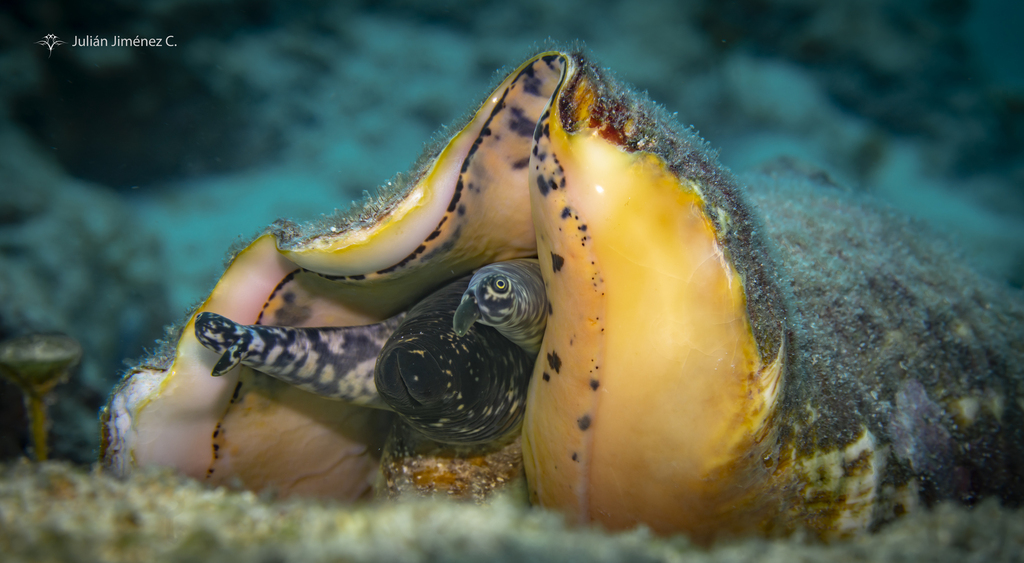
Queen Conch
Aliger gigas
Aliger gigas, originally known as Strombus gigas or more recently as Lobatus gigas, commonly known as the queen conch, is a species of large sea snail, a marine gastropod mollusc in the family of true conches, the Strombidae. This species is one of the largest molluscs native to the Caribbean Sea, and tropical northwestern Atlantic, reaching up to 35.2 centimetres (13.9 in) in shell length. A. gigas is closely related to the goliath conch, Titanostrombus goliath, a species endemic to Brazil, as well as the rooster conch, Aliger gallus.
The queen conch is herbivorous. It feeds by browsing for plant and algal material growing in the seagrass beds, and scavenging for decaying plant matter. These large sea snails typically reside in seagrass beds, which are sandy plains covered in swaying sea grass and associated with coral reefs, although the exact habitat of this species varies according to developmental age. The adult animal has a very large, solid and heavy shell, with knob-like spines on the shoulder, a flared, thick outer lip, and a characteristic pink or orange aperture (opening). The outside of the queen conch is sandy colored, helping them blend in with their surroundings. The flared lip is absent in juveniles; it develops once the snail reaches reproductive age. The thicker the shell's flared lip is, the older the conch is. The external anatomy of the soft parts of A.
From the article Aliger gigas on Wikipedia (CC BY-SA), quoted section by section
Range & habitat
Aliger gigas is native to the tropical Western Atlantic coasts of North and Central America in the greater Caribbean tropical zone. Although the species undoubtedly occurs in other places, this species has been recorded within the scientific literature as occurring, in: Aruba (Netherlands Antilles); Barbados; the Bahamas; Belize; Bermuda; North and northeastern regions of Brazil (though this is contested); Old Providence Island in Colombia; Costa Rica; Haiti; the Dominican Republic; Panama; Swan Islands in Honduras; Jamaica; Martinique; Alacran Reef, Campeche, Cayos Arcas and Quintana Roo, in Mexico; Puerto Rico; Saint Barthélemy; Mustique and Grenada in the Grenadines; Pinar del Río, North Havana Province, North Matanzas, Villa Clara, Cienfuegos, Holguín, Santiago de Cuba and Guantánamo, in Cuba and in the Turks and Caicos Islands; South Carolina, Florida, with the Florida Keys and Flower Garden Banks National Marine Sanctuary, in the United States; Carabobo, Falcon, Gulf of Venezuela, Los Roques archipelago, Los Testigos Islands and Sucre in Venezuela; all islands of the United States Virgin Islands.
Wikipedia: “Distribution”
What it does
Aliger gigas is gonochoristic, which means each individual snail is either distinctly male or distinctly female. Females are usually larger than males in natural populations, with both sexes existing in similar proportion. After internal fertilization, the females lay eggs in gelatinous strings, which can be as long as 75 feet (23 m). These are layered on patches of bare sand or seagrass. The sticky surface of these long egg strings allows them to coil and agglutinate, mixing with the surrounding sand to form compact egg masses, the shape of which is defined by the anterior portion of the outer lip of the female's shell while they are layered. Each one of the egg masses may have been fertilized by multiple males. The number of eggs per egg mass varies greatly depending on environmental conditions such as food availability and temperature. Commonly, females produce 8–9 egg masses per season, each containing 180,000–460,000 eggs, but numbers can be as high as 750,000 eggs. A. gigas females may spawn multiple times during the reproductive season, which lasts from March to October, with activity peaks occurring from July to September.
Queen conch embryos hatch 3–5 days after spawning. At the moment of hatching, the protoconch (embryonic shell) is translucent and has a creamy, off-white background color with small, pustulate markings. …
Wikipedia: “Life cycle”
At the table
Conch meat has been consumed for centuries and has traditionally been an important part of the diet in many islands in the West Indies and Southern Florida. It is consumed raw, marinated, minced or chopped in a wide variety of dishes, such as salads, chowder, fritters, soups, stew, pâtés and other local recipes. In both English and Spanish-speaking regions, for example in the Dominican Republic, Aliger gigas meat is known as lambí. Although conch meat is used mainly for human consumption, it is also sometimes employed as fishing bait (usually the foot). A. gigas is among the most important fishery resources in the Caribbean: its harvest value was US$30 million in 1992, increasing to $60 million in 2003. The total annual harvest of meat of A. gigas ranged from 6,519,711 kg to 7,369,314 kg between 1993 and 1998, later production declined to 3,131,599 kg in 2001. Data about US imports shows a total of 1,832,000 kg in 1998, as compared to 387,000 kg in 2009, a nearly 80% reduction twelve years later.
Queen conch shells were used by Native Americans and Caribbean Indians in a wide variety of ways. South Florida bands (such as the Tequesta), the Carib, the Arawak and Taíno used conch shells to fabricate tools (such as knives, axe heads and chisels), jewelry, cookware and used them as blowing horns. …
Wikipedia: “Uses”
In human culture
The queen conch was originally described from a shell in 1758 by Swedish naturalist and taxonomist Carl Linnaeus, who originated the system of binomial nomenclature. Linnaeus named the species Strombus gigas, which remained the accepted name for over 200 years. Linnaeus did not mention a specific locality for this species, giving only "America" as the type locality. The specific name is the ancient Greek word gigas (γίγας), which means "giant", referring to the large size of this snail compared with almost all other gastropod molluscs. Strombus lucifer, which was considered to be a synonym much later, was also described by Linnaeus in Systema Naturae. In the first half of the 20th century, the type material for the species was thought to have been lost; in other words, the shell on which Linnaeus based his original description and which would very likely have been in his own collection, was apparently missing, which created a problem for taxonomists. To remedy this, in 1941 a neotype of this species was designated by the American malacologists William J. Clench and R. Tucker Abbott. In this case, the neotype was not an actual shell or whole specimen, but a figure from a 1684 book Recreatio mentis, et occuli, published 23 years before Linnaeus was born by the Italian Jesuit scholar Filippo Buonanni (1638–1723). This was the first book that was solely about seashells. …
Wikipedia: “History”
Where it lives
Recorded sightings
—
geo-referenced records in GBIF, from museums, herbaria and field observers.
Drag the globe to turn it. Dots are where records exist, not a range map; darker means more records.
In the stacks
Searching the stacks…
Every page naming Aliger gigas in the Biodiversity Heritage Library →
This page is assembled live from iNaturalist, GBIF, Wikipedia, the Source Library and the Internet Archive. It is not yet part of the hand-edited codex. iNaturalist taxon 1099504.