 NL·0317
Herbarium of the Nature Library
- Name
- Prionace glauca
- Family
- Carcharhinidae
- Native to
- Temperate and tropical oceans worldwide
- Habitat
- Open ocean (pelagic)
Blue shark
Prionace glauca
Also calledTintorera / Tiburón azul (Spanish) · Yoshikirizame (Japanese) · Peau bleue (French) · Tubarão-azul (Portuguese)
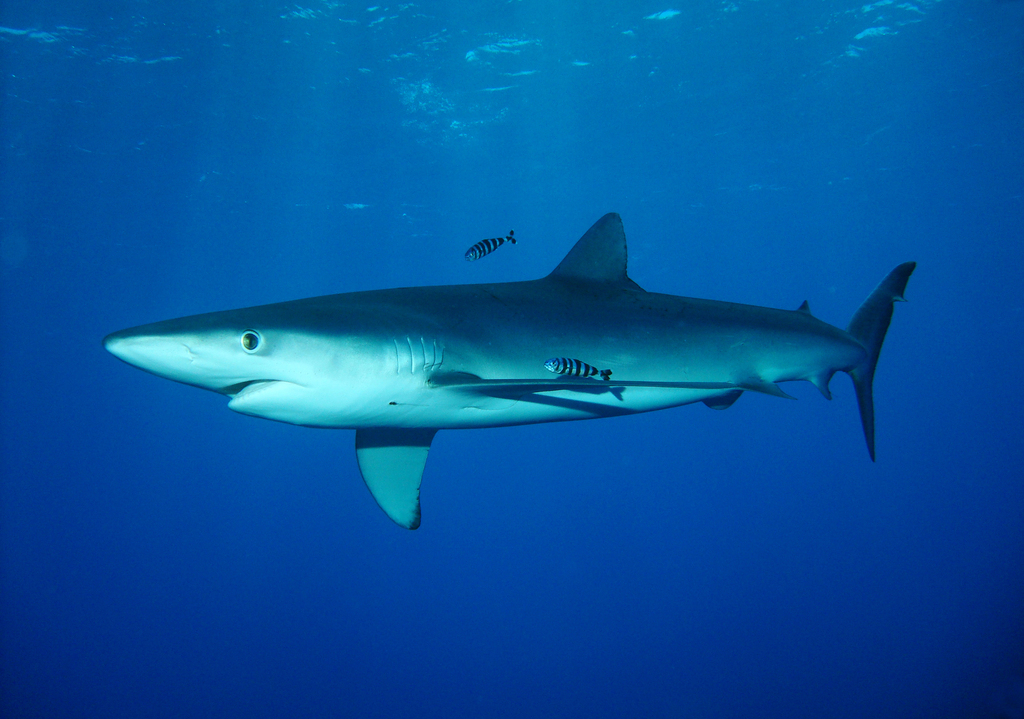
A slender, long-finned shark of brilliant indigo that roams entire ocean basins. It is the most heavily fished shark in the world, with tens of millions taken each year, many for fins.
The blue shark, also known as the great blue shark, is a species of requiem shark in the family Carcharhinidae which inhabits deep waters in the world's temperate and tropical oceans. It is the only living species of genus Prionace. An extinct species, P. clarki, is known from teeth from California of the Late Pliocene. Averaging around 3.1 m (10 ft) and preferring cooler waters, the blue shark migrates long distances, such as from New England to South America. It is listed as Near Threatened by the IUCN. Wikipedia
What it can do
- iMakes trans-oceanic migrations, crossing the North Atlantic in a clockwise loop with the Gulf Stream
- iiFemales have skin up to three times thicker than males, protecting them from mating bites
- iiiGives birth to large litters, sometimes over 100 pups
- ivDives repeatedly to more than 1,000 m in eddies to hunt squid
In the field
Field marks
- aVery slender body with a long, pointed snout
- bBrilliant metallic indigo-blue back, bright blue sides, white belly
- cVery long, narrow, sickle-shaped pectoral fins
- dLarge eyes and a low first dorsal fin set back on the body
- Not to be confused with
- Shortfin mako is stockier with shorter pectorals and a crescent tail; oceanic whitetip has broad, rounded white-tipped fins.
- Where to see it
- Offshore snorkel trips from Pico (Azores), Cape Point (South Africa), Cornwall and Rhode Island
- When
- Azores Jul–Sep; Cornwall Jul–Sep
Life & habits
- Diet
- Squid, small fish, also seabirds and carrion
- Habitat
- Open ocean, from the surface to over 1,000 m
- Size
- Commonly 2–3 m; up to ~3.8 m
- Lifespan
- About 20 years
Sexes and size classes often segregate geographically; nursery grounds are near the Azores and off Portugal.
Where it lives
Recorded sightings
—
geo-referenced records in GBIF, from museums, herbaria and field observers.
Native range
Temperate and tropical oceans worldwide
Drag the globe to turn it. Dots are where records exist, not a range map; darker means more records.
In the stacks
Searching the stacks…
Every page naming Prionace glauca in the Biodiversity Heritage Library →
Marginalia
Its genus name means 'saw' (prion) and its species name 'blue-grey' (glauca); in 2022 it was among the requiem sharks added to CITES Appendix II.
Curiosity
Blue sharks tagged off New England have been recaptured off Spain, Portugal and Brazil, thousands of kilometres away.
Kinship





Photographs: iNaturalist contributors under the licences shown. Records: GBIF.org. Historical plates: Source Library (CC BY-SA 4.0; originals public domain). Summary text: Nature Library editors and Wikipedia (CC BY-SA). Medicinal and edibility notes are historical and educational, not advice. iNaturalist taxon 110361.