- Fungi Including Lichens
- ›Basidiomycete Fungi
- ›Higher Basidiomycetes
- ›Mushrooms, Bracket Fungi, Puffballs, and Allies
- ›Agaricomycetidae
- ›boletes and allies
- ›boletes
- ›Boletoideae
- ›Boletus
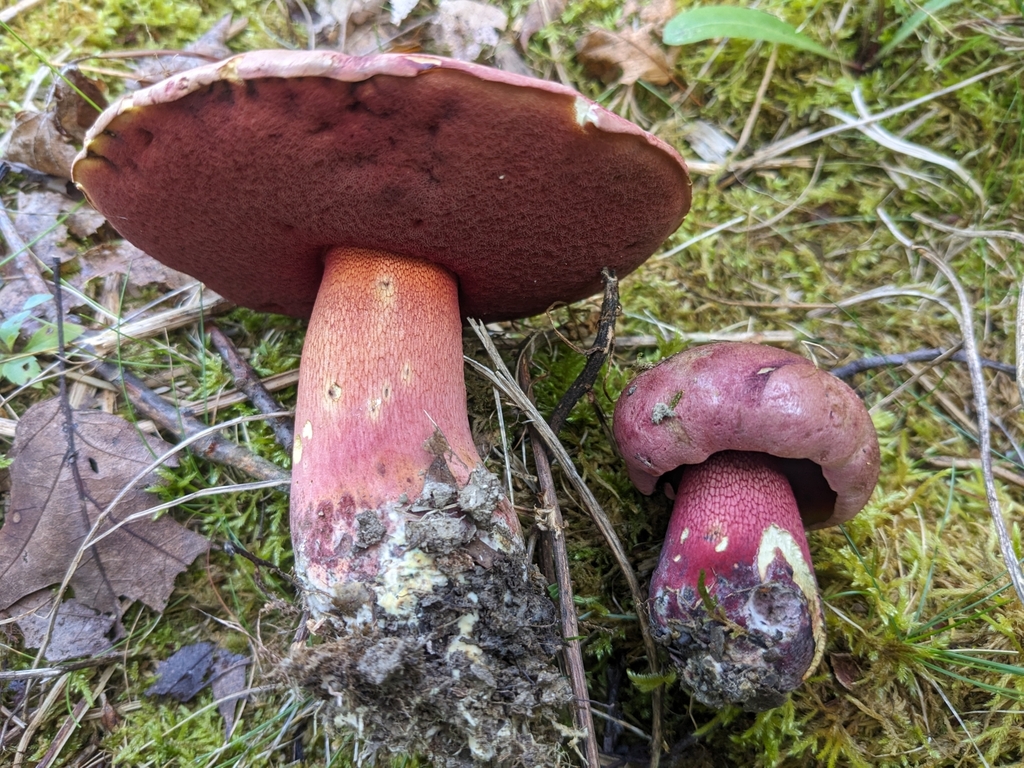
Boletus rubroflammeus
Boletus rubroflammeus is a species of bolete fungus in the family Boletaceae. First described from Michigan in 1971, it is found in the eastern United States and Mexico, where it grows in a mycorrhizal association with hardwood trees. The fruit bodies (mushrooms) of the fungus have caps that are deep red to purplish red, and dark red pores. The stem has coarse, dark red reticulations (raised, net-like ridges) and a narrow yellow area at the top. All parts of the mushroom quickly stain blue when injured or cut. Lookalikes include Boletus flammans, a lighter-colored species that grows with conifers. Other similar species can be distinguished by differences in distribution, morphology, staining reaction, and microscopic characteristics. Boletus rubroflammeus mushrooms are poisonous, and can cause gastrointestinal distress if consumed.
From the article Boletus rubroflammeus on Wikipedia (CC BY-SA), quoted section by section
Description
The shape of the cap of B. rubroflammeus is convex to broadly convex, and reaches a diameter of 6–12 cm (2.4–4.7 in). The margin of the cap extends slightly beyond the tubes. The cap surface is dry and initially appears appressed-fibrillose (with fibrils pressed down flat against the surface) or has a matted grayish tomentum, but later the hairs slough off and the matted tomentum is present only along the cap margin. In maturity, the center of the caps develop slight cracks. The cap is a deep vinaceous-red color that remains constant throughout the life of the fruit bodies. The flesh is thick, soft, and yellow. Its taste is mild, and it has no distinct odor. On the underside of the cap, the spore-bearing surface comprises vertically arranged minute tubes with pore-like openings. The tubes are yellow, 1–2 cm (0.4–0.8 in) deep, initially adnate (fused) to the stem, but later becoming free from attachment (or nearly so). Individual pores are round and small (about 2 per mm), while the overall pore surface is uneven or pitted. Its color is initially deep red, but fades slightly in maturity; the pore surface quickly turns blue with injury. The stem is 6–8 cm (2.4–3.1 in) long, 1–2 cm (0.4–0.8 in) thick, solid (i.e., not hollow), and equal in width throughout to club-shaped. Inside, it is yellowish with reddish streaks. …
Range & habitat
Boletus rubroflammeus is a mycorrhizal species, and its fruit bodies grow scattered or in groups on the ground under hardwood trees. The fungus fruits in summer and autumn months, and tends to appear after hot weather and heavy rains. Known only from North America, its range extends from New England south to Tennessee, and west to Michigan. It has also been recorded from Mexico.
Wikipedia: “Habitat and distribution”
Where it lives
Recorded sightings
—
geo-referenced records in GBIF, from museums, herbaria and field observers.
Drag the globe to turn it. Dots are where records exist, not a range map; darker means more records.
In the stacks
Searching the stacks…
Every page naming Boletus rubroflammeus in the Biodiversity Heritage Library →
This page is assembled live from iNaturalist, GBIF, Wikipedia, the Source Library and the Internet Archive. It is not yet part of the hand-edited codex. iNaturalist taxon 1106260.