On eBird ↗
Moorea Sandpiper
Live sightings near you, the range map, bar charts of when it is seen, and Macaulay Library photos and recordings.
Moorea Sandpiper
Prosobonia ellisi
The Moorea sandpiper or white-winged sandpiper (Prosobonia ellisi) is an extinct member of the large wader family Scolopacidae that was endemic to the Moorea in French Polynesia, where the locals called it te-te in the Tahitian language.
From the article Moorea sandpiper on Wikipedia (CC BY-SA), quoted section by section
Description
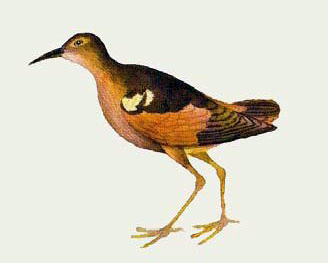
Illustrations of the bird show a somewhat lighter brown bird than the Tahiti Sandpiper, with no white spot behind the eye, a more conspicuous light rusty eye-ring, two white wing-bars and rusty secondary and primary coverts; one of Latham's specimens had yellow legs and feet. The exact relationships between the Moorea and Tahiti specimens are still not fully resolved, with some being unsure if they are separate species.
In human culture
Two specimens were collected by Georg Forster and William Anderson between September 30 and October 11, 1777, during Captain Cook's third voyage, but both have since disappeared and the bird became extinct in the nineteenth century. Several drawings of the bird were made by those accompanying Cook on his voyage; William Ellis and John Webber both illustrated the sandpiper between August-December 1777.
Wikipedia: “History”
Listen
Looking for field recordings…
Where it lives
Recorded sightings
—
geo-referenced records in GBIF, from museums, herbaria and field observers.
Drag the globe to turn it. Dots are where records exist, not a range map; darker means more records.
In the stacks
Searching the stacks…
Every page naming Prosobonia ellisi in the Biodiversity Heritage Library →
This page is assembled live from iNaturalist, GBIF, Wikipedia, the Source Library and the Internet Archive. It is not yet part of the hand-edited codex. iNaturalist taxon 110658.