- Plants
- ›Vascular Plants
- ›flowering plants
- ›Dicots
- ›Mints, Plantains, Olives, and Allies
- ›figwort family
- ›Buddlejeae
- ›Buddleja
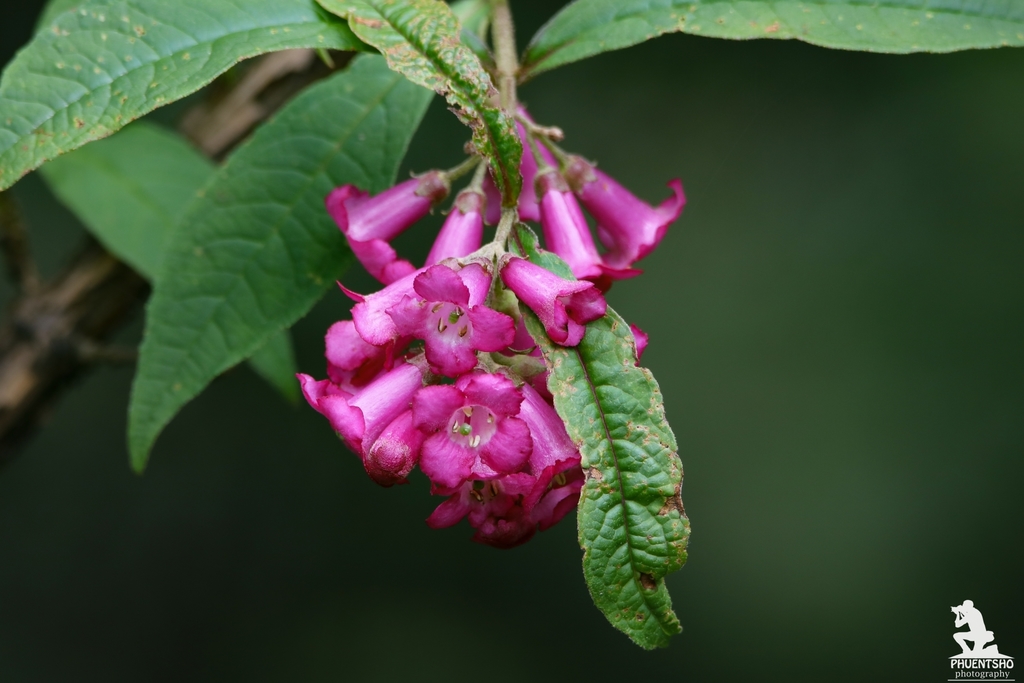
Buddleja colvilei
Buddleja colvilei is endemic to the eastern Himalaya; discovered by Hooker in 1849, he declared it 'the handsomest of all Himalayan shrubs.' In 1896 the species was awarded the RHS First Class Certificate (FCC), given to plants 'of outstanding excellence for exhibition'.
From the article Buddleja colvilei on Wikipedia (CC BY-SA), quoted section by section
Description
B. colvilei is a deciduous large shrub or small tree which can grow > 13 m, often single stemmed. The flowers are arranged in drooping panicles, 15–20 cm long by > 8 cm wide, rose pink to crimson, but often white within the corolla tube. The flowers are among the largest of any in the genus, and appear in June. The leaves are < 25 cm long, narrow, shallowly-toothed, and tapered at either end. This species has a high degree of polyploidy with a correspondingly high chromosome number of 2n = 152–456 (8x–24x).
How it is grown
The shrub is not entirely hardy in the UK, and can only be reliably grown outdoors along the Atlantic coast. Hardiness: United States Department of Agriculture zones 8–9.
Wikipedia: “Cultivation”
Where it lives
Recorded sightings
—
geo-referenced records in GBIF, from museums, herbaria and field observers.
Drag the globe to turn it. Dots are where records exist, not a range map; darker means more records.
In the stacks
Searching the stacks…
Every page naming Buddleja colvilei in the Biodiversity Heritage Library →
This page is assembled live from iNaturalist, GBIF, Wikipedia, the Source Library and the Internet Archive. It is not yet part of the hand-edited codex. iNaturalist taxon 1107798.