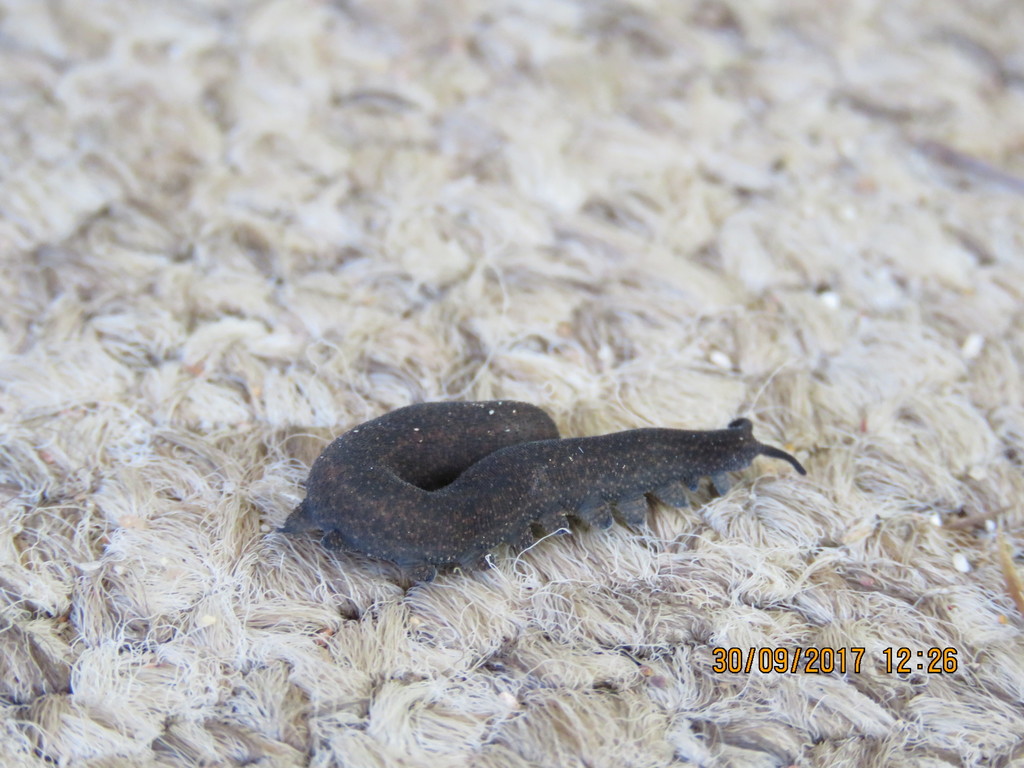
Occiperipatoides gilesii
Occiperipatoides is a monospecific genus of velvet worm containing the single species Occiperipatoides gilesii. This genus is ovoviviparous and found in Western Australia. The genus is part of the ancient phylum Onychophora that contains soft-bodied, many-legged relatives of arthropods known commonly as velvet worms.
From the article Occiperipatoides on Wikipedia (CC BY-SA), quoted section by section
Description
Occiperipatoides gilesii has a unique combination of features that differentiate it from other members of the family Peripatopsidae found in Western Australia. It has 16 pairs of oncopods, unstructured appendages with a stubby appearance, that are mostly uniform in size. The skin of the velvet worm is covered with papillae that are cylindrical in shape and more elongated in comparison to closely related West Australian species in the genus Kumbadjena. These papillae are covered in ribbed scales that give the skin a velvety appearance. O. gilesii also exhibits a ridge-like structure that segments the papillae at the first oncopod pair. The underside of the body in Australian Onychophorans displays repeated pairs of posteriorly situated ventral and anteriorly situated pre-ventral organs at each oncopod segment. These pairs arise during development when segmental hardenings occur in the tissue of an embryo and serve to attach limb depressor muscles to the body in adulthood. Antenna are present and are composed of 30 antennal rings that widen to form sensory pads at their base. Colouration differs between specimens but has been described as ranging from tan to greyish-blue. O. gilesii is sexually dimorphic, with the larger females ranging in length from 7-46mm and the smaller males between 5-31mm.
Glands. Males of the species possess a posterior accessory gland. …
Wikipedia: “Characteristics”
Range & habitat
Occiperipatoides gilesii is primarily found in banksia and eucalypt dominated bush with relatively low rainfall in comparison to areas preferred by other members of the Peripatopsidae family. Most samples of the species have been collected in the Perth Basin, which stretches from the Swan Coastal Plain to the Darling Scarp. Its occurrence in this area has been noted as widespread by the Environmental Protection Authority of Western Australia. The range of O. gilesii receives most of its rainfall in winter months and it was in that period that the most specimens were observed during a survey conducted in 2002.
Speciation. Occiperipatoides gilesii is considered to be part of the south-west Australian biodiversity hotspot, an area populated with many varieties of endemic flora and fauna. It is, along with other West Australian Onychophora, believed to represent relictual lineages of species that lived in the Mesozoic epoch. Short range endemism in the biodiversity hotspot comes as a result of climatic change in Australia during the Miocene that shrunk mesic habitats by the process of aridification, limiting ecologically diverse faunal communities to the eastern coast and south-west of the continent. This, combined with the geographical isolation of Australia and the large period of time that has elapsed since it detached from Gondwana, has made O. …
Wikipedia: “Distribution”
What it does
Male O. gilesii lack spermatophore carrying papillae adjacent to the eyes, a feature common in other Australian Ochynophorans, and the method of sperm transfer that they employ is not definitively known. Females possess a large spermatheca and a cross shaped gonopore. The purpose of the spermatheca is to store sperm before it moves through the reproductive tract and fertilizes eggs that go on to form embryotic juveniles in the uterus. In other Australian Peripatopsidae the sperm is admitted to the spermatheca by means of deposit of the spermatophore on the skin of the female, where it breaks through into the body cavity. Broods are often of multiple paternity as different males deposit spermatophores on the skin of the female, a process that may increase genetic diversity of species with confined ranges like O. gilesii. Due to O. gilesii's lack of spermatophore-transferring head structures, it has been theorized that dermal insemination may instead be achieved by use of a spiked appendage, or that sperm may be deposited via the vaginal opening. Members of the Peripatopsidae family such as O. gilesii have longer female maturation times, frequently entering into diapause, but higher fecundity than tropical velvet worms. This species exhibits lecithotrophic ovoviviparity; that is, mothers in this species produce and retain yolky eggs in their uteri. …
Wikipedia: “Reproduction”
Where it lives
Recorded sightings
—
geo-referenced records in GBIF, from museums, herbaria and field observers.
Drag the globe to turn it. Dots are where records exist, not a range map; darker means more records.
In the stacks
Searching the stacks…
Every page naming Occiperipatoides gilesii in the Biodiversity Heritage Library →
This page is assembled live from iNaturalist, GBIF, Wikipedia, the Source Library and the Internet Archive. It is not yet part of the hand-edited codex. iNaturalist taxon 1107840.