- Animals
- ›Chordates
- ›Vertebrates
- ›Ray-finned Fishes
- ›Sturgeons and Paddlefishes
- ›Sturgeons
- ›Pseudoscaphirhynchus
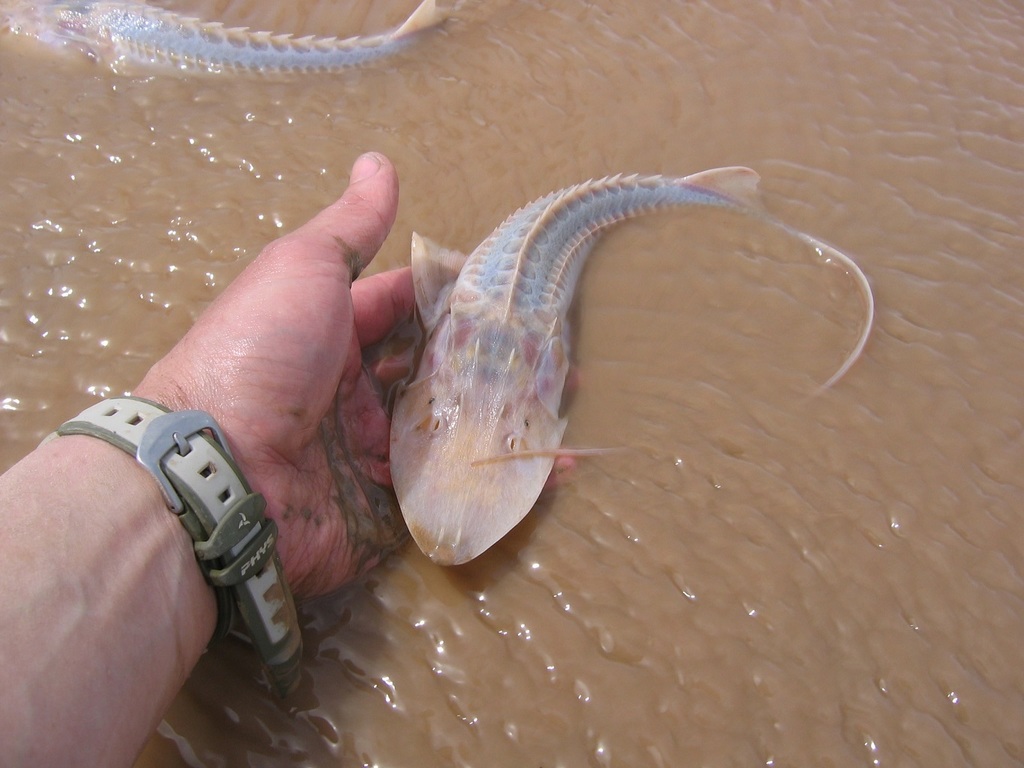
Amu Darya Sturgeon
Pseudoscaphirhynchus kaufmanni
The Amu Darya sturgeon or false shovelnose sturgeon (Pseudoscaphirhynchus kaufmanni) is a critically endangered species of fish in the family Acipenseridae. It is found in Turkmenistan, Uzbekistan, Tajikistan and perhaps Afghanistan. It inhabits quite shallow flowing waters that are turbid and muddy.
From the article Amu Darya sturgeon on Wikipedia (CC BY-SA), quoted section by section
Description
The Amu Darya sturgeon is a small sturgeon, but the largest species of Pseudoscaphirhynchus, reaching up to 2 kg (4.4 lb) in weight and 75 cm (30 in) in total length, excluding tail filament. It has a long, thin tail filament. For example, two individuals that both had a length of about 55 cm (22 in) excluding tail filament were 77 cm (30.5 in) and 85.5 cm (33.5 in) including tail filament. The species occurs in two morphs: a relatively large, light-coloured and late maturing morph, and a small, dark-coloured and early maturing morph. The small morph is roughly of similar size to P. hermanni, a species that lacks a tail filament.
Wikipedia: “Appearance”
What it does
The Amu Darya sturgeon feeds on small fish and aquatic insect larvae, with large individuals being mostly piscivorous. Studies in the 1960s and 1970s showed that Amu Darya sturgeon reach maturity when 5–8 years old (slightly later in females than males), but in the 1990s the youngest mature individuals only were 4 years old, possibly due to environmental changes in their habitat. The breeding season is from March to May when the water is 14 to 16 °C (57 to 61 °F). During a season, a female of the large morph lays about 3,100–36,500 eggs and a female of the small morph about 1,000–2,000 eggs, but it is possible that they only do this every 4–5-year. The species can reach an age of more than 14 years. Historically, it was known to hybridize with P. hermanni, with the offspring having features that are intermediate between the two species.
Wikipedia: “Behavior”
Where it lives
Recorded sightings
—
geo-referenced records in GBIF, from museums, herbaria and field observers.
Drag the globe to turn it. Dots are where records exist, not a range map; darker means more records.
In the stacks
This page is assembled live from iNaturalist, GBIF, Wikipedia, the Source Library and the Internet Archive. It is not yet part of the hand-edited codex. iNaturalist taxon 111095.