- Plants
- ›Vascular Plants
- ›flowering plants
- ›Dicots
- ›Legumes, Milkworts, and Allies
- ›Legumes
- ›Faboideae
- ›Mirbelieae
- ›Gastrolobium
Gastrolobium minus
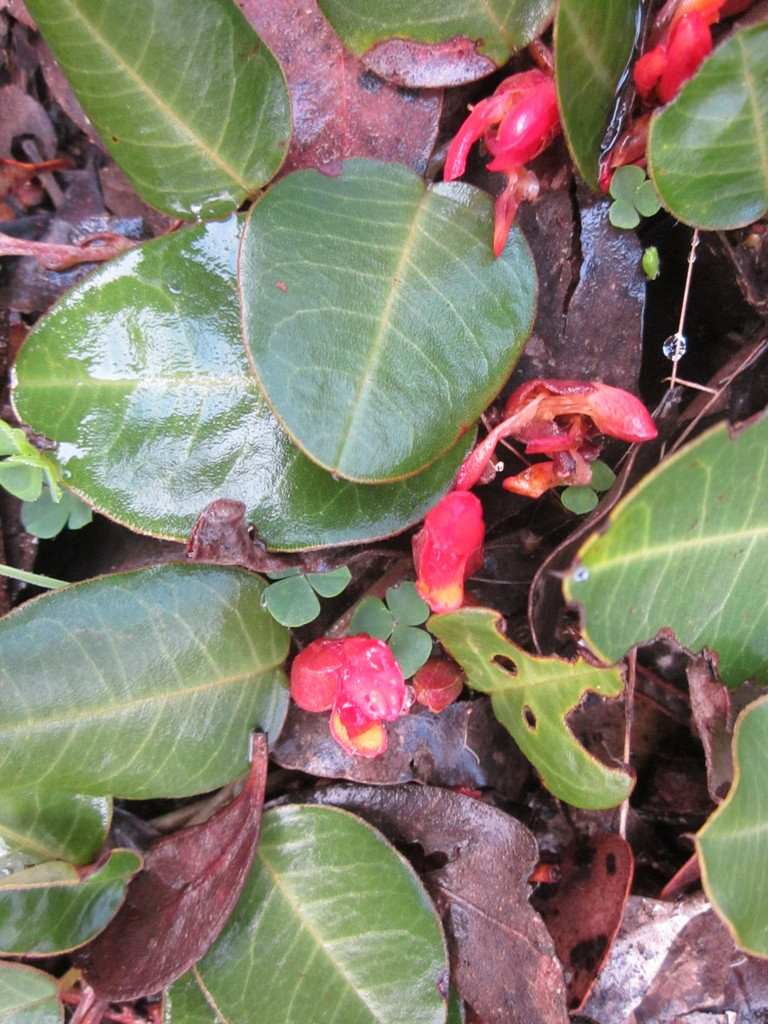
Gastrolobium minus, also known as broad-leaved brachysema, is a prostrate shrub which is endemic to the south-west of Western Australia. It is a member of the family Fabaceae and of the genus Gastrolobium, which contains many toxic species, however the toxicity of this species is unknown.
From the article Gastrolobium minus on Wikipedia (CC BY-SA), quoted section by section
Description
The plant grows to about 1 metre in diameter and has leaves that are oval in shape with a dark green upper surface and a silky undersurface. The flowers appear predominantly between July and October in the species' native range. These are orange-red with a standard that has recurved margins and yellow markings.
Range & habitat
The species occurs in open jarrah (Eucalyptus marginata) forest near Mount Barker and Cranbrook, with an outlying population in Fitzgerald River National Park.
Wikipedia: “Distribution and habitat”
How it is grown
The species has been popular in cultivation for many years, often distributed under the incorrect name of Brachysema latifolium. The plant may be used as a groundcover on embankments or in large containers or hanging baskets. It prefers light shade and good drainage, and is somewhat frost-tolerant.
Wikipedia: “Cultivation”
Where it lives
Recorded sightings
—
geo-referenced records in GBIF, from museums, herbaria and field observers.
Drag the globe to turn it. Dots are where records exist, not a range map; darker means more records.
In the stacks
Searching the stacks…
Every page naming Gastrolobium minus in the Biodiversity Heritage Library →
This page is assembled live from iNaturalist, GBIF, Wikipedia, the Source Library and the Internet Archive. It is not yet part of the hand-edited codex. iNaturalist taxon 1116865.