- Plants
- ›Vascular Plants
- ›flowering plants
- ›Dicots
- ›myrtles, evening primroses, and allies
- ›myrtle family
- ›Myrtoideae
- ›Leptospermeae
- ›Kunzea
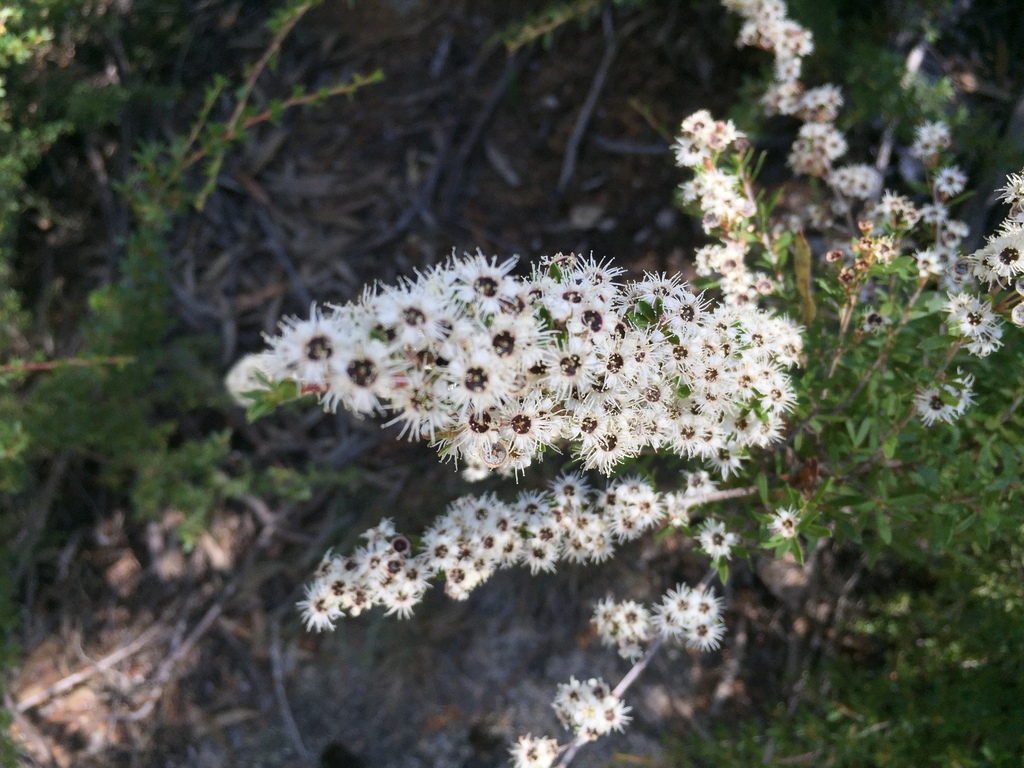
mountain burgan
Kunzea peduncularis
Kunzea peduncularis, commonly known as mountain burgan, is a flowering plant in Myrtaceae, the myrtle family, and is endemic to Victoria, Australia. It is usually a dense shrub and has lance-shaped to egg-shaped leaves with the narrower end towards the base. Dense groups of white flowers appear in early summer.
From the article Kunzea peduncularis on Wikipedia (CC BY-SA), quoted section by section
Description
Kunzea peduncularis is a spreading shrub which grows to a height of about 1–2 metres (3–7 feet) but sometimes a single-trunked tree more than 4 m (10 ft) tall. The leaves are arranged alternately, lance-shaped to egg-shaped with the narrower end towards the base, 5–13 mm (0.2–0.5 in) long and 2–3.5 mm (0.08–0.1 in) wide with a petiole 1 mm (0.04 in) or less long. The flowers are white and crowded in leaf axils near the ends of the branches on pedicels up to 1 mm (0.04 in) long. The floral cup is about 3 mm (0.1 in) and usually hairy. The sepal lobes are green, triangular and about 1 mm (0.04 in) long. The petals are white, almost round and about 2 mm (0.08 in) in diameter and there are 50-65 stamens which are up to 4 mm (0.2 in) long. Flowering occurs between November and January.
Range & habitat
Mountain burgan grows in montane and subalpine woodland in eastern Victoria, usually at altitudes above 900 m (3,000 ft).
Wikipedia: “Distribution and habitat”
How it is grown
Kunzea peduncularis is suitable for use as a screening plant. It grows best in full sun in well-drained soils and attracts butterflies.
== References ==
Wikipedia: “Use in horticulture”
Where it lives
Recorded sightings
—
geo-referenced records in GBIF, from museums, herbaria and field observers.
Drag the globe to turn it. Dots are where records exist, not a range map; darker means more records.
In the stacks
Searching the stacks…
Every page naming Kunzea peduncularis in the Biodiversity Heritage Library →
This page is assembled live from iNaturalist, GBIF, Wikipedia, the Source Library and the Internet Archive. It is not yet part of the hand-edited codex. iNaturalist taxon 1120952.