- Plants
- ›Vascular Plants
- ›flowering plants
- ›Dicots
- ›myrtles, evening primroses, and allies
- ›myrtle family
- ›Myrtoideae
- ›Leptospermeae
- ›Kunzea
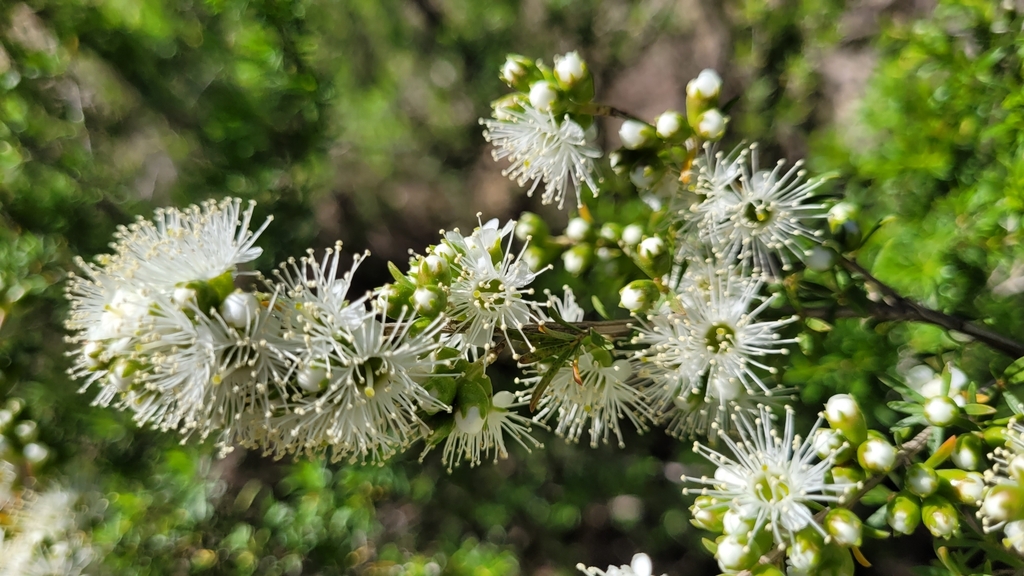
Kunzea occidentalis
Kunzea occidentalis is a flowering plant in the myrtle family, Myrtaceae and is endemic to a western New South Wales. It is a shrub with narrow leaves and small groups of white flowers on leafy side-branches. It is distinguished from the similar Kunzea ambigua by the flanges on the sides of its young branches.
From the article Kunzea occidentalis on Wikipedia (CC BY-SA), quoted section by section
Description
Kunzea occidentalis is a shrub which usually grows to a height of 1–2.5 m (3–8 ft) with its young branches having its leaf bases as raised, spongy, cream-coloured tissue. The leaves are arranged alternately, linear to narrow lance-shaped, 4–6.5 mm (0.2–0.3 in) long and about 1 mm (0.04 in) wide with a petiole usually less than 1 mm (0.04 in) long. The flowers are arranged singly or in groups of up to six near the ends of the branches. There are egg-shaped to elliptic bracts about 2 mm (0.08 in) long and 1 mm (0.04 in) wide and smaller paired bracteoles at the base of the flowers. The floral cup is glabrous and 3–4 mm (0.1–0.2 in) long with the sepal lobes 1–1.5 mm (0.04–0.06 in) long and glabrous. The petals are white, broadly egg-shaped to almost round and about 2–3 mm (0.08–0.1 in) long. There are about 50-60 stamens which are 2–5 mm (0.08–0.2 in) long. Flowering occurs in October and November.
Range & habitat
This kunzea grows in heath and forest, mainly in rocky places and in creek beds. It is found on the western slopes of the Great Dividing Range and is common in the Warrumbungle and Mount Kaputar national parks.
== References ==
Wikipedia: “Distribution and habitat”
Where it lives
Recorded sightings
—
geo-referenced records in GBIF, from museums, herbaria and field observers.
Drag the globe to turn it. Dots are where records exist, not a range map; darker means more records.
In the stacks
Searching the stacks…
Every page naming Kunzea occidentalis in the Biodiversity Heritage Library →
This page is assembled live from iNaturalist, GBIF, Wikipedia, the Source Library and the Internet Archive. It is not yet part of the hand-edited codex. iNaturalist taxon 1122173.