- Animals
- ›Arthropods
- ›Hexapods
- ›Insects
- ›Winged and Once-winged Insects
- ›Ants, Bees, Wasps, and Sawflies
- ›Narrow-waisted Wasps, Ants, and Bees
- ›Proctotrupomorpha
- ›Gall Wasps and Allies
- ›Gall Wasps
- ›Cynipinae
- ›Oak Gall Wasps
- ›Andricus
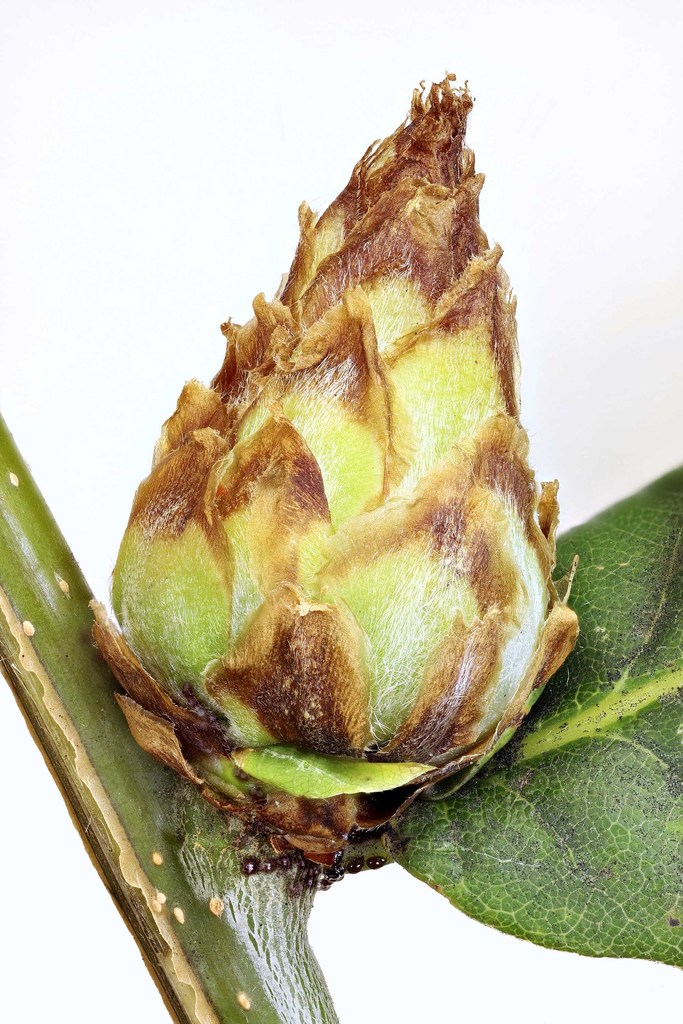
Oak Artichoke Gall Wasp
Andricus foecundatrix
Andricus foecundatrix (formerly Andricus fecundator) is a parthenogenetic gall wasp which lays a single egg within a leaf bud, using its ovipositor, to produce a gall known as an oak artichoke gall, oak hop gall, larch-cone gall or hop strobile. The gall develops as a chemically induced distortion of leaf axillary or terminal buds on pedunculate oak (Quercus robur) or sessile oak (Quercus petraea) trees. The larva lives inside a smaller hard casing inside the artichoke and this is released in autumn. The asexual wasp emerges in spring and lays her eggs in the oak catkins. These develop into small oval galls which produce the sexual generation of wasps. A yew artichoke gall caused by the fly Taxomyia taxi also exists, but is unrelated to the oak-borne species. Previous names or synonyms for the species A. fecundator are A. fecundatrix, A. pilosus, A. foecundatrix (see below), A. gemmarum, A. gemmae, A. gemmaequercus, A. gemmaecinaraeformis and A. quercusgemmae.
The scientific name is now once again Andricus foecundatrix.
From the article Andricus foecundatrix on Wikipedia (CC BY-SA), quoted section by section
What it does
The wasps emerging from the oak artichoke galls will be female; and these females will go on to lay a solitary egg in the male flowers of the oaks, which will cause the formation of the 'hairy catkin galls.' The flies that arise form these galls are of both sexes and the cycle then starts again after they have mated and eggs are laid in the oak buds. Once the oak artichoke gall has fallen to the ground the imago may leave the gall in the following spring, or may delay the emergence for 2–3 years. Galls may persist and exhibit opened scales curving outwards.
Wikipedia: “Life cycle”
Listen
Looking for field recordings…
Where it lives
Recorded sightings
—
geo-referenced records in GBIF, from museums, herbaria and field observers.
Drag the globe to turn it. Dots are where records exist, not a range map; darker means more records.
In the stacks
Searching the stacks…
Every page naming Andricus foecundatrix in the Biodiversity Heritage Library →
This page is assembled live from iNaturalist, GBIF, Wikipedia, the Source Library and the Internet Archive. It is not yet part of the hand-edited codex. iNaturalist taxon 1122539.