- Animals
- ›Molluscs
- ›Bivalves
- ›Autobranchia
- ›Heteroconchia
- ›Euheterodonta
- ›Imparidentia
- ›Myida
- ›Myoidea
- ›Corbulid Clams
- ›Erodoninae
- ›Potamocorbula
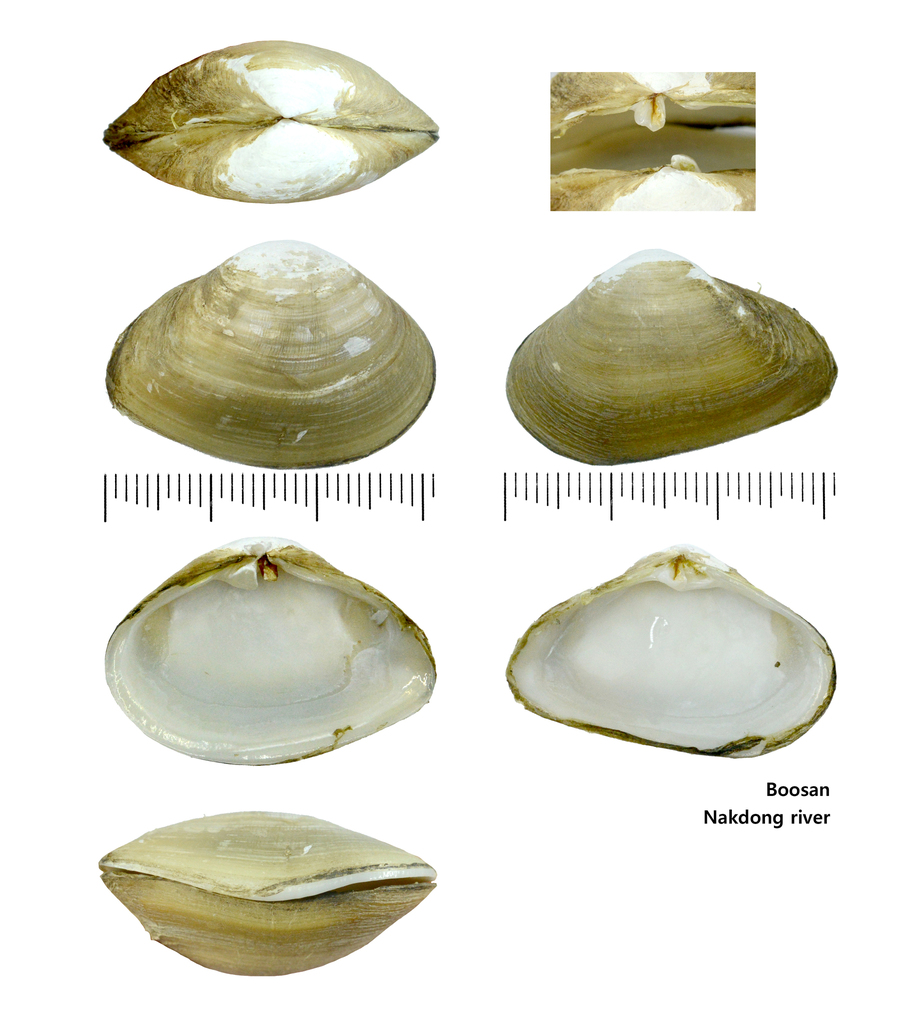
Brackish-water Corbula
Potamocorbula amurensis
Potamocorbula amurensis is a species of small saltwater clam, a marine bivalve mollusc in the order Myida. Common names include the overbite clam, the Asian clam, the Amur River clam and the brackish-water corbula. The species is native to marine and brackish waters in the northern Pacific Ocean, its range extending from Siberia to China, Korea and Japan. It has become naturalised in San Francisco Bay.
From the article Potamocorbula amurensis on Wikipedia (CC BY-SA), quoted section by section
Description
Potamocorbula amurensis grows to a length of about 25 mm (1 in). The umbo is about halfway along the hinge side of the shell and the shape of each valve is like a wide isosceles triangle with rounded corners. The right valve is rather larger than the left so that it overlaps a little at the margin, a fact that distinguishes this species from other similar clams. The surface is smooth with faint concentric sculpture that is parallel to the margin. The general colour is cream, yellowish or light brown. In young individuals, a dark-coloured periostracum covers the outer surface of each valve, but in older specimens this skin is largely worn away except for some wrinkled remnants at the valve margin. The part of the shell buried in the substrate is clean, whereas the exposed portion is often colonised by other organisms which stain it a dark colour.
Range & habitat
The native range of Potamocorbula amurensis, "of the Amur River" is Siberia, China, Korea and Japan, between the latitudes of 53° N and 22° N. It has also become established in San Francisco Bay. It lives subtidally and on intertidal mud flats partially buried in soft sediment. It is tolerant of a wide range of salinities, ranging from about one part to thirty-three parts per thousand. In San Francisco Bay it is found subtidally in winter at 8 °C (46 °F) and in summer occurs on exposed mud flats at 23 °C (73 °F). It is believed that it was transported across the Pacific in ballast water and discharged accidentally into the Bay around 1986.
Wikipedia: “Distribution and habitat”
Where it lives
Recorded sightings
—
geo-referenced records in GBIF, from museums, herbaria and field observers.
Drag the globe to turn it. Dots are where records exist, not a range map; darker means more records.
In the stacks
Searching the stacks…
Every page naming Potamocorbula amurensis in the Biodiversity Heritage Library →
This page is assembled live from iNaturalist, GBIF, Wikipedia, the Source Library and the Internet Archive. It is not yet part of the hand-edited codex. iNaturalist taxon 1123964.