- Plants
- ›Vascular Plants
- ›flowering plants
- ›Dicots
- ›Mallows, Rock Roses, and Allies
- ›Mallow and Hibiscus Family
- ›Byttnerioideae
- ›Seringia
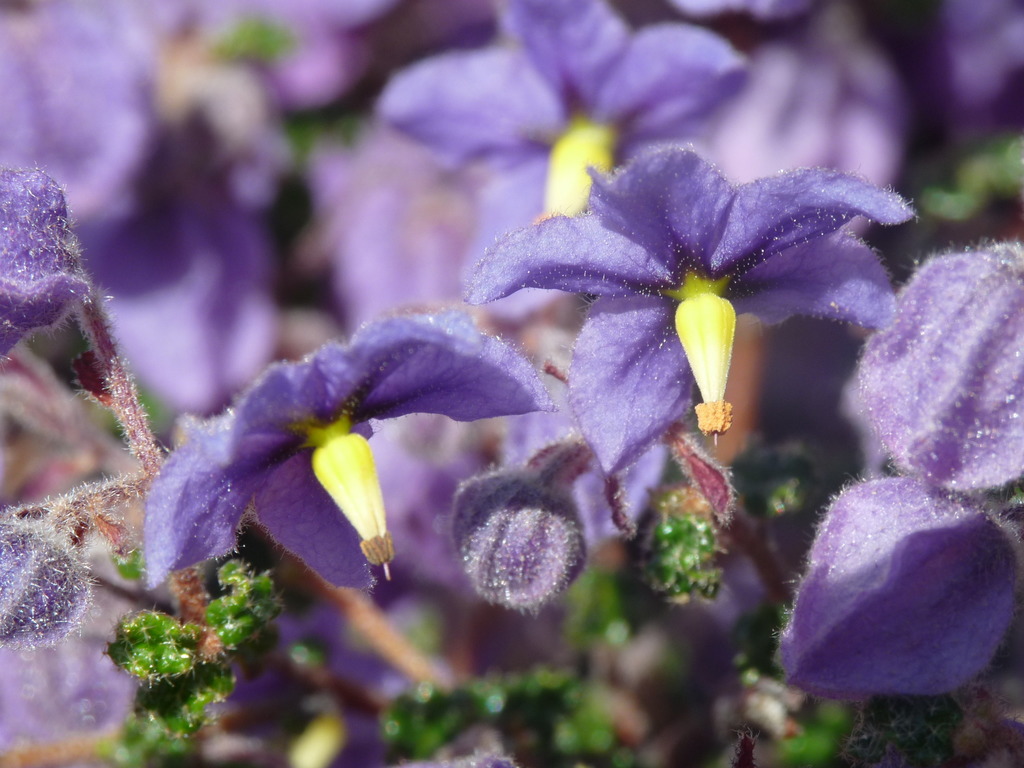
Seringia saxatilis
Seringia saxatilis, commonly known as gorge fire-bush, is a species of flowering plant in the mallow family and is endemic to Kalbarri National Park in Western Australia. It is a sprawling, open shrub with hairy young stems, oblong to broadly elliptic leaves and purple flowers arranged in groups of 3 to 6.
From the article Seringia saxatilis on Wikipedia (CC BY-SA), quoted section by section
Description
Seringia saxatilis is a sprawling, open shrub that typically grows to a height of 0.4–1 m (1 ft 4 in – 3 ft 3 in), about 1 m (3 ft 3 in) wide, and has hairy stems. The leaves are oblong to broadly elliptic, mostly 2–8 mm (0.079–0.315 in) long and 4–5 mm (0.16–0.20 in) wide on a petiole up to 2.5 mm (0.098 in) long with stipules up to 2 mm (0.079 in) long at the base. The leaves are lobed, crinkled and undulating, with deeply impressed veins on the upper surface. The flowers are arranged in a cyme with 3 to 6 flowers on a peduncle 4–9 mm (0.16–0.35 in) long, each flower on a pedicel 2–8 mm (0.079–0.315 in) long. The flowers are 15 mm (0.59 in) wide and purple with petal-like sepals joined at the base to form a tube with lobes 75% the length of the tube. Petals are absent and the stamens have yellow filaments, and dark coloured anthers. Flowering occurs from July to October.
Range & habitat
This species of seringia is only known from the Kalbarri area where it grows among sandstone boulders in the Geraldton Sandplains bioregions of Western Australia.
Wikipedia: “Distribution and habitat”
Where it lives
Recorded sightings
—
geo-referenced records in GBIF, from museums, herbaria and field observers.
Drag the globe to turn it. Dots are where records exist, not a range map; darker means more records.
In the stacks
Searching the stacks…
Every page naming Seringia saxatilis in the Biodiversity Heritage Library →
This page is assembled live from iNaturalist, GBIF, Wikipedia, the Source Library and the Internet Archive. It is not yet part of the hand-edited codex. iNaturalist taxon 1124805.