- Plants
- ›Vascular Plants
- ›flowering plants
- ›Dicots
- ›myrtles, evening primroses, and allies
- ›myrtle family
- ›Myrtoideae
- ›Leptospermeae
- ›Kunzea
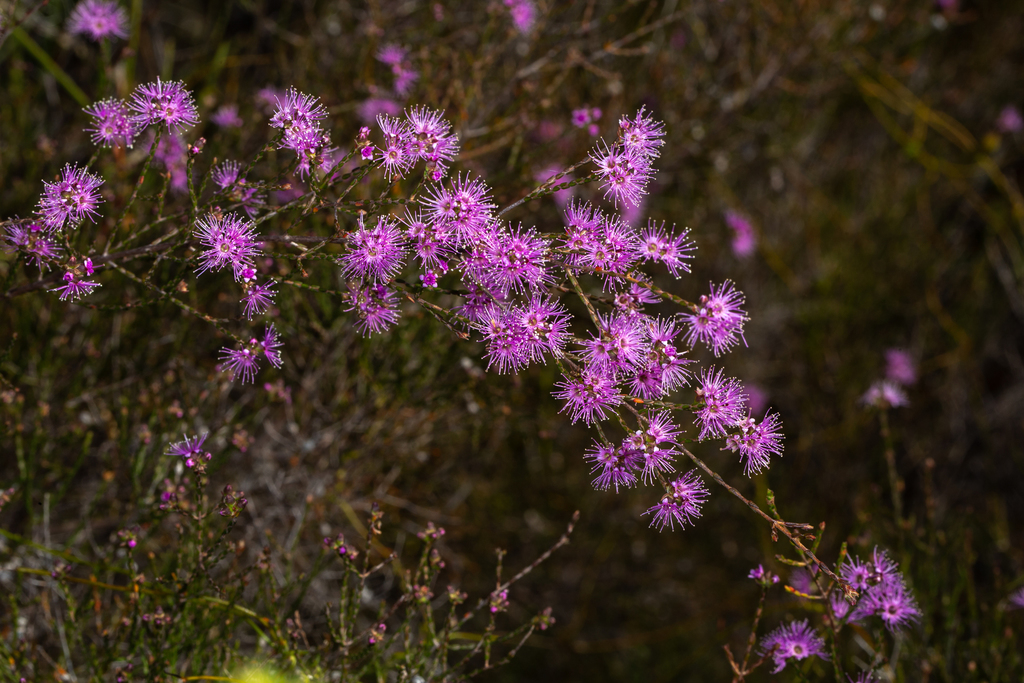
Kunzea opposita
Kunzea opposita is a plant in the myrtle family, Myrtaceae and is endemic to eastern Australia. It is a spindly shrub which has small leaves arranged in opposite pairs, and pink flowers with five petals and many stamens, the stamens much longer than the petals. It usually grows in woodland or on exposed cliffs.
From the article Kunzea opposita on Wikipedia (CC BY-SA), quoted section by section
Description
Kunzea opposita is a spindly shrub which grows to a height of 0.5–3 m (2–10 ft) with its young stems covered with fine hairs. The leaves are mostly arranged in opposite pairs along the branches and are narrow egg-shaped, 1–3 mm (0.04–0.1 in) long and less than 1 mm (0.04 in) wide on a very short petiole. The leaves are glabrous. The flowers are arranged in rounded groups of five to nine on the ends of the branches. There are lance-shaped to egg-shaped bracts which are 2–3 mm (0.08–0.1 in) long and 1–2 mm (0.04–0.08 in) wide, and smaller paired bracteoles at the base the flowers. The floral cup is 3–4 mm (0.1–0.2 in) long and hairy. The sepals are triangular to egg-shaped, 1–1.5 mm (0.04–0.06 in) long and sometimes hairy. The petals are pink, oblong to broadly egg-shaped, about 1.5 mm (0.06 in) long and there are 40 to 50 stamens in several rows. The stamens are 3–5 mm (0.1–0.2 in) long. Flowering occurs in August to November and is followed by fruit which an urn-shaped capsule about 3 mm (0.1 in) long and wide with the sepal lobes attached.
Range & habitat
This kunzea grows in woodland, forest or exposed cliffs north of the Mount Kaputar National Park in New South Wales and in south-east Queensland.
== References ==
Wikipedia: “Distribution and habitat”
Where it lives
Recorded sightings
—
geo-referenced records in GBIF, from museums, herbaria and field observers.
Drag the globe to turn it. Dots are where records exist, not a range map; darker means more records.
In the stacks
Searching the stacks…
Every page naming Kunzea opposita in the Biodiversity Heritage Library →
This page is assembled live from iNaturalist, GBIF, Wikipedia, the Source Library and the Internet Archive. It is not yet part of the hand-edited codex. iNaturalist taxon 1126783.