 NL·0460
Herbarium of the Nature Library
- Name
- Furnarius rufus
- Family
- Furnariidae
- Native to
- Eastern and central South America: Brazil, Bolivia, Paraguay, Uruguay and northern and central Argentina
- Habitat
- Savanna, Pampas grassland, Farmland, Towns and parks
On eBird ↗
Rufous Hornero
Live sightings near you, the range map, bar charts of when it is seen, and Macaulay Library photos and recordings.
Rufous hornero
Furnarius rufus
Also calledHornero (Spanish) · João-de-barro (Portuguese, 'John of clay')
A plain, rufous ovenbird that builds a domed nest of mud and straw shaped like a traditional clay bread oven. Pairs stay together for years and duet loudly, and it is the national bird of Argentina.
The rufous hornero is a medium-sized ovenbird in the family Furnariidae. It occurs in eastern South America and is the national bird of Argentina. Also known as the red ovenbird, it is common in savannas, second-growth scrub, pastures, and agricultural land and is synanthropic. Its range includes midwestern, southeastern, and southern Brazil, Bolivia, Paraguay, Uruguay, and northern and central Argentina, extending as far south as northern Patagonia. The species is most closely related to the crested hornero of Paraguay and Argentina. There are four accepted subspecies. Wikipedia
What it can do
- iBuilds a heavy, oven-shaped nest of mud, dung and plant fibre with a curved inner wall separating the entrance from the egg chamber
- iiConstructs a nest in a few weeks using thousands of beakfuls of wet mud, often after rain
- iiiOld nests are reused by other birds such as Saffron Finches, swallows and parakeets
- ivMated pairs sing synchronised, shrill duets
In the field
Field marks
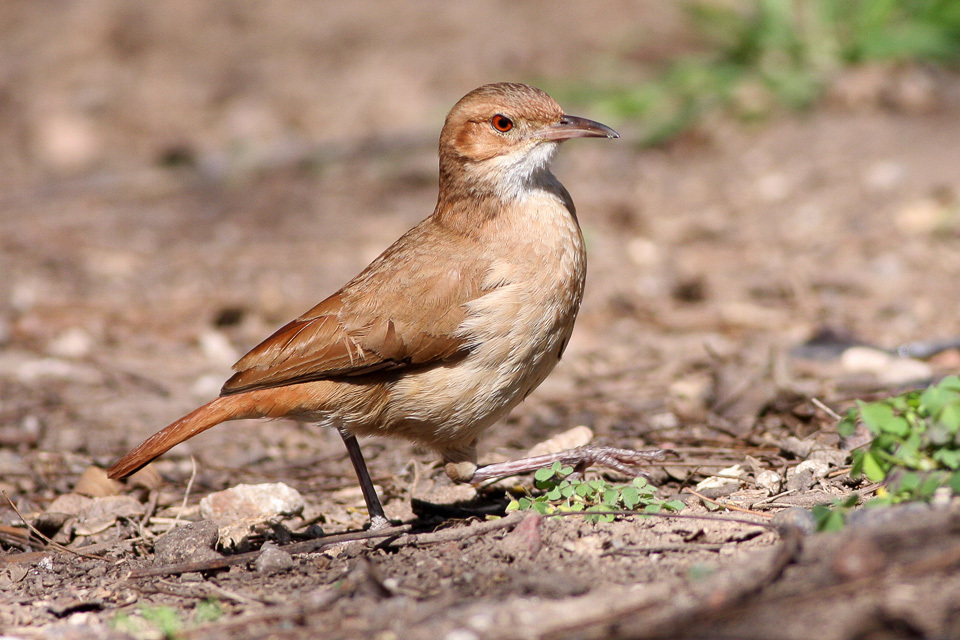
- aRufous-brown upperparts with a brighter rufous tail
- bPale buffy underparts with a whitish throat
- cSlender, slightly decurved bill
- dWalks deliberately on the ground with a high-stepping gait
- Voice
- Loud, shrill, accelerating series of notes, often given as a duet by the pair, which sing with wings drooped and quivering.
- Not to be confused with
- Pale-legged Hornero (north and west) has pale legs and a whitish eyebrow. Crested Hornero has a small crest and is found in Paraguay and Argentina's Chaco. Thrushes have a different bill shape and do not walk.
- Where to see it
- Parks and farmland around Buenos Aires, Montevideo and southern Brazil; abundant in the Pampas and Pantanal.
- When
- Resident year-round
Listen
Looking for field recordings…
Life & habits
- Diet
- Insects, worms and other invertebrates gleaned from the ground
- Habitat
- Open country with scattered trees, pastures, roadsides and city parks
- Size
- 18–20 cm; 49–65 g
Nests are placed on posts, branches, utility poles and even street lamps, in full view.
Where it lives
Recorded sightings
—
geo-referenced records in GBIF, from museums, herbaria and field observers.
Native range
Eastern and central South America: Brazil, Bolivia, Paraguay, Uruguay and northern and central Argentina
Drag the globe to turn it. Dots are where records exist, not a range map; darker means more records.
In the stacks
Searching the stacks…
Every page naming Furnarius rufus in the Biodiversity Heritage Library →
Marginalia
Argentina's national bird since 1928, it appears widely in gaucho folklore as a model of the hard-working household.
Curiosity
Its mud nests can last several years and weigh several kilograms.
Kinship






Fact-checked: 1 correction made to this sheet. Photographs: iNaturalist contributors under the licences shown. Records: GBIF.org. Historical plates: Source Library (CC BY-SA 4.0; originals public domain). Summary text: Nature Library editors and Wikipedia (CC BY-SA). Medicinal and edibility notes are historical and educational, not advice. iNaturalist taxon 11275.