- Animals
- ›Arthropods
- ›Hexapods
- ›Insects
- ›Winged and Once-winged Insects
- ›Dragonflies and Damselflies
- ›Dragonflies
- ›Libelluloidea
- ›Emerald Dragonflies
- ›Somatochlora
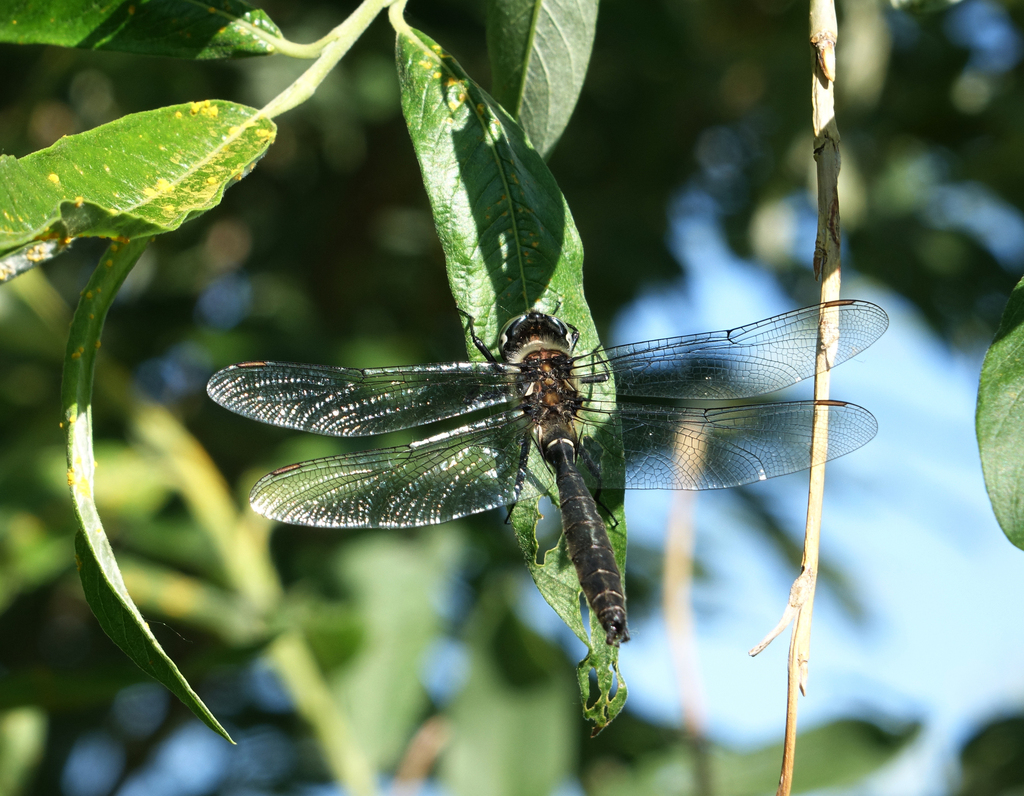
Treeline Emerald
Somatochlora sahlbergi
The treeline emerald (Somatochlora sahlbergi) is a species of dragonfly in the family Corduliidae. It is found in Canada, Finland, Norway, Russia, Sweden, and the United States. Its natural habitats are tundra wetlands and Alpine wetlands.
From the article Somatochlora sahlbergi on Wikipedia (CC BY-SA), quoted section by section
Description
Somatochlora sahlbergi adults are medium-sized (about 4.8 cm (1.9 in) long) dragonflies with dark, metallic green bodies and transparent wings, much like other species of Somatochlora. Unlike some other species in the genus, there is very little paler yellow marking on the thorax and abdomen. The body is covered in a dense coat of setae. The shape of the male cerci, on the tip of the abdomen, is distinctive. The larva is dark reddish-brown or orange-brown on top, and paler below, and also has a dense coat of setae. Some sources indicate that the larva has long lateral spines on the 8th and 9th abdominal segments, but it is not clear if this is consistent across the species' range.
Range & habitat
The distribution of Somatochlora sahlbergi is somewhat poorly known, with under 100 specimens known worldwide. The species is found across northern portions of Norway, Sweden, Finland, Russia, and Alaska. In Canada, it is known from Yukon and Northwest Territories, but has not been found anywhere east of the Mackenzie River and may be absent from e.g. Nunavut and Quebec. Reports from Kazakhstan and southern portions of Russia are erroneous. The species occurs further north than any other species of dragonfly or damselfly, and the southern limit of its breeding range, typically coinciding with the northern treeline, is to the north of most North American and Eurasian dragonflies. Locations where the species is found typically have annual mean temperatures under 0 °C (32 °F), and annual mean rainfall under 450 mm (18 in).
Wikipedia: “Distribution”
In human culture
Somatochlora sahlbergi is found at pools, ponds and small lakes near treeline and in fens and bogs. Pools are typically lined with sedges and contain aquatic mosses, and may be underlain by permafrost. The species has been observed in Siberia in clear, cold, slow-moving water surrounded by forest, but this habitat has not been noted in North America. In Fennoscandia, S. sahlbergi may be closely associated with palsa mires. Larvae are found in the pools, while adults fly around the surrounding habitats. Larvae prey upon zooplankton and aquatic insects, while adults feed on flying insects. Adults are most active in the afternoon, and do not fly at night, in shade, or in inclement weather. Males patrol breeding sites searching for females. When a female is found, males grab the female by the head, with copulation occurring in nearby vegetation. Females lay eggs in open water away from the shoreline. It likely takes up to 4-5 years for larvae to mature due to the short summer season in the breeding range of this species.
Wikipedia: “Life History”
Listen
Looking for field recordings…
Where it lives
Recorded sightings
—
geo-referenced records in GBIF, from museums, herbaria and field observers.
Drag the globe to turn it. Dots are where records exist, not a range map; darker means more records.
In the stacks
Searching the stacks…
Every page naming Somatochlora sahlbergi in the Biodiversity Heritage Library →
This page is assembled live from iNaturalist, GBIF, Wikipedia, the Source Library and the Internet Archive. It is not yet part of the hand-edited codex. iNaturalist taxon 112805.