- Animals
- ›Arthropods
- ›Crustaceans
- ›Typical Crustaceans
- ›Malacostracans
- ›Decapods, Isopods, and allies
- ›Amphipods, Isopods, and Allies
- ›Amphipods
- ›Senticaudata
- ›Gammarida
- ›Crangonyctidira
- ›Crangonyctoidea
- ›Crangonyctidae
- ›Stygobromus
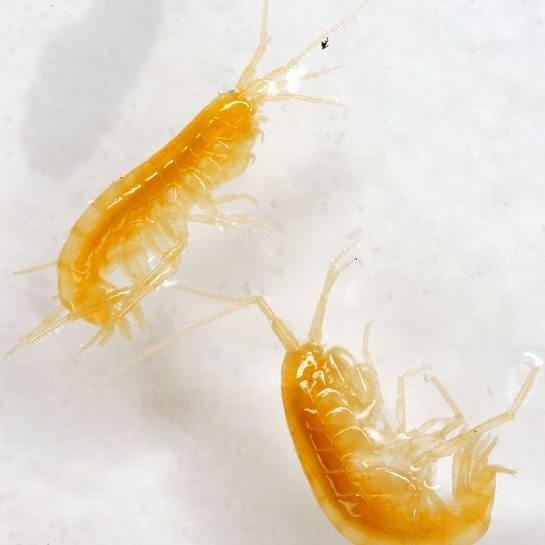
Peck's Cave Amphipod
Stygobromus pecki
Stygobromus pecki, the Peck's cave amphipod, is a rare species of crustacean found in four cavern areas of southwestern Texas (Comal Springs, Hueco Springs, Landa Park, and Panther Canyon) in the United States. It is a federally listed endangered species in the United States and is also listed as Endangered on the IUCN Red List. Because of the species' limited geographical distribution, not much information on S. pecki is known. As of April 2022, there is no available 5-year review, Species Status Assessment, or recovery plan for the species. However, the Edwards' Aquifer Habitat Conservation Program (EAHCP), with the support of the U.S. Fish and Wildlife Service (UFWS), has been attempting to further study and promote conservation of S. pecki.
From the article Stygobromus pecki on Wikipedia (CC BY-SA), quoted section by section
Description
Stygobromus pecki is a small, aquatic organism reaching up to 10.5 millimetres (0.41 in) in length. Although the length of individuals may vary, most are usually less than 5 millimetres (0.20 in) long. It is eyeless and unpigmented, as are all the genus Stygobromus. The amphipod has five pairs of legs, two pairs of antennae, and a laterally flattened body. Though most are uncolored, some populations in the Comal Springs have been found to have an orange hue, linked to their food intake. The S. pecki collected from Hueco springs were found to be white. The color of some amphipods is often dependent on their diet, which includes carotenoids produced by plants, algae, and likely bacteria. It is possible that the particular orange coloration found within the Comal Springs population of S. pecki is derived from food sources such as leaf litter that are scarce in the Hueco Springs region.
Range & habitat
S. pecki primarily reside in spaces of hollowed out limestone found in spring underground aquifers. These spaces provide zones of permanent darkness that this species prefers as a result of its light sensitivity, though they have been found to occasionally rise to the surface in areas around spring openings. Gravel, rocks, and associated debris (leaves, roots, and wood) have been found directly in or near springs, seeps, and upwellings of Comal Springs and Landa Lake. The debris would provide S. pecki with food and may help explain the localization of the species. Because S. pecki has only been found near or within spring systems, it is likely a phreatobite and does not disperse well in downstream gravel beds. To move between caves and springs, they likely follow underground water connections between the locations.
Wikipedia: “Habitat”
What it does
S. pecki is known to be an opportunistic feeder, meaning that it feeds on a large variety of prey and have the ability to adapt to whichever foods are available. Generally, its diet consists of bacterial biofilm, debris, and smaller invertebrates. As mentioned earlier, the diet of S. pecki has a great influence on body color, which can range from white to orange depending on the carotenoids ingested. Researchers have also recently discovered that ostracods, seed shrimp found attached to leaves, make up part of the S. pecki diet.
Wikipedia: “Diet”
In human culture
Though the life history of S. pecki is unknown, most amphipod species complete their life cycle (from egg to adult) in one year. The average female S. pecki lays approximately 5 eggs with a mean incubation time of 50 days. Females can have broods of 10 young each, with the neonates being about 2 mm in length upon hatching. They were found to reach 9 mm in 14 months, producing offspring in the following year. Amphipods are also susceptible to environmental sex determination, putting them more at risk to the adverse effects of chemical pollutants. The life span of S. pecki is unknown, though wild-caught adults have been reared in captivity for at least 2.7 years.
Wikipedia: “Life history”
Where it lives
Recorded sightings
—
geo-referenced records in GBIF, from museums, herbaria and field observers.
Drag the globe to turn it. Dots are where records exist, not a range map; darker means more records.
In the stacks
Searching the stacks…
Every page naming Stygobromus pecki in the Biodiversity Heritage Library →
This page is assembled live from iNaturalist, GBIF, Wikipedia, the Source Library and the Internet Archive. It is not yet part of the hand-edited codex. iNaturalist taxon 113361.