- Animals
- ›Molluscs
- ›Bivalves
- ›Autobranchia
- ›Pteriomorphia
- ›Mytilida
- ›True Mussels
- ›Horsemussels and Allies
- ›Bathymodiolinae
- ›Bathymodiolus
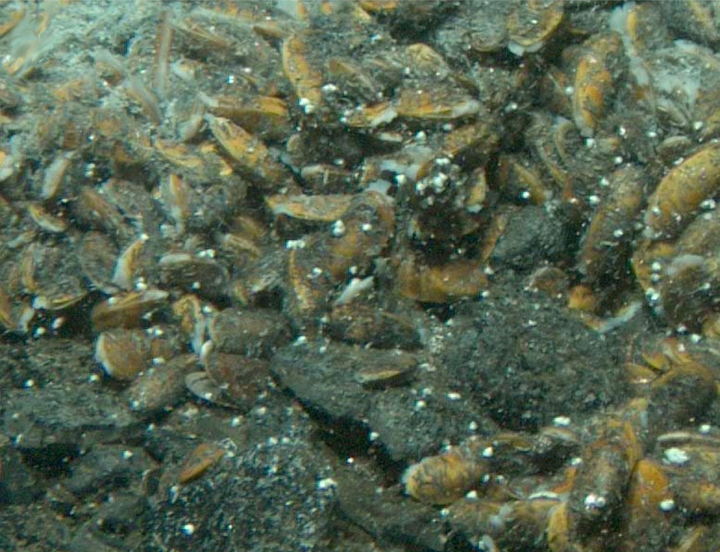
Bathymodiolus thermophilus
Bathymodiolus thermophilus is a species of large, deep water mussel, a marine bivalve mollusc in the family Mytilidae, the true mussels. The species was discovered at abyssal depths when submersible vehicles such as DSV Alvin began exploring the deep ocean. It occurs on the sea bed, often in great numbers, close to hydrothermal vents where hot, sulphur-rich water wells up through the floor of the Pacific Ocean. They can form dense aggregations and act as a foundation species in vent habitats. A major component of its nutrition can come from chemosynthetic symbionts housed in the gills (within bacteriocytes), linking the mussel's success to vent chemistry and microbial metabolism.
From the article Bathymodiolus thermophilus on Wikipedia (CC BY-SA), quoted section by section
Description
Bathymodiolus thermophilus is a very large mussel with a dark brown periostracum, growing to a length of about 20 cm (8 in). It is attached to rocks on the seabed by byssus threads but it is able to detach itself and move to a different location. It is sometimes very abundant, having been recorded at densities of up to 300 individuals per square metre (270 per square yard).
Range & habitat
Bathymodiolus thermophilus is found clustered around deep sea thermal vents on the East Pacific Rise between 13°N and 22°S and in the nearby Galapagos Rift at depths around 2800 metres (one and a half miles). Deep sea hydrothermal vents are frequently found along tectonic plate boundaries, and underwater mountain ranges and ridges. They are particularly well dispersed along the global mid-ocean ridge system. Specific geographical barriers exist along the mid-ocean ridge system that may impede gene flow between populations along the ridge-axis. A study sampled mussels across various topographical interruptions along the ridge system and localities encompassed the Galapagos Rift and the East Pacific Rise. Results determined that mussel populations that were geographically isolated from one another via the Easter Microplate, known for its strong cross-axis currents, were genetically more divergent than populations from the Galapagos Rift and the East Pacific Rise, where there are no barriers to dispersal and no isolation-by-distance. Mussels in these populations were genetically homogeneous and contained high levels of unimpeded interpopulational gene flow.
The environments surrounding hydrothermal vents are important for the B. thermophilus to survive. It has been shown that environmental changes can impair the ability of the mussels and their symbiotic bacteria to live. …
Wikipedia: “Distribution”
What it does
The larvae of Bathymodiolus thermophilus drift with the currents and are planktotrophic, feeding on phytoplankton and small zooplankton. This method of feeding is likely to give them good dispersal capabilities and it has been shown by DNA analysis that there is a high rate of gene flow between populations round different vents. The Bathymodiolus species represents one of the most well-known fauna to colonize hydrothermal vents and cold seeps. In particular, B. thermophilus has been extensively studied due to their chemosynthetic symbioses and their crucial roles in ecosystem productivity. In early stages of development, deep-sea mussels appear to follow similar growth processes of gametogenesis in comparison to shallow-water mytilidae. It has been observed that Bathymodiolins produce small oocytes which may predict high fecundity levels for this species. While there are limited studies regarding fecundity of B. thermophilus, one way to improve understanding of both fecundity as well as spawning patterns would to observe a spawning event with use of yearly sampling. Adult stages of the bathymodioline species have received the most attention, especially when studying the bacterial symbionts that are fundamental to the mussels nutritional needs. When reaching maturity, adults form close aggregations along seeps and vents. The mantle of B. …
Wikipedia: “Life cycle”
Where it lives
Recorded sightings
—
geo-referenced records in GBIF, from museums, herbaria and field observers.
Drag the globe to turn it. Dots are where records exist, not a range map; darker means more records.
In the stacks
Searching the stacks…
Every page naming Bathymodiolus thermophilus in the Biodiversity Heritage Library →
This page is assembled live from iNaturalist, GBIF, Wikipedia, the Source Library and the Internet Archive. It is not yet part of the hand-edited codex. iNaturalist taxon 1135567.