- Animals
- ›Chordates
- ›Vertebrates
- ›Ray-finned Fishes
- ›Spiny-rayed fishes
- ›Pipefishes and Allies
- ›Syngnathoidei
- ›Pipefishes, Seahorses, and Seadragons
- ›Tail-brooding Pipefishes
- ›Syngnathus
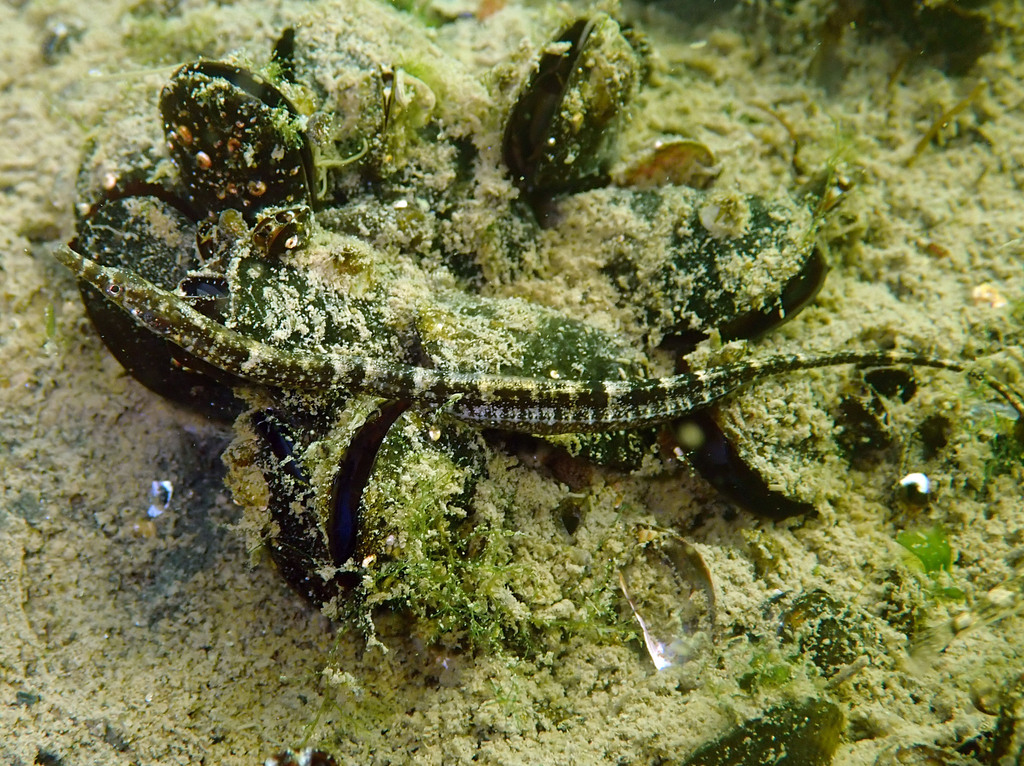
Black-striped Pipefish
Syngnathus abaster
The black-striped pipefish (Syngnathus abaster) is a species of fish in the family Syngnathidae. It is found in the eastern Atlantic from the southern Gulf of Biscay to Gibraltar, also in the Mediterranean and Black Seas. As the introduced species it is mentioned in the Caspian Sea and fresh waters of its basin.
From the article Black-striped pipefish on Wikipedia (CC BY-SA), quoted section by section
Description
The long bodies are encased in bony plates resembling scales. These plates are a protective armour and serve as camouflage. Even though pipefish have these bony plates, their bodies are very flexible and have the ability to move much like snakes do. Their elongated head looks like a horse head and resembles that of the related seahorses. They also have the ability to wrap their tails around sea grasses to anchor themselves, just as sea horses do. Unlike sea horses, pipefish swim horizontally. Another unique feature is their long snout, which is where the pipefish gets its name.
Wikipedia: “Appearance and body type”
Range & habitat
The black-striped pipefish is found in coastal waters and in the lower reaches of rivers in the Caspian, Black and Mediterranean Sea basins, along the European Atlantic coast from Gibraltar north to the southern part of the Bay of Biscay; in the Danube reaching west to the frontier between Romania and Hungary, as well as in the Dnieper up to Kyiv. It was introduced into reservoirs of the middle and lower Volga with mysids brought from the Don estuary, where it is now expanding its range and has been recorded to the south of Moscow. The pipefish has significantly expanded its range within the Volga River basin. It is now a common and often abundant species in the coastal fish communities of the Lower Volga reservoirs, the unregulated section of the river, and the Volga Delta. Genetic studies suggest that the Volga pipefish populations are closely related to those from the Black Sea basin, indicating a dispersal route from the Azov-Black Sea region.
Wikipedia: “Distribution”
What it does
As stated above, a pipefish's diet consists mostly of newborn fish and small crustaceans. As the pipefish does not chew its food, the prey needs to be small enough to fit in the mouth and be swallowed whole. The long pipe-like mouth of the pipefish is used as a sucking tool when it eats. The pipefish wraps its tail around sea grass, using it as an anchor. It patiently waits until its prey swims close, and then sucks it up, puffing out its cheeks in the process. The tube is dilated which creates a small, strong current in the water near the fish's mouth. According to Guenther Sterba, author of Freshwater Fishes of the World, the current is accompanied by a sucking noise, much like a small vacuum cleaner. Many species of large fish prey on pipefish, as do otters and blue crabs. This particular species of pipefish has no real defense against predators aside from camouflage and swimming away, making it an easy target.
Wikipedia: “Diet”
Where it lives
Recorded sightings
—
geo-referenced records in GBIF, from museums, herbaria and field observers.
Drag the globe to turn it. Dots are where records exist, not a range map; darker means more records.
In the stacks
Searching the stacks…
Every page naming Syngnathus abaster in the Biodiversity Heritage Library →
This page is assembled live from iNaturalist, GBIF, Wikipedia, the Source Library and the Internet Archive. It is not yet part of the hand-edited codex. iNaturalist taxon 113578.