- Animals
- ›Arthropods
- ›Hexapods
- ›Insects
- ›Winged and Once-winged Insects
- ›Dragonflies and Damselflies
- ›Dragonflies
- ›Libelluloidea
- ›Skimmers
- ›Tramea
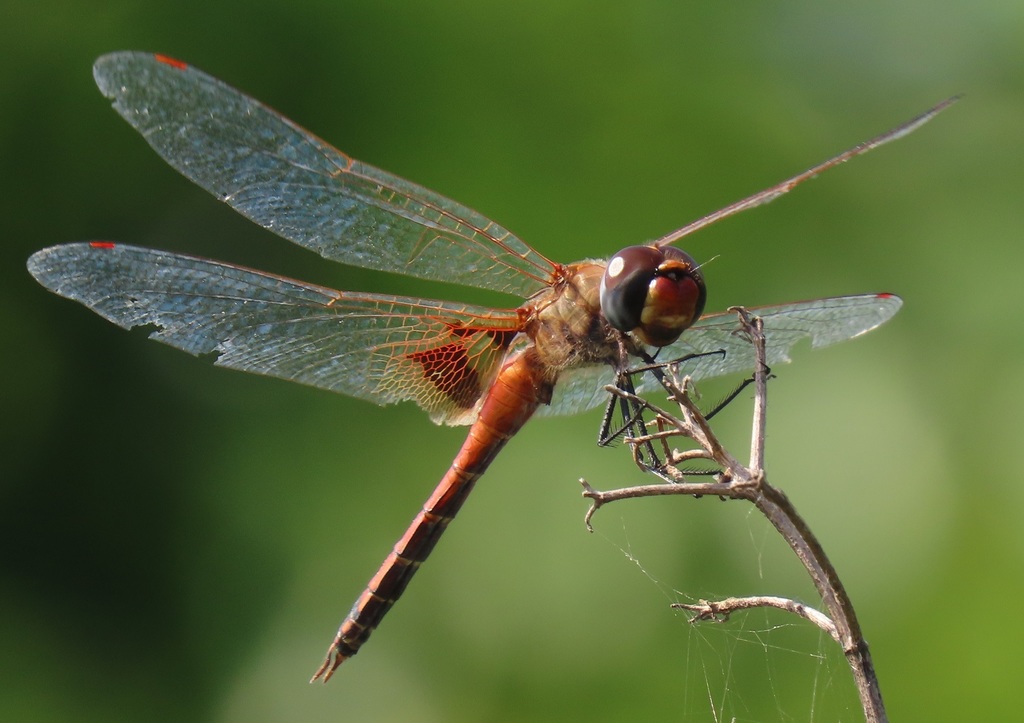
Keyhole Glider
Tramea basilaris
Tramea basilaris, also known as the keyhole glider, red marsh trotter, or wheeling glider, is a species of dragonfly in the family Libellulidae. It is found throughout most of Africa, Arabia and in Asia. Capable of very long migration and nomadic flight, it reached Europe once, with a pair being recorded at the island of Linosa, Sicily (Italy) in 2016. Similarly, this species is able to use the trade winds to reach the Caribbean and South Americas, where it has been spotted in Bonaire, Venezuela, and Martinique.
From the article Tramea basilaris on Wikipedia (CC BY-SA), quoted section by section
Description
It is a medium-sized red dragonfly with extremely long anal appendages. It can be distinguished from other species of this genus by the two brownish black hind-wing patch surrounded by a golden yellow areola in the base. Female is similar to male; but yellowish in color. This species is found at pools, ponds, marshes, lakes and water tanks. Typical reproducing habitats are grassy marshes and ponds, but this species may be found anywhere during migrations. They are seen in tireless soaring flight in sunny days, sometimes in conspecific groups or in mixed groups of other soaring dragonflies like Pantala flavescens or Hydrobasileus croceus. It perches on exposed twigs; sometimes with the abdomen held downwards to balance in wind.
Wikipedia: “Description and habitat”
Listen
Looking for field recordings…
Where it lives
Recorded sightings
—
geo-referenced records in GBIF, from museums, herbaria and field observers.
Drag the globe to turn it. Dots are where records exist, not a range map; darker means more records.
In the stacks
Searching the stacks…
Every page naming Tramea basilaris in the Biodiversity Heritage Library →
This page is assembled live from iNaturalist, GBIF, Wikipedia, the Source Library and the Internet Archive. It is not yet part of the hand-edited codex. iNaturalist taxon 114309.