 NL·0698
Herbarium of the Nature Library
- Name
- Wallago attu
- Family
- Siluridae
- Native to
- Pakistan, India, Nepal, Bangladesh, Sri Lanka, Myanmar, Thailand, Indochina, Malaysia and Indonesia
- Habitat
- Large rivers, Lakes, Floodplain wetlands
Wallago (boal)
Wallago attu
Also calledBoal বোয়াল (Bengali) · Mulley ملی (Urdu/Punjabi) · Barari (Hindi) · Pla khao ปลาเค้า (Thai) · Valai (Tamil) · Tapah (Malay)
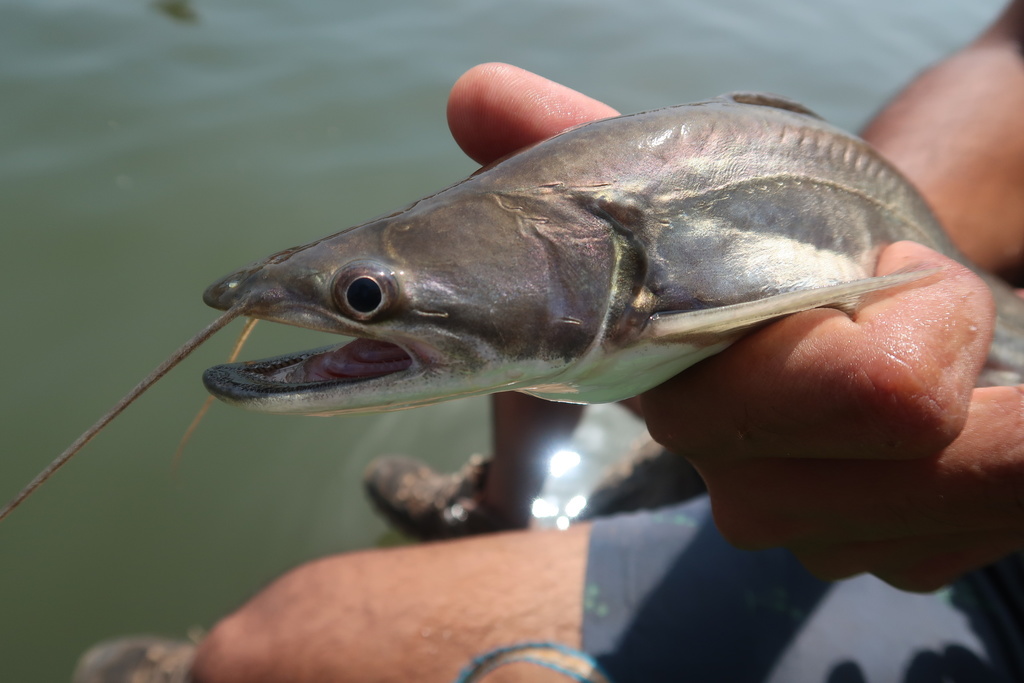
A long, fast-swimming freshwater 'shark' catfish with an enormous mouth, the top predator of South and Southeast Asian rivers. It is now Vulnerable after heavy fishing and river damage.
Wallago attu, boal, or helicopter catfish, is a species of freshwater catfish of the family Siluridae, native to South and Southeast Asia. W. attu is found in large rivers and lakes in two geographically disconnected regions, with one population living over much of the Indian subcontinent and the other in parts of Southeast Asia. This species can reach a length up to 1.1 m. Wikipedia
What it can do
- iIts mouth gape reaches well behind the eye, so it can swallow large fish whole
- iiHunts mostly at night using long barbels and a well-developed lateral-line sense
- iiiSwims fast in open water, chasing prey instead of only waiting in ambush
- ivGrows to over 2 m
In the field
Field marks
- aLong, scaleless, laterally compressed body tapering to a forked tail
- bHuge mouth with the gape extending behind the eye, and bands of sharp teeth
- cTiny dorsal fin and a very long anal fin running almost to the tail
- dTwo pairs of barbels, the upper jaw pair very long
- eSilvery-grey to olive with a pinkish sheen
- Not to be confused with
- The pabda catfishes (Ompok) look similar but are much smaller (under 30 cm), and their mouth does not reach behind the eye. The goonch (Bagarius) is mottled brown, bottom-dwelling and has a flattened head.
- Where to see it
- Bengal and Assam floodplain beels; the Ganges and Brahmaputra; Thai and Cambodian fish markets
- When
- Resident; breeds in the monsoon (June–August)
Life & habits
- Diet
- Carnivore: fish, prawns, frogs and occasionally water birds
- Habitat
- Large rivers, lakes, reservoirs and floodplain beels
- Size
- Commonly 1 m; up to about 2.4 m and 45 kg
- Lifespan
- Not well documented; probably 10+ years
Mostly nocturnal; it rests in deep water by day and hunts schools of small fish at dusk. It breeds in flooded areas during the monsoon.
Where it lives
Recorded sightings
—
geo-referenced records in GBIF, from museums, herbaria and field observers.
Native range
Pakistan, India, Nepal, Bangladesh, Sri Lanka, Myanmar, Thailand, Indochina, Malaysia and Indonesia
Drag the globe to turn it. Dots are where records exist, not a range map; darker means more records.
In the stacks
Searching the stacks…
Every page naming Wallago attu in the Biodiversity Heritage Library →
Marginalia
The boal is a stock figure in Bengali proverbs as the greedy big fish that swallows the small. It was described from India by Bloch and Schneider in 1801.
Curiosity
Anglers in India and Pakistan nicknamed it the 'freshwater shark' because it attacks lures fast in open water and has a slim, shark-like build.
Kinship



Fact-checked: 1 correction made to this sheet. Photographs: iNaturalist contributors under the licences shown. Records: GBIF.org. Historical plates: Source Library (CC BY-SA 4.0; originals public domain). Summary text: Nature Library editors and Wikipedia (CC BY-SA). Medicinal and edibility notes are historical and educational, not advice. iNaturalist taxon 115010.