- Plants
- ›Vascular Plants
- ›flowering plants
- ›Dicots
- ›Mints, Plantains, Olives, and Allies
- ›figwort family
- ›Buddlejeae
- ›Buddleja
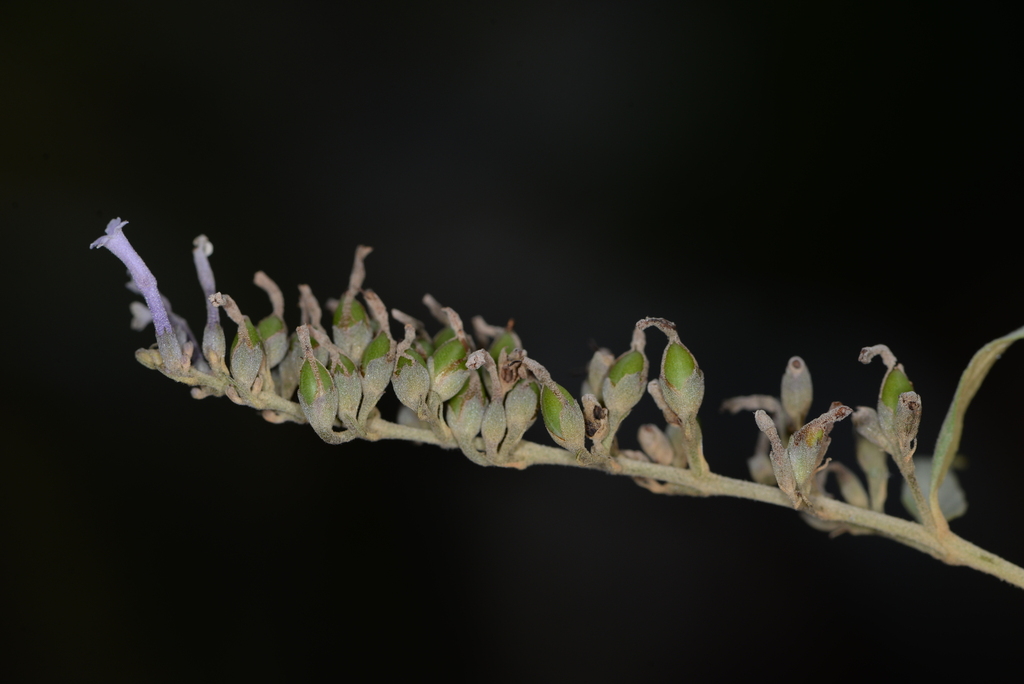
Buddleja curviflora
Buddleja curviflora is a deciduous shrub native to southern Japan and Taiwan, where it grows in thickets on stony slopes at elevations of 100–300 m. B. curviflora was named and described Hooker and Arnott in 1838. Plants in Taiwan have been described as a separate species Buddleja formosana and assessed as Critically Endangered by IUCN, but the distinction is not recognized by Li and Leeuwenberg, who sank formosana as a synonym.
From the article Buddleja curviflora on Wikipedia (CC BY-SA), quoted section by section
Description
Buddleja curviflora grows to < 2 m in height in the wild, its branches subquadrangular in section, and glabrescent. The leaves are opposite, lanceolate to ovate, 5–15 cm long by 2–6 cm wide, the upper surface glabrous, the underside almost glaucous. The purple flowers are borne on slender, terminal, one-sided panicles 5–15 cm long; flowering occurs in June and July. Ploidy 2n = 38 (diploid).
How it is grown
The shrub is rare in cultivation. In the UK, specimens are grown at the Royal Botanic Garden Edinburgh, the Royal Horticultural Society garden at Wisley, and at Longstock Park Nursery, NCCPG national collection holder, near Stockbridge, Hampshire. Hardiness: USDA zones 8–9.
Wikipedia: “Cultivation”
Where it lives
Recorded sightings
—
geo-referenced records in GBIF, from museums, herbaria and field observers.
Drag the globe to turn it. Dots are where records exist, not a range map; darker means more records.
In the stacks
Searching the stacks…
Every page naming Buddleja curviflora in the Biodiversity Heritage Library →
This page is assembled live from iNaturalist, GBIF, Wikipedia, the Source Library and the Internet Archive. It is not yet part of the hand-edited codex. iNaturalist taxon 1156084.