- Plants
- ›Vascular Plants
- ›flowering plants
- ›Dicots
- ›Mints, Plantains, Olives, and Allies
- ›broomrape family
- ›Rhinantheae
- ›Euphrasia
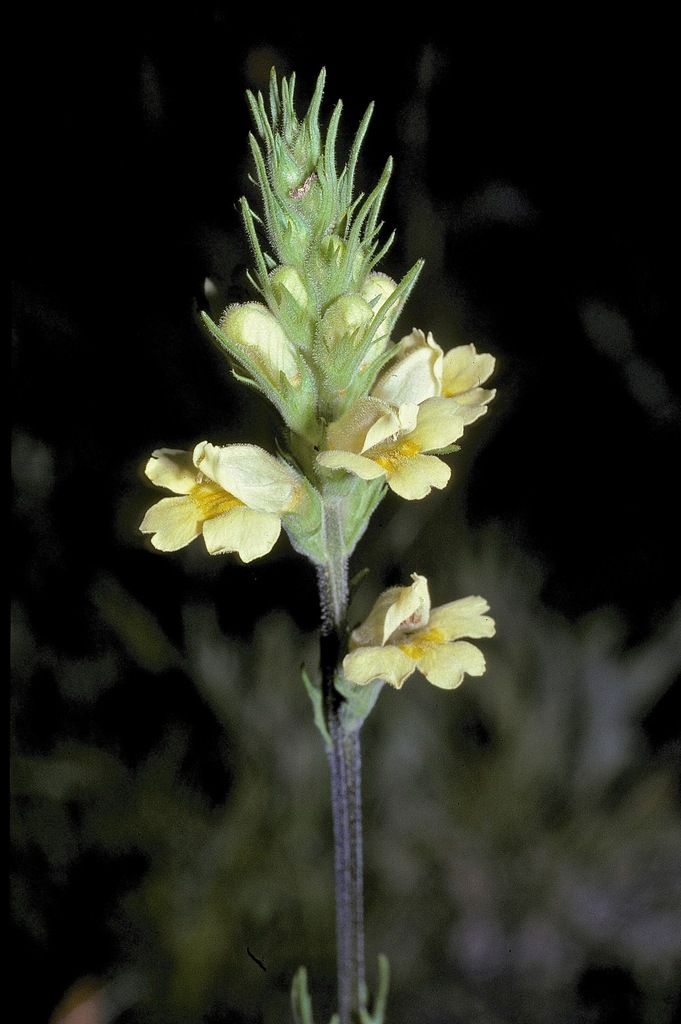
Euphrasia scabra
Euphrasia scabra commonly known as yellow eyebright or rough eyebright, is a flowering plant in the family Orobanchaceae that is endemic to Australia, where it occurs in Tasmania, Victoria, New South Wales, South Australia and Western Australia.
From the article Euphrasia scabra on Wikipedia (CC BY-SA), quoted section by section
Description
Euphrasia scabra is an erect annual herb that grows between 8.5–50 cm high. It has green leaves, sometimes with reddish parts, that form in opposite and alternate pairs, growing from the stem at right angles from each other.The leaves are ovate to elliptic, 6–20 mm long and 1–9.5 mm wide. Leaf margins vary from pinnatifid to serrate-crenate, with each bearing 1–5 pairs of teeth and the leaf base been rounded-cuneate to truncate. The stems are reddish-brown and have short, scabrous (rough) white hairs, especially on the upper parts of the plant. The branches develop in consecutive nodes from the stem, with the oldest being just below the inflorescences (flowering structures). The branches end in an inflorescence, consisting of up to 16 pairs of flowers. The species typically flowers between October and February, with the flowers been a creamy yellow colour and 9–12 mm long and 8 mm wide. Capsules are 5–9.3 mm long, bristly except at the base.
Range & habitat
Euphrasia scabra is endemic to Australia and is distributed across south-eastern and western Australia. It usually occurs in moist herb and sedge communities, including grassy leads in marshes. It is also found in open, drier grassy areas on hills, often near the headwaters of creeks. Its habitat often occurs where gaps in the vegetation have been created by disturbances such as grazing and flooding. The dispersal range of seeds is very limited, with the vast majority of seeds being deposited within 30 cm of the plant, however flooding events can improve their dispersal. Euphrasia scabra seeds need light to germinate, therefore areas of open ground are essential for successful germination. Euphrasia scabra also needs a period of low temperatures to germinate. These requirements, along with their small size and fragmented populations increase the species vulnerability to catastrophic events and the risk of local extinctions.
Wikipedia: “Distribution and habitat”
Where it lives
Recorded sightings
—
geo-referenced records in GBIF, from museums, herbaria and field observers.
Drag the globe to turn it. Dots are where records exist, not a range map; darker means more records.
In the stacks
Searching the stacks…
Every page naming Euphrasia scabra in the Biodiversity Heritage Library →
This page is assembled live from iNaturalist, GBIF, Wikipedia, the Source Library and the Internet Archive. It is not yet part of the hand-edited codex. iNaturalist taxon 1161362.