- Animals
- ›Arthropods
- ›Hexapods
- ›Insects
- ›Winged and Once-winged Insects
- ›True Bugs, Hoppers, Aphids, and allies
- ›True Hoppers
- ›Planthoppers
- ›Fulgoroidea
- ›Flatid Planthoppers
- ›Flatinae
- ›Siphantini
- ›Siphanta
- ›Siphanta acuta
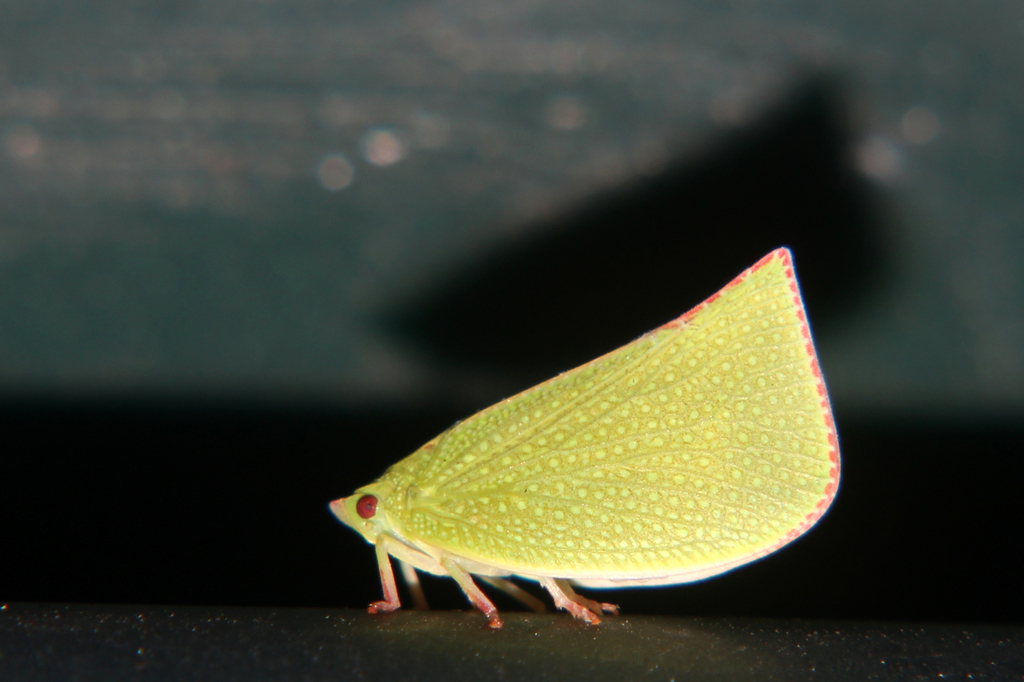
Torpedo Bug
Siphanta acuta
Siphanta acuta is a plant-feeding insect in the family Flatidae; this species of planthopper is found in various parts of the world, and is sometimes called the green planthopper, or the torpedo bug. About 15 mm long, they resemble small leaves and are generally found in trees. Their wings are triangular, and the back edge and corners of their wings are lined with dotted red.
From the article Siphanta acuta on Wikipedia (CC BY-SA), quoted section by section
Description
Adult Siphanta acuta are large-winged (as are other members of the family Flatidae) and bright green. Their wings are triangular, sharply pointed at the tip, and sit held like a steep roof. Their wings project behind the end of their abdomen and almost reach the ground. Most of their body is concealed. A pointed head and distal segments of front and middle legs (sometimes tarsus of hind legs) are visible. The body length of mature green planthoppers is around 9.3 mm. They have two pairs of wings, three pairs of legs, one pair of antennae, and compound eyes on either side of their head. They have piercing/sucking mouthparts and females have an ovipositor at the end of the abdomen. Nymphs of Siphanta acuta are white with a pair of waxy filaments either side of the sixth abdominal segment, with two long tufts at the tip of the abdomen. Their form is like that of the mature form, with a rostrum to feed from, three pairs of legs, and a pair of antennae.
Range & habitat
Siphanta acuta naturally occurs in Australia (continentally and Tasmania), California (adventive), Hawaii (adventive), and South Africa (adventive).
Wikipedia: “Natural global range”
What it does
In terms of phenology, adult forms of Siphanta acuta are most common in summer and autumn. After mating, females usually lay 90-110 eggs on a leaf in a flat oval cluster via the ovipositor. These are known as egg-cushions, which turn from white to black, due to a fungus that grows on empty shells. The newly hatched forms are nymphs, which reside near their eggs for the first early part of their life, also known as the first instar. Siphanta acuta molts to move through different instars/stages of growth and maturity. Second and third instars gradually become greener where they reach 3.6mm at the third, the fourth instars gain a small amount of reddish marks, and the fifth have white with pink markings.
Wikipedia: “Life cycle and phenology”
Listen
Looking for field recordings…
Where it lives
Recorded sightings
—
geo-referenced records in GBIF, from museums, herbaria and field observers.
Drag the globe to turn it. Dots are where records exist, not a range map; darker means more records.
In the stacks
Searching the stacks…
Every page naming Siphanta acuta in the Biodiversity Heritage Library →
This page is assembled live from iNaturalist, GBIF, Wikipedia, the Source Library and the Internet Archive. It is not yet part of the hand-edited codex. iNaturalist taxon 116658.