On eBird ↗
Western Corella
Live sightings near you, the range map, bar charts of when it is seen, and Macaulay Library photos and recordings.
Western Corella
Cacatua pastinator
The western corella (Cacatua pastinator) formerly known as the western long-billed corella, is a species of white cockatoo endemic to south-western Australia.
From the article Western corella on Wikipedia (CC BY-SA), quoted section by section
Description
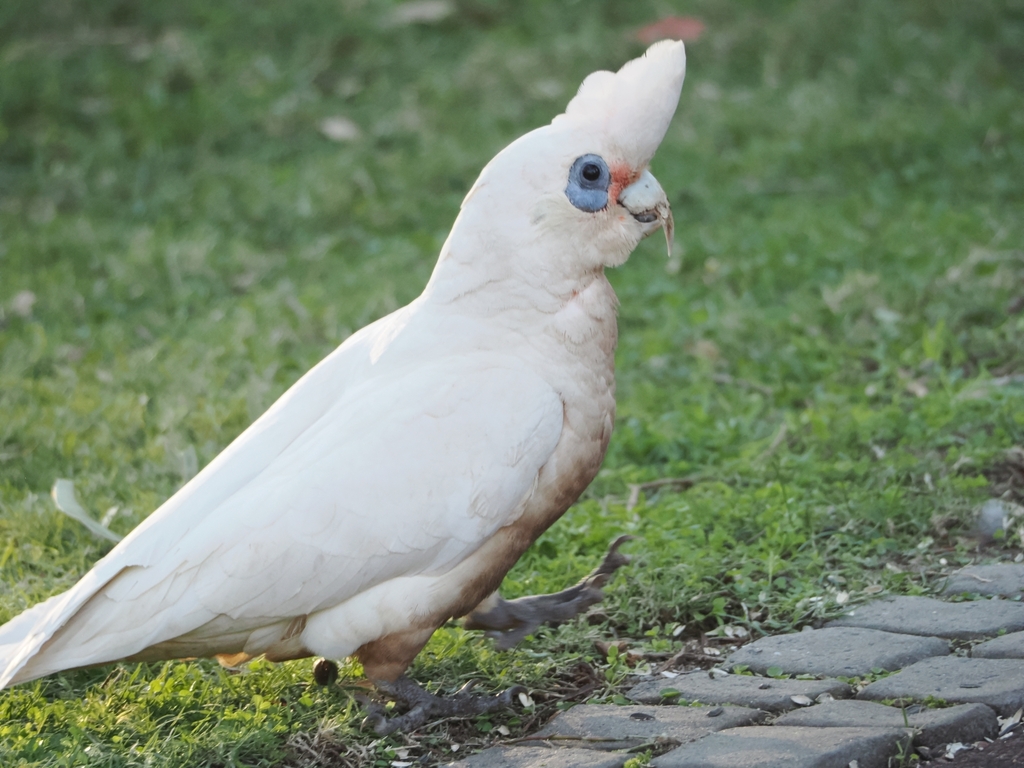
Cacatua pastinator is a white cockatoo with the upper wing entirely white and under surface of the wing pale yellow. It has an erect white crest, blue grey eye skin, crimson pink colouring between the eyes and beak, a small pink patch on the throat, and long pointed bill. Cacatua pastinator lacks sexual dimorphism and the sexes are difficult to distinguish. Determination of the sex of Cacatua pastinator cannot be determined on the basis of eye colour or plumage, observations of pairs have revealed that the males are larger than the females and have a deeper alarm call. Cacatua pastinator is a medium-sized stocky cockatoo with broad rounded wings, a short tail, and a crest which is usually flattened. Muir's Corella (Cacatua pastinator pastinator) adults range in length from 43–48 centimetres (17–19 in) and weigh 560–815 grams (19.8–28.7 oz). The northern subspecies, Butler's Corella (Cacatua pastinator butleri), are a smaller bird with adults 40–48 centimetres (16–19 in) in length and weighing up to 700 grams (25 oz). The bill is a dullish grey white, the legs are dark grey and the upper mandible has a long tip. The underparts are often stained or dirty as a result of feeding on the ground and digging. The flesh of the western corella is described as plump and tender, and suitable for stewing.
Range & habitat
The two separate populations described as subspecies occur in south-west Western Australia. The population occurring in the northern wheatbelt of south-western Australia consist of 5000–10000 birds while the population in the far south west of Western Australia consists of approximately 1000 birds. The two isolated populations each consist of one of the identified sub species. Butler's corella (Cacatua pastinator butleri) occurs in the northern and central wheatbelt of Western Australia whilst Muir's corella (Cacatua pastinator pastinator) occurs in the very south-west area of Western Australia. Historical records indicate the species was common at the time of colonisation of Western Australia, and continued to be seen in large flocks during the nineteenth century. The absence of records by the early collector John Gilbert's suggests that this corella was abundant and ubiquitous. The habitat of Cacatua pastinator consists of undulating land with low relief (less than 100 m) with more than 90% of native vegetation cleared for farming of wheat and sheep. The remaining woodland and shrub vegetation communities are restricted to small isolated patches and road reserves. …
Wikipedia: “Distribution and habitat”
What it does
Cacatua pastinator are an iconic species of bird in Western Australia. They are often conspicuous in large flocks of up to 700 birds during summer which move around the areas spending days or week in any one location feeding and behaving raucously. The flocks of immature birds and breeding pairs and the foraging occurred up to 10 km from their nest trees. The breeding pairs of tend to be stable but a moderate rate of divorce of about 15% has been observed. Flocks of Corellas are often very noisy and can be heard from a considerable distance. The call of the Corella is a wavering falsetto with distinctly eerie or ghostly tonal qualities. They also have various shrieks and quaverings of squeaky conversational tones.
Breeding. Cacatua pastinator nest in hollows in large eucalypt trees and occasionally other tree species such as paperbarks. The preferred nesting trees are large live or dead eucalypts, particularly marri (Corymbia calophylla) and jarrah (Eucalyptus marginata), located in remnant woodlands, in forested areas, along road corridors or as lone paddock trees. The Corellas prefer to nest in trees with open canopies and some dead limbs but will nest in dead trees when there is an adjacent healthy tree in which the bird can shelter. …
Wikipedia: “Behaviour”
In human culture
This species has the ability to mimic clearly and, like other cockatoos, bonds strongly to its owner. The western corella may show aggression to other birds in the aviary. It is not as common in aviculture as the little corella or long-billed corella. The Noongar peoples have used the feathers of this species as an adornment for a headband or placed in their hair. Consumption of this corella by the Indigenous inhabitants of Southwest Australia is undocumented, but assumed from methods that could be employed, using a wounded bird near a pool of water as a decoy, and the reports of English colonists that it was a wholesome and good tasting meal.
Wikipedia: “Aviculture”
Listen
Looking for field recordings…
Where it lives
Recorded sightings
—
geo-referenced records in GBIF, from museums, herbaria and field observers.
Drag the globe to turn it. Dots are where records exist, not a range map; darker means more records.
In the stacks
Searching the stacks…
Every page naming Cacatua pastinator in the Biodiversity Heritage Library →
This page is assembled live from iNaturalist, GBIF, Wikipedia, the Source Library and the Internet Archive. It is not yet part of the hand-edited codex. iNaturalist taxon 116836.