On eBird ↗
Glossy Black-Cockatoo
Live sightings near you, the range map, bar charts of when it is seen, and Macaulay Library photos and recordings.
Glossy Black Cockatoo
Calyptorhynchus lathami
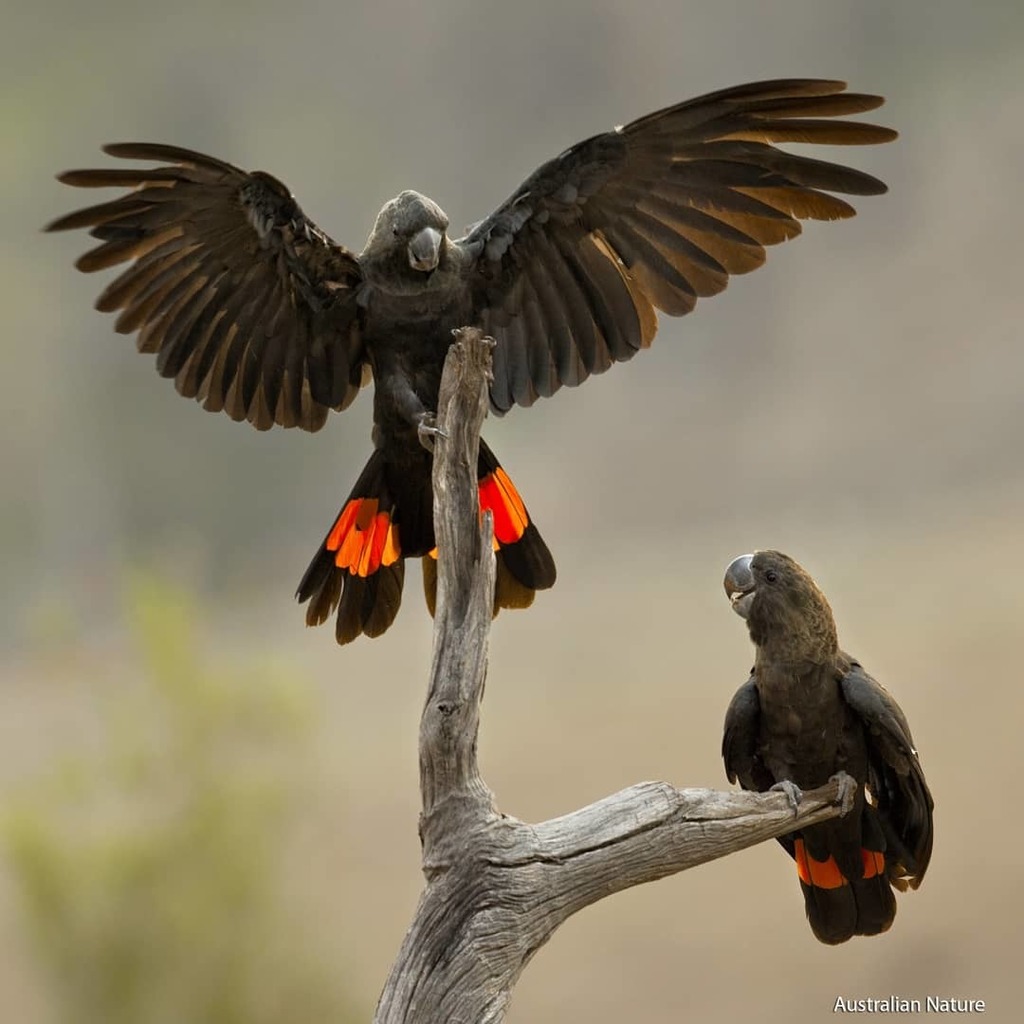
The glossy black bird called the glossy black cockatoo (Calyptorhynchus lathami) is a species of bird found in Australia. It is the smallest member of the subfamily Calyptorhynchinae, and found in eastern Australia. Adult glossy black cockatoos may reach 50 cm (19.5 in) in length. They are sexually dimorphic. Males are blackish brown, except for their prominent sub-terminal red tail bands; the females are dark brownish with idiosyncratic yellow marking around the neck and prominent sub-terminal tail band of red with black bars.
Three subspecies have been recognised. Calyptorhynchus lathami lathami, or south-eastern glossy black cockatoo, is listed as vulnerable under the federal Environment Protection and Biodiversity Conservation Act 1999 (EPBC Act), while the Kangaroo Island subspecies (C. l. halmaturinis) is listed as endangered. The subdivision into subspecies has been recently challenged, with a detailed morphological analysis by Saunders and Pickup 2023, who have argued that with no differentiation in bill morphology, little difference in genetic makeup, no differences in plumage pattern or colour, and no differences in diet, there is no justification in subdividing the species. C. l. erebus, is listed under state legislation in Queensland only.
From the article Glossy black cockatoo on Wikipedia (CC BY-SA), quoted section by section
Description
Like the related red-tailed black cockatoo, this species is sexually dimorphic. The male glossy black cockatoo is predominantly black with a chocolate-brown head and striking caudal red patches. The female is a duller dark brown, with flecks of yellow in the tail and collar. The female's tail is barred whereas the male's tail is patched. An adult will grow to be about 46–50 cm (18–19.5 in) in length.
Range & habitat
Glossy black cockatoos are found in open forest and woodlands, and usually feed on seeds of the she-oak (Casuarina spp.)
Wikipedia: “Distribution and habitat”
Listen
Looking for field recordings…
Where it lives
Recorded sightings
—
geo-referenced records in GBIF, from museums, herbaria and field observers.
Drag the globe to turn it. Dots are where records exist, not a range map; darker means more records.
In the stacks
Searching the stacks…
Every page naming Calyptorhynchus lathami in the Biodiversity Heritage Library →
This page is assembled live from iNaturalist, GBIF, Wikipedia, the Source Library and the Internet Archive. It is not yet part of the hand-edited codex. iNaturalist taxon 116846.