On eBird ↗
Orange-fronted Barbet
Live sightings near you, the range map, bar charts of when it is seen, and Macaulay Library photos and recordings.
Orange-fronted Barbet
Capito squamatus
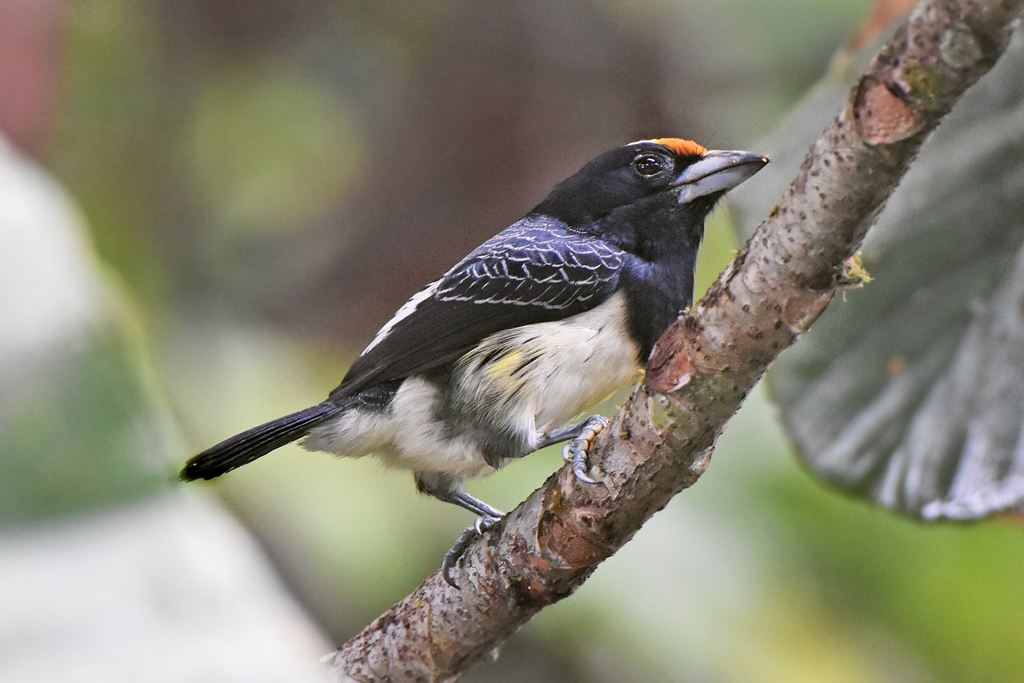
The orange-fronted barbet (Capito squamatus) is a species of bird in the Capitonidae family. It is found in forests in western Ecuador and extreme southwestern Colombia. It is threatened by habitat loss. Both male and female orange-fronted barbets are mostly black and white, and have a red forecrown. The chest of the male bird is very pale yellowish and the throat is white, while these sections are black in the female bird. Unlike the male, the...
From the article Orange-fronted barbet on Wikipedia (CC BY-SA), quoted section by section
Description
The orange-fronted barbet is 16 to 18 cm (6.3 to 7.1 in) long and weighs 56 to 64 g (2.0 to 2.3 oz). The male has a white crown and an orange to red forecrown (the "front"). Its head except for the chin and its upperparts are black; white on some wing feathers remain visible when they are folded. Its underside from chin to the belly are yellowish white, sometimes with an orange tinge. Its flanks usually have light black spotting and the vent area is black. The female's front is yellow-orange; the rest of its head, its throat, and chest are black. Its black back has fine white markings on the wing-coverts.
Range & habitat
The orange-fronted barbet is found from El Oro Province in southwestern Ecuador north into Nariño Department in extreme southwestern Colombia. There it inhabits wet lowlands and hill country, using primary and secondary forest and their edges as well as more open areas such as farms, orchards, and pastures with trees. In elevation it usually ranges from sea level to 800 m (2,600 ft) but can be found up to 1,500 m (4,900 ft) in some areas.
Wikipedia: “Distribution and habitat”
What it does
The orange-fronted barbet usually forages in pairs, hunting all levels of the vegetation, and will join mixed-species foraging flocks. Its diet is primarily fruits and berries but also includes insects and spiders.
Wikipedia: “Feeding”
Listen
Looking for field recordings…
Where it lives
Recorded sightings
—
geo-referenced records in GBIF, from museums, herbaria and field observers.
Drag the globe to turn it. Dots are where records exist, not a range map; darker means more records.
In the stacks
Searching the stacks…
Every page naming Capito squamatus in the Biodiversity Heritage Library →
This page is assembled live from iNaturalist, GBIF, Wikipedia, the Source Library and the Internet Archive. It is not yet part of the hand-edited codex. iNaturalist taxon 117154.