- Plants
- ›Vascular Plants
- ›flowering plants
- ›Dicots
- ›beeches, oaks, walnuts, and allies
- ›birch family
- ›Betula
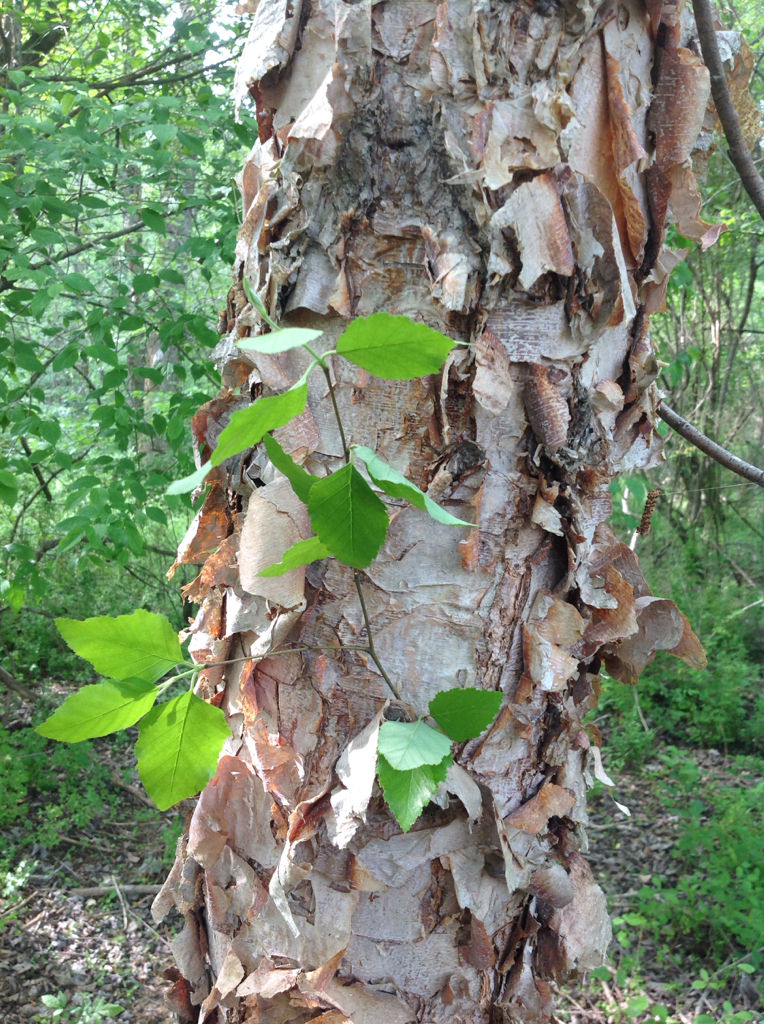
river birch
Betula nigra
Betula nigra, the black birch, river birch or water birch, is a species of birch native to the Eastern United States from New Hampshire west to southern Minnesota, and south to northern Florida and west to Texas. It is one of the few heat-tolerant birches in a family of mostly cold-weather trees which do not thrive in USDA Zone 6 and up. B. nigra commonly occurs in floodplains and swamps.
From the article Betula nigra on Wikipedia (CC BY-SA), quoted section by section
Description
Betula nigra is a deciduous tree growing to 25–30 meters (80–100 ft) with a trunk 50 to 150 centimeters (20 to 60 in) in diameter. The base of the tree is often divided into multiple slender trunks. Bark Bark characteristics of the river birch differ during its youth stage, maturation, and old growth. The bark of a young river birch can vary from having a salmon-pink to brown-gray tint and can be described as having loose layers of curling, paper thin scales. As the tree matures, the salmon-pink color is exchanged for a reddish-brown with a dark grey base color. The scales on a mature tree lack the loose curling and are closely pressed into thick, irregular plates. These scales are slightly separated from the trunk and can shift outward to the side. Once the river birch ages past maturity, the scales become thicker towards the base of the trunk and are divided in deep furrows. Leaves and fruit
The twigs are glabrous or thinly hairy. There is an absence of terminal buds, and lateral buds often have a hook at the tip of the bud, which differs from other species in the family Betulaceae. The leaves are alternate, ovate, 4–8 centimeters (1+1⁄2–3+1⁄4 in) long and 3–6 centimeters (1+1⁄4–2+1⁄4 in) broad, with a serrated margin and five to twelve pairs of veins. …
Range & habitat
The river birch is often found in low-elevation regions from as north as New Hampshire to as south as northern Florida. It can be found extending west to Kansas and east to the coast where proper habitat conditions occur. As its name depicts, this birch is found along stream-sides. It can also be a prominent species found in forested wetland communities and in areas containing moist soil, such as floodplains. States include: Alabama, Arkansas, Connecticut, Delaware, Florida, Georgia, Illinois, Indiana, Iowa, Kansas, Kentucky, Louisiana, Maryland, Massachusetts, Mississippi, Missouri, New Hampshire, New Jersey, New York, North Carolina, Ohio, Oklahoma, Pennsylvania, South Carolina, Tennessee, Texas, Virginia, West Virginia, and Wisconsin. River birch is best placed in USDA hardiness zones 4–9.
Wikipedia: “Habitat and range”
What it does
In states in which mining is prevalent, the river birch is often used for reclamation and erosion control, as it is well suited for soils that are too acidic for other species of hardwoods. In West Virginia, they have been found to establish within mine refuse sites after being blown from neighboring areas.As the species occurs predominately in flood plains and along stream banks, it is described as being moderately tolerant of flooding. Saplings were observed to survive up to 30 days of continuous flooding in some regions. While the species is tolerant of excessive water, it is intolerant of shade. Seeds will not germinate without a large amount of direct sunlight. This species is utilized by many local bird species, such as waterfowl, ruffed grouse, and wild turkey. Many waterfowl use the cover for nesting sites, while the ruffed grouse and wild turkey use the seeds as a food source. Deer have been known to graze on saplings or reachable branches. It is a larval host for over fifteen moth species, including Acronicta betulae, Acrobasis betulivorella, Bucculatrix coronatella, Nemoria bistriaria, Nites betulella, Orgyia leucostigma, and Pseudotelphusa betulella.
Wikipedia: “Ecology”
At the table
While its native habitat is wet ground, it will grow on higher land, and its bark is quite distinctive, making it a favored ornamental tree for landscape use. A number of cultivars with much whiter bark than the normal wild type have been selected for garden planting, including 'Heritage' and 'Dura Heat'; these are notable as the only white-barked birches resistant to the bronze birch borer (Agrilus anxius) in warm areas of the southeastern United States of America.Native Americans used the boiled sap as a sweetener similar to maple syrup, and the inner bark as a survival food. The river birch is not typically used in the commercial lumber industry, due to knotting, but its strong, closely grained wood is sometimes used for local furniture, woodenware, and fuel.
Wikipedia: “Cultivation and uses”
Where it lives
Recorded sightings
—
geo-referenced records in GBIF, from museums, herbaria and field observers.
Drag the globe to turn it. Dots are where records exist, not a range map; darker means more records.
In the stacks
Searching the stacks…
Every page naming Betula nigra in the Biodiversity Heritage Library →
This page is assembled live from iNaturalist, GBIF, Wikipedia, the Source Library and the Internet Archive. It is not yet part of the hand-edited codex. iNaturalist taxon 117429.