- Plants
- ›Vascular Plants
- ›flowering plants
- ›Dicots
- ›Soapberries, Cashews, Mahoganies, and Allies
- ›citrus family
- ›Aurantioideae
- ›Citrus
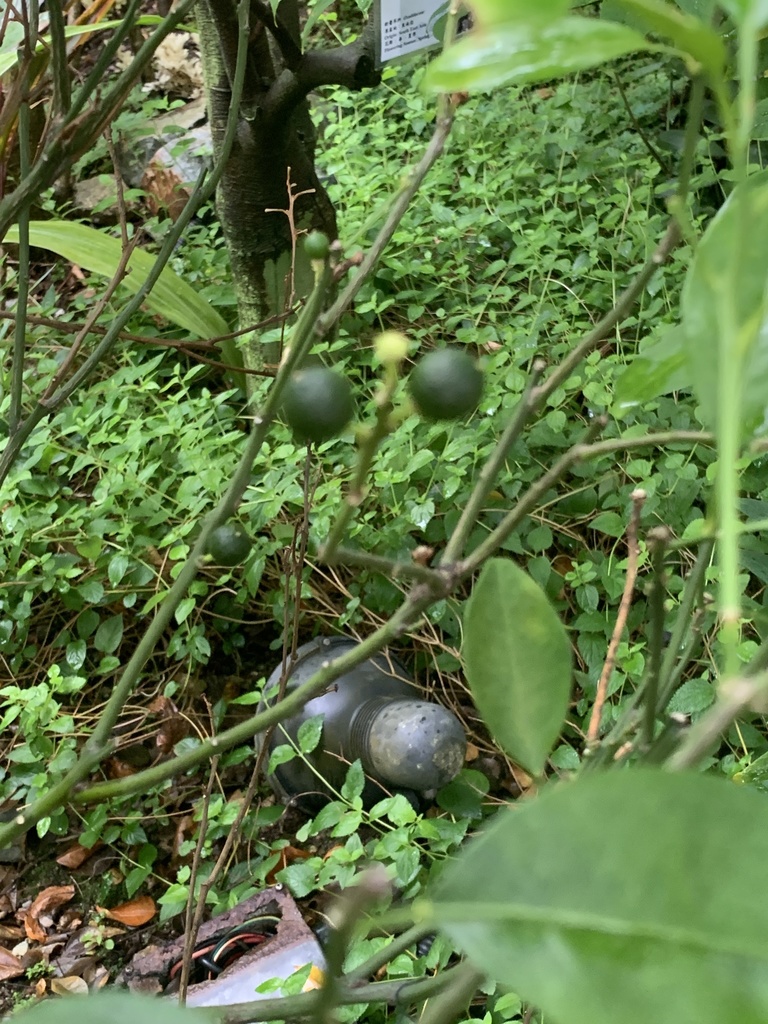
Papeda
Citrus micrantha
The micrantha is a wild citrus from the papeda group, native to southern Philippines, particularly islands of Cebu and Bohol. Two varieties are recognized: small-flowered papeda (C. hystrix var. micrantha), locally known as biasong, and small-fruited papeda (C. hystrix var. microcarpa) or samuyao.
Although long viewed as a separate species, C. micrantha, it is now generally viewed to fall within Citrus hystrix, but genomic data on the latter is insufficient for a definitive conclusion. A micrantha was one of the progenitor species of some varieties of lime.
From the article Micrantha (citrus) on Wikipedia (CC BY-SA), quoted section by section
Description
The micrantha was first described to Western science in 1915 by Peter Jansen Wester, who worked for the Philippine Bureau of Agriculture at the time.
Biasong. Wester collected ripe fruit specimens of biasong (small-flowered papeda, Citrus hystrix var. micrantha) on islands of Cebu, Bohol, Dumaguete, Negros, and in the Zamboanga and Misamis provinces in Mindanao. The fruits were collected throughout the year, indicating that the plant is ever-bearing. Biasong is characterized by small flowers (thus the "small-flowered" moniker) with fewer stamens than other papedas and oblong-obovate, few-loculed fruits. Though the fruit is not eaten and with little economic importance, its juice is used as a souring agent for kinilaw, or for hair-washing. Biasong's aroma is similar to that of the samuyao variety of micrantha. The tree reaches 7.5 to 9 metres (25 to 30 ft) in height. Leaves are 9–12 cm (3.5–4.7 in) long, 2.7–4.0 cm (1.1–1.6 in) wide, broadly elliptical to ovate, crenate, thin, with base rounded or broadly acute; apex acutely blunt pointed. Petioles are 3.5–6 cm (1.4–2.4 in) long, broadly winged, up to 4 cm (1.6 in) wide, with wings (phyllodes) sometimes larger than the leaf. Flowers are small, four-petaled, white with a thin purple edge, 12–13 mm (0.47–0.51 in) in diameter, forming cymes of two to five. There are 15 to 17 equal stamens. …
Toxicity
The micrantha contains a significant amount of bergapten, a linear furanocoumarin well known for its phototoxic effects. Of 61 Citrus varieties tested, C. micrantha had the highest concentration of bergapten of any Citrus species. In particular, C. micrantha contained almost twice as much bergapten as the bergamot orange whose essential oil is highly phototoxic. Indiscriminate use of bergamot essential oil has led to several cases of phytophotodermatitis, a potentially severe skin inflammation. In these cases, the primary causal agent is believed to be bergapten.
Where it lives
Recorded sightings
—
geo-referenced records in GBIF, from museums, herbaria and field observers.
Drag the globe to turn it. Dots are where records exist, not a range map; darker means more records.
In the stacks
Searching the stacks…
Every page naming Citrus micrantha in the Biodiversity Heritage Library →
This page is assembled live from iNaturalist, GBIF, Wikipedia, the Source Library and the Internet Archive. It is not yet part of the hand-edited codex. iNaturalist taxon 1176353.