- Animals
- ›Molluscs
- ›Bivalves
- ›Autobranchia
- ›Pteriomorphia
- ›Mytilida
- ›True Mussels
- ›mussels
- ›Mytilinae
- ›Mytilus
- ›Mytilus edulis
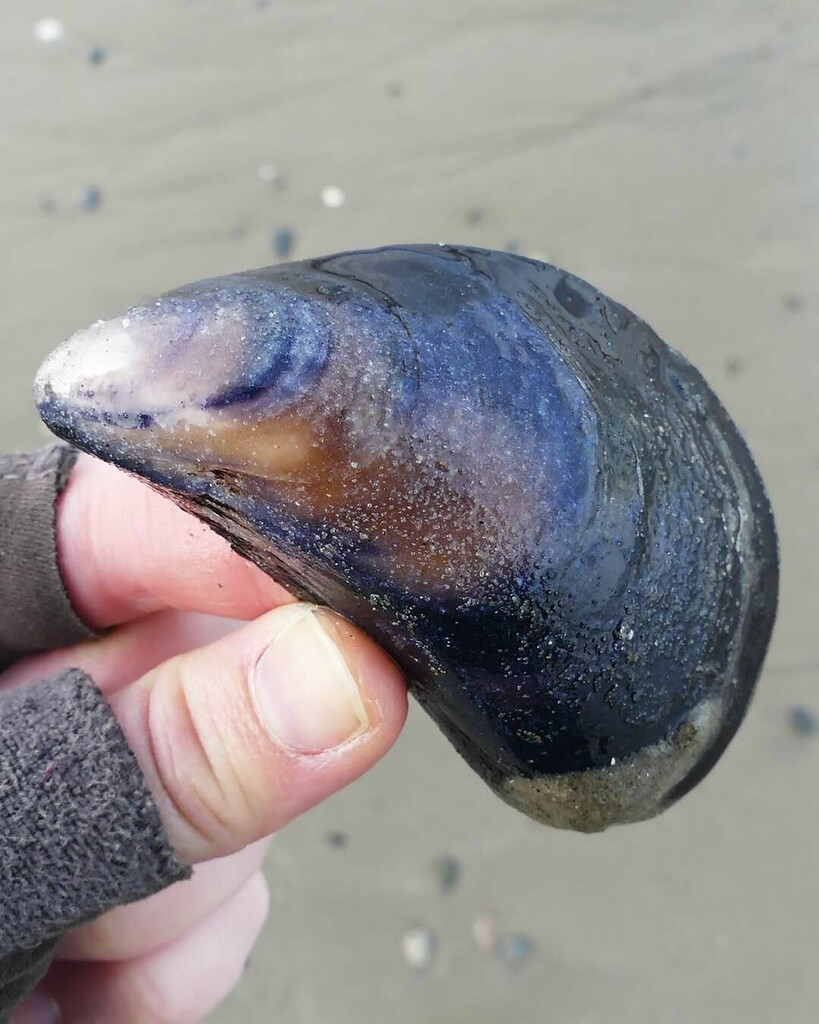
Blue Mussel
Mytilus edulis
The blue mussel (Mytilus edulis), also known as the common mussel, is a medium-sized edible marine bivalve mollusc in the family Mytilidae, the only extant family in the order Mytilida, known as "true mussels". Blue mussels are subject to commercial use and intensive aquaculture. A species with a large range, the blue mussel leaves empty shells that are commonly found on beaches around the world.
From the article Blue mussel on Wikipedia (CC BY-SA), quoted section by section
Description
The shape of the shell is triangular and elongated with rounded edges. The shell is smooth with a sculpturing of fine concentric growth lines but no radiating ribs. The shells of this species are purple, blue or sometimes brown in color, occasionally with radial stripes. The outer surface of the shell is covered by the periostracum which as eroded, exposes the colored prismatic calcitic layer. Blue mussels are semi-sessile, having the ability to detach and reattach to a surface allowing the mollusk to reposition itself relative to the water position.
Range & habitat
Blue mussels are boreo-temperate invertebrates that live in intertidal areas attached to rocks and other hard substrates by strong (and somewhat elastic) thread-like structures called byssal threads, secreted by byssal glands located in the foot of the mussel.
Wikipedia: “Habitat”
What it does
Mussels have separate sexes. Once the sperm and eggs are fully developed they are released into the water column for fertilization. Although there are about 10,000 sperm per egg, large proportions of eggs deposited by blue mussels are never fertilized. As few as 1% of larvae that do mature ever reach adulthood. The majority are eaten by predators before completing metamorphosis. The reproductive strategy seen in blue mussels is characteristic of planktotrophs. By minimizing nutrients in egg production to the bare minimum they are able to maximize the number of gametes produced. If the adult mussels are stressed during the beginning of gametogenesis, the process is terminated. When stressed while fresh gametes are present, adult mussels reabsorb gametes. Larvae viability is also affected by the condition of parents: high water temperatures, pollutants and scarcity of food, during gamete production. The reduction in viability is probably due to the lack of lipid reserves distributed to the eggs.
Wikipedia: “Reproduction”
At the table
Blue mussels are filter feeders and play a vital role in estuaries by removing bacteria and toxins. Mytilus edulis is commonly harvested for food throughout the world, from both wild and farmed sources. Mussels are a staple of many seafood dishes in various cuisines including Spanish (especially Galician), Portuguese, French, British, Dutch, Belgian, Italian and Turkey as midye dolma. They are also commonly used as lab animals. Blue mussels were also harvested by the indigenous peoples of North America. Blue mussels are starting to decline in areas such as the Gulf of Maine. Historical references have shown a decrease of about 40 percent in the last fifty years. This can cause a future problem because mussels are foundation species providing homes and protecting other small animals in the intertidal zone like small fish as well as filtering the water. Mussels filter out bacteria, metals, and toxins, that would increase significantly without mussels around. Ocean acidification due to increasing atmospheric carbon dioxide is projected to reduce the growth and survival of blue mussels; in turn, this could drastically reduce their positive impact on coastal water quality.
Wikipedia: “Uses and ecosystem services”
Where it lives
Recorded sightings
—
geo-referenced records in GBIF, from museums, herbaria and field observers.
Drag the globe to turn it. Dots are where records exist, not a range map; darker means more records.
In the stacks
Searching the stacks…
Every page naming Mytilus edulis in the Biodiversity Heritage Library →
This page is assembled live from iNaturalist, GBIF, Wikipedia, the Source Library and the Internet Archive. It is not yet part of the hand-edited codex. iNaturalist taxon 117650.