- Animals
- ›Chordates
- ›Vertebrates
- ›Ray-finned Fishes
- ›Spiny-rayed fishes
- ›Blennies, Damselfishes and Allies
- ›Damselfishes
- ›Typical Damselfishes and Anemonefishes
- ›Amphiprion
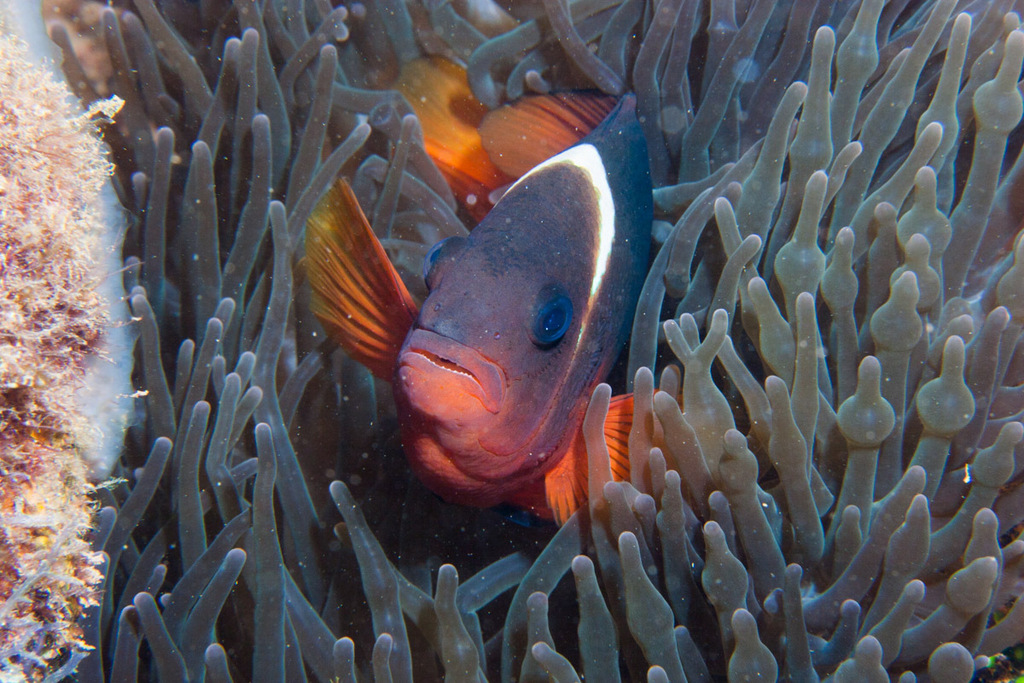
Australian Anemonefish
Amphiprion rubrocinctus
Amphiprion rubrocinctus, also known as the Australian clownfish or red anemonefish, is a species of anemonefish that is endemic to north west Australia. Like all anemonefishes it forms a symbiotic mutualism with sea anemones and is unaffected by the stinging tentacles of the host anemone. It is a sequential hermaphrodite with a strict sized based dominance hierarchy: the female is largest, the breeding male is second largest, and the male non-breeders get progressively smaller as the hierarchy descends. They exhibit protandry, meaning the breeding male will change to female if the sole breeding female dies, with the largest non-breeder becomes the breeding male. The fish's natural diet includes zooplankton.
From the article Australian clownfish on Wikipedia (CC BY-SA), quoted section by section
Description
The side of A. rubrocinctus has blackish or dark brown sides with red snout, breast, belly and fins. it has a single white head bar that is often poorly developed and lacking a pronounced black margin.
Color variations. Some anemonefish species have color variations based on geographic location, sex and host anemone. A. rubrocinctus does not show any of these variations.
Similar species. A. rubrocinctus is included in the tomato complex and so has similarities with other species in this complex. A. frenatus is similar however males are entirely bright red and the white head bar is more vivid on females. A. barberi was originally thought to be a geographic color variation of A. rubrocinctus but was described as a separate species in 2008. A. barberi lacks the dark brown or black sides and is geographically distinct. A. rubrocinctus is easily distinguished from the 4 other species of anemonefish commonly found within its range. A. perideraion and A. sandaracinos have a distinctive white stripe along the dorsal ridge while A. clarkii and A. ocellaris each have 3 white bars.
Range & habitat
A. rubrocinctus is only found in the tropical seas of north west Australia, from Ningaloo Reef, Western Australia, to Groote Eylandt in the Gulf of Carpentaria, Northern Territory.
Host anemones. The relationship between anemonefish and their host sea anemones is not random and instead is highly nested in structure. A. rubrocinctus is specialised, being hosted by only 2 out of the 9 host anemones found within its range. A. rubrocinctus is hosted by the following species of anemone:
Entacmaea quadricolor Bubble-tip anemone (usually) Stichodactyla gigantea giant carpet anemone
Wikipedia: “Distribution and habitat”
Where it lives
Recorded sightings
—
geo-referenced records in GBIF, from museums, herbaria and field observers.
Drag the globe to turn it. Dots are where records exist, not a range map; darker means more records.
In the stacks
Searching the stacks…
Every page naming Amphiprion rubrocinctus in the Biodiversity Heritage Library →
This page is assembled live from iNaturalist, GBIF, Wikipedia, the Source Library and the Internet Archive. It is not yet part of the hand-edited codex. iNaturalist taxon 117751.