- Animals
- ›Molluscs
- ›Gastropods
- ›Heterobranchs
- ›Euthyneura
- ›Tectipleura
- ›Eupulmonata
- ›Common Land Snails and Slugs
- ›Helicina
- ›Limacoidei
- ›Trochomorphoidea
- ›Microcystidae
- ›Microcystinae
- ›Fanulena
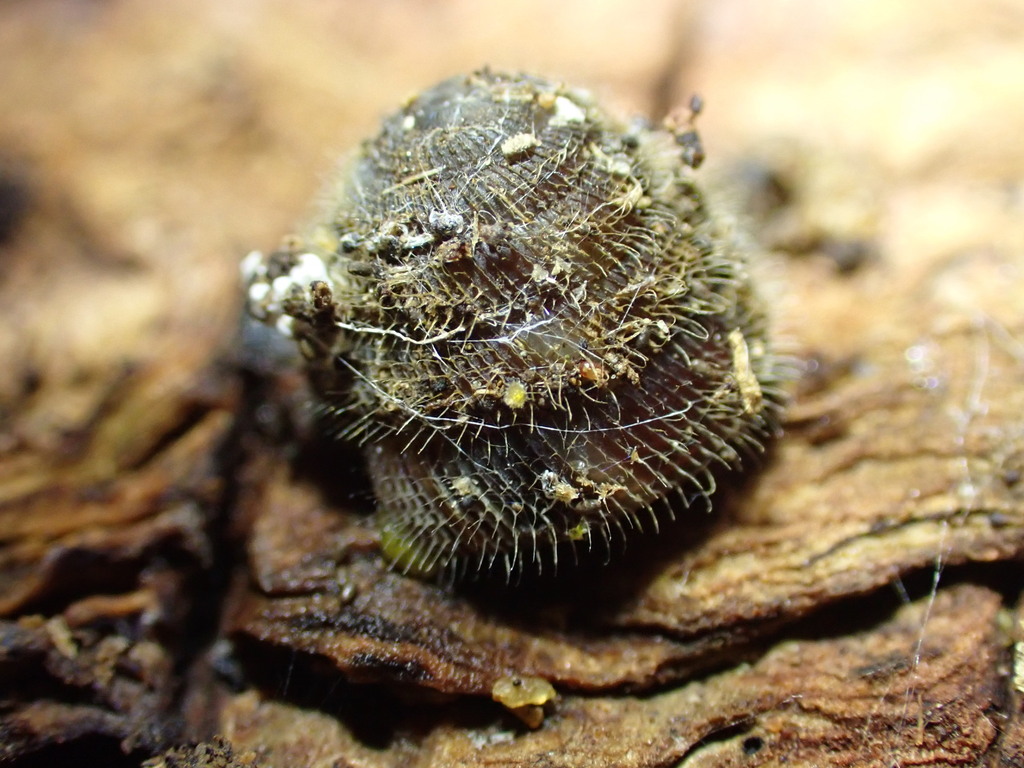
Fanulena imitatrix
Fanulena imitatrix, commonly known as the Norfolk Island hairy snail (Norf'k: laha snail), is a species of air-breathing land snail, a terrestrial pulmonate gastropod mollusk in the family Microcystidae. It is the type species of the genus Fanulena and is endemic to Norfolk Island. It is one of three Norfolk Island land snail species identified as being at highest risk of extinction.
From the article Fanulena imitatrix on Wikipedia (CC BY-SA), quoted section by section
Description
The shell is small, measuring 5.6–6.8 mm in width and 4.9–6.0 mm in height, with 6.0–6.5 whorls. It is dark golden brown to chocolate brown with cream flammulations, conical in shape with a domed, strongly raised spire and apex. The protoconch is sculptured with moderately closely spaced radial ribs, faint to obsolete on the early whorl but becoming stronger towards the teleoconch. The teleoconch is sculptured with strong, moderately closely spaced radial ribs ornamented with long periostracal hairs arranged in spiral rows — four rows on early whorls and five to seven rows on outer whorls. This distinctive hair-like sculpture gives the species its common name. The whorl profile is rounded above and below a keeled periphery. The aperture is ovate, with a small, indistinct columellar tooth. The animal is grey with a white sole. Unlike many other Norfolk Island microcystids, F. imitatrix completely lacks shell lappets.
Reproductive anatomy. Fanulena imitatrix possesses a short penis that is not coiled within the penial tunica, with a small blind tip that narrows significantly towards the penis–epiphallus boundary. The inner penial wall is flat with v-shaped grooves in the upper half and a single longitudinal pilaster in the lower half. …
Range & habitat
This species is endemic to Norfolk Island, a volcanic island situated approximately 1,500 km from the Australian mainland and 1,000 km from New Zealand in the South Pacific Ocean. The historical distribution of F. imitatrix is poorly understood; the original 1900 description lacked locality data. The species is common in subfossil deposits at Emily Bay and Cemetery Bay, indicating it was once more widespread. A single specimen was reportedly recorded from Mount Pitt by Neuweger et al. (2001), but the identity could not be confirmed. As of the most recent surveys, the species is known only from a single population in Selwyn Reserve, where it inhabits remnant subtropical rainforest and shelters under logs and palm fronds in leaf litter.
Wikipedia: “Distribution and habitat”
Where it lives
Recorded sightings
—
geo-referenced records in GBIF, from museums, herbaria and field observers.
Drag the globe to turn it. Dots are where records exist, not a range map; darker means more records.
In the stacks
Searching the stacks…
Every page naming Fanulena imitatrix in the Biodiversity Heritage Library →
This page is assembled live from iNaturalist, GBIF, Wikipedia, the Source Library and the Internet Archive. It is not yet part of the hand-edited codex. iNaturalist taxon 1179338.