- Fungi Including Lichens
- ›Basidiomycete Fungi
- ›Higher Basidiomycetes
- ›Dacrymycetes
- ›Dacrymycetales
- ›Dacrymycetaceae
- ›Guepiniopsis
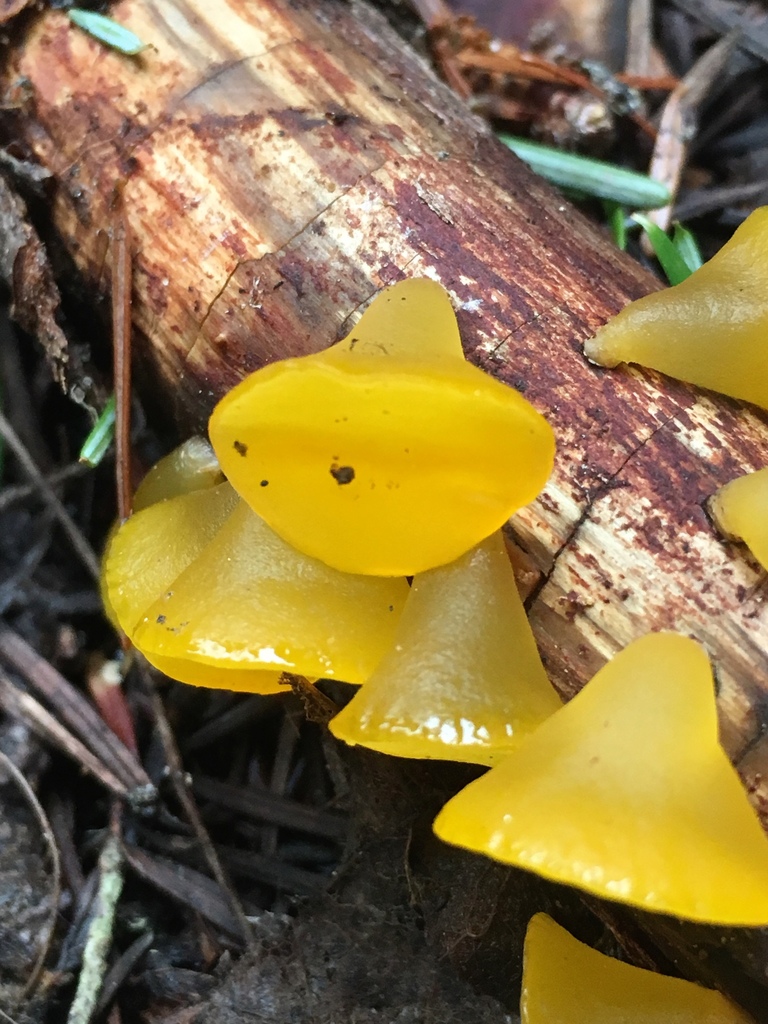
alpine jelly cone
Guepiniopsis alpina
Guepiniopsis alpina, commonly known as the jelly cup, alpine jelly cone, or poor man's gumdrop, is a species of fungus in the family Dacrymycetaceae. The small, gelatinous fruit bodies are orange and cone- or cup-shaped, producing a yellowish spore print.
Found in western North America and Iran, the fungus grows on decaying conifer wood. It is of little to no culinary interest.
From the article Guepiniopsis alpina on Wikipedia (CC BY-SA), quoted section by section
Description
The fruit bodies are cone-shaped, measuring up to 2.5 cm (1 in) across. They hang from a narrow attachment to the substrate. They are bright yellow to orange, with a gelatinous texture and a smooth and sticky surface on top, but have external hairs. The dried fruit bodies deepen to reddish-orange and become hard. The basidiospores are produced on the inner surface of the cup and are yellowish in deposit. The spores are sausage shaped, 11–18 by 4–6 μm, and have three or four septa. Like all members of the Dacrymycetes, the basidia are Y-shaped.
Similar species. Species with which G. alpina could be confused include Bisporella citrina, Dacrymyces capitatus (up to 3 millimetres wide), and D. stillatus (never cone-shaped). Guepiniopsis chrysocomus is a related species with a somewhat similar appearance. It has a yellow fruit body, larger spores, and uses rotting hardwood as a substrate.
Range & habitat
The fruit bodies grow scattered, in groups, or clusters on decaying, bark-free conifer wood. A snowbank fungus, it is most common at higher elevations after snowmelt in the spring. It is found in North America west of the Rocky Mountains. In 2010, it was recorded for the first time in Iran. It may also appear in Sweden.
Wikipedia: “Habitat and distribution”
At the table
The edibility of G. alpina is unknown, but it is too small to be considered for the table. It has been claimed to be edible, but tastes bland at best. One guide classifies it as inedible.
Wikipedia: “Edibility”
Where it lives
Recorded sightings
—
geo-referenced records in GBIF, from museums, herbaria and field observers.
Drag the globe to turn it. Dots are where records exist, not a range map; darker means more records.
In the stacks
Searching the stacks…
Every page naming Guepiniopsis alpina in the Biodiversity Heritage Library →
This page is assembled live from iNaturalist, GBIF, Wikipedia, the Source Library and the Internet Archive. It is not yet part of the hand-edited codex. iNaturalist taxon 118032.