- Fungi Including Lichens
- ›Basidiomycete Fungi
- ›Higher Basidiomycetes
- ›Mushrooms, Bracket Fungi, Puffballs, and Allies
- ›Agaricomycetidae
- ›Common Gilled Mushrooms and Allies
- ›Agaricineae
- ›bird's nest fungi
- ›Cyathus
- ›Cyathus olla
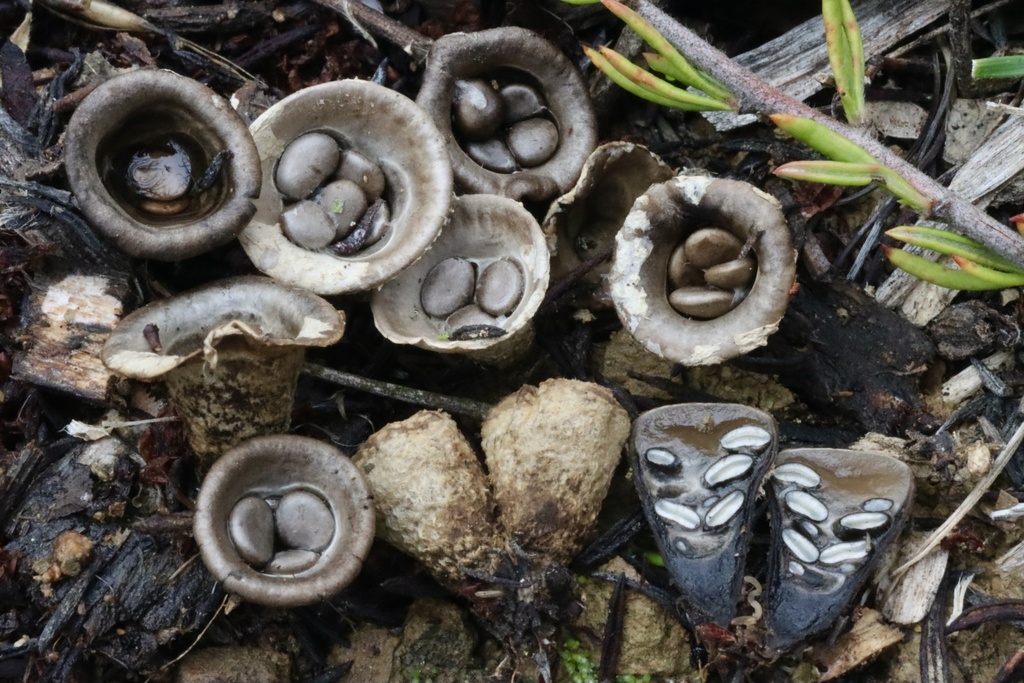
field bird's nest fungus
Cyathus olla
Cyathus olla also known as the field bird's nest is a species of saprobic fungus in the genus Cyathus of the family Nidulariaceae. The fruit bodies resemble tiny bird's nests filled with "eggs" – spore-containing structures called peridioles. Like other bird's nest fungi, C. olla relies on the force of falling water to dislodge peridioles from fruiting bodies to eject and disperse their spores. The life cycle of this fungus allows it to reproduce both sexually, with meiosis, and asexually via spores. It is a relatively common fungus, with a worldwide distribution.
The species is the subject of agricultural research to determine its potential as a means to accelerate the breakdown of crop residue, and reduce the population of plant pathogens.
From the article Cyathus olla on Wikipedia (CC BY-SA), quoted section by section
Description
Cyathus olla bears a resemblance to a miniature bird's nest containing eggs, hence the common name bird's nest fungi. The fruiting body, or peridium, is roughly funnel-shaped, 10–18 mm tall and 8–12 mm wide. It is greyish yellow or greyish brown to fawn-colored and covered with even, fine-textured hairs on the outside surface. The inner surface is silver grey and smooth, often with faint transverse ridges. Cyathus olla is thick-walled, and flared outwards at the rim; the rim is typically wavy in outline. The 'eggs', or peridioles, typically number 8 to 10 in the cup, and they are white or grey in color, with a diameter of 2–4 mm—conspicuously larger than other Cyathus species. They are covered with a thin membrane called a tunica. Peridioles are often attached to the fruiting body by a funiculus, a structure of hyphae that is differentiated into three regions: the basal piece, which attaches it to the inner wall of the peridium, the middle piece, and an upper sheath, called the purse, connected to the lower surface of the peridiole. Inside the purse and middle piece is a coiled thread of interwoven hyphae called the funicular cord, attached at one end to the peridiole and at the other end to an entangled mass of hyphae called the hapteron. C. olla has a wide purse with an upper portion not easily distinguishable from the lower part. …
Range & habitat
Being a saprobic fungus, Cyathus olla obtains nutrients from the breakdown of dead organic matter, and as such is usually found growing on woody debris; specimens found growing on soil are usually attached to bits of wood or stems present in the soil. Brodie notes that this species usually grows in moist and shaded locations, although its discovery in the arid regions of Lima, Peru, suggest that it is tolerant of low-moisture conditions. It is the most abundant species of Cyathus found in Europe, and is also common in North America. Its range extends north to Sweden and far south in South America; it has also been reported in Australia, South Africa, Iran, and India.
Wikipedia: “Habitat and distribution”
How it is grown
Blackleg is a fungal disease of canola that results in major yield loss in affected crops. It overwinters on infected stubble (leftover crop residue) that is left on farm fields, and can continue to produce spores, infecting future crops, until the stubble is buried or broken down completely. The observation that C. olla grows and fruits on canola stubble has led to research on the potential of this fungus to degrade canola stubble, and reduce the incidence of stubble-borne diseases like blackleg and blackspot. In a study of its lignin-degrading abilities, C. olla was shown to colonize canola, wheat, and barley residue, but appeared to have a preference for the woody taproots of canola as compared to the cereal residue.
Wikipedia: “Agricultural applications”
Where it lives
Recorded sightings
—
geo-referenced records in GBIF, from museums, herbaria and field observers.
Drag the globe to turn it. Dots are where records exist, not a range map; darker means more records.
In the stacks
Searching the stacks…
Every page naming Cyathus olla in the Biodiversity Heritage Library →
This page is assembled live from iNaturalist, GBIF, Wikipedia, the Source Library and the Internet Archive. It is not yet part of the hand-edited codex. iNaturalist taxon 118131.