- Plants
- ›Vascular Plants
- ›flowering plants
- ›Dicots
- ›Buttercups, Poppies, and Allies
- ›buttercup family
- ›Columbines and Meadow-Rues
- ›Thalictrum
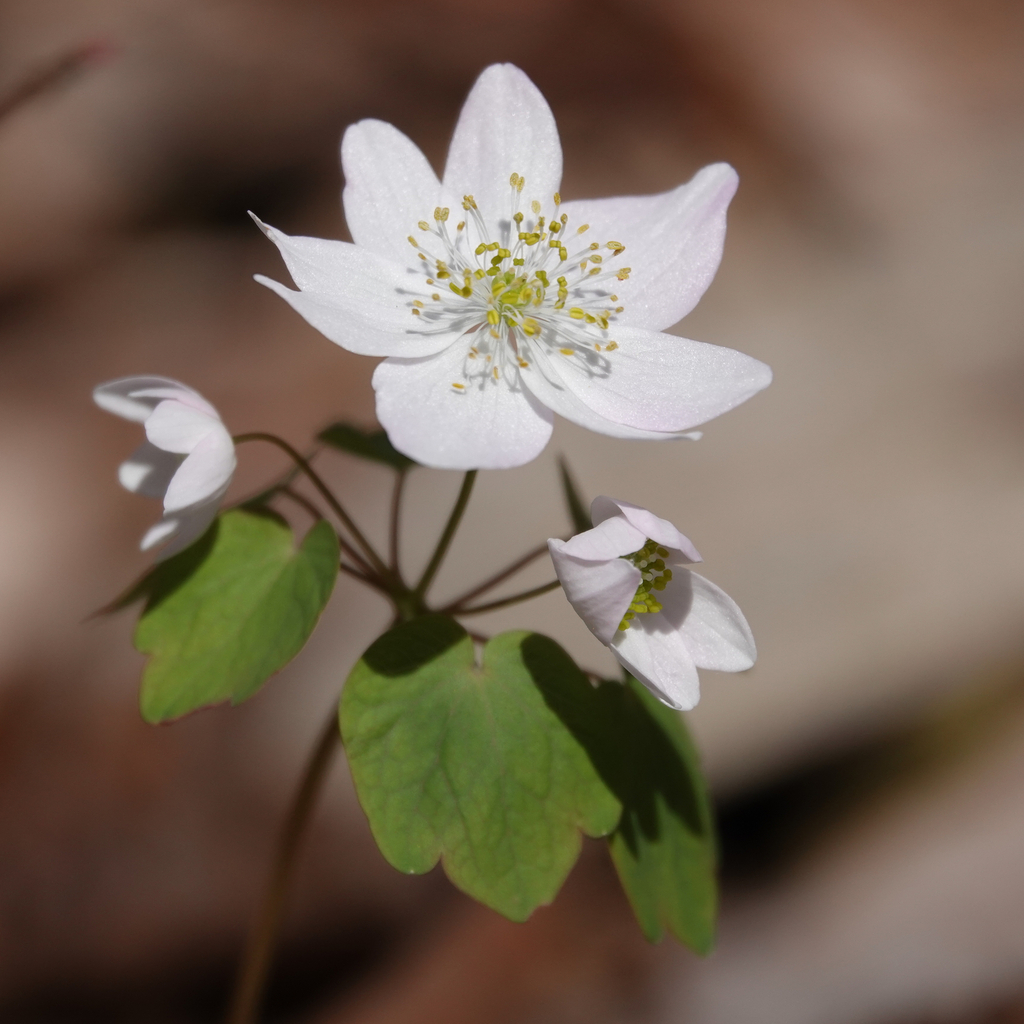
rue anemone
Thalictrum thalictroides
Thalictrum thalictroides (syn. Anemonella thalictroides), the rue-anemone or windflower, is a herbaceous perennial plant native to woodland in eastern North America. It has white or pink flowers surrounded by a whorl of leaflets, and it blooms in spring.
From the article Thalictrum thalictroides on Wikipedia (CC BY-SA), quoted section by section
Description
Thalictrum thalictroides is a hairless plant growing from a cluster of tuberous roots, with upright stems 10 to 30 cm (4 to 12 in) tall that end with flowers. The basal leaves have petioles (leaf stalks) 10–30 cm (4–12 in) long and leaf blades that are two times ternately compound. The leaflets are widely rounded in shape and the ends are three lobed. It flowers in spring, with flowers are borne singly or in umbel-like inflorescences with 3 to 6 flowers. The flowers have short stems that hold the fully opened flowers above the foliage. The involucral bracts have three leaflets like the leaves. The showy rounded flowers have 4-15 carpels surrounded by many yellow stamens in the middle, and a cup of 5 to 10 white to pinkish-lilac petal-like sepals. The sepals are about 5 to 18 mm (3⁄16 to 11⁄16 in) long and the filaments 3–4 mm (1⁄8–3⁄16 in) long. In late spring, 3 to 4.5 mm (1⁄8 to 3⁄16 in) long, ovoid to fusiform shaped fruits called achenes are released. The green achenes have 8 to 10 prominent veins and become dark brown when ripe. The Latin specific epithet thalictroides is in reference to the plant's leaves that look similar to meadow rue.
Range & habitat
It typically inhabits banks and thickets in low-lying deciduous woodland, at 0–300 m (0–984 ft). Distribution is mainly in the north eastern United States, and Ontario in Canada.
Wikipedia: “Distribution and habitat”
Where it lives
Recorded sightings
—
geo-referenced records in GBIF, from museums, herbaria and field observers.
Drag the globe to turn it. Dots are where records exist, not a range map; darker means more records.
In the stacks
Searching the stacks…
Every page naming Thalictrum thalictroides in the Biodiversity Heritage Library →
This page is assembled live from iNaturalist, GBIF, Wikipedia, the Source Library and the Internet Archive. It is not yet part of the hand-edited codex. iNaturalist taxon 118548.