On eBird ↗
Cave Swallow
Live sightings near you, the range map, bar charts of when it is seen, and Macaulay Library photos and recordings.
Cave Swallow
Petrochelidon fulva
The cave swallow (Petrochelidon fulva) is a medium-sized, squarish-tailed swallow belonging to the same genus as the more familiar and widespread cliff swallow of North America. The cave swallow, also native to the Americas, nests and roosts primarily in caves and sinkholes.
Cave swallows are found in Mexico and the Greater Antilles, with fall and winter vagrants reaching the east and Gulf Coasts of the U.S. Breeding colonies occur in south-eastern New Mexico, Texas, Florida, the Greater Antilles, portions of southern Mexico, and along the west coast of South America. Five subspecies are currently recognized according to Birds of North America, three occurring in North America and two in South America.
From the article Cave swallow on Wikipedia (CC BY-SA), quoted section by section
Description
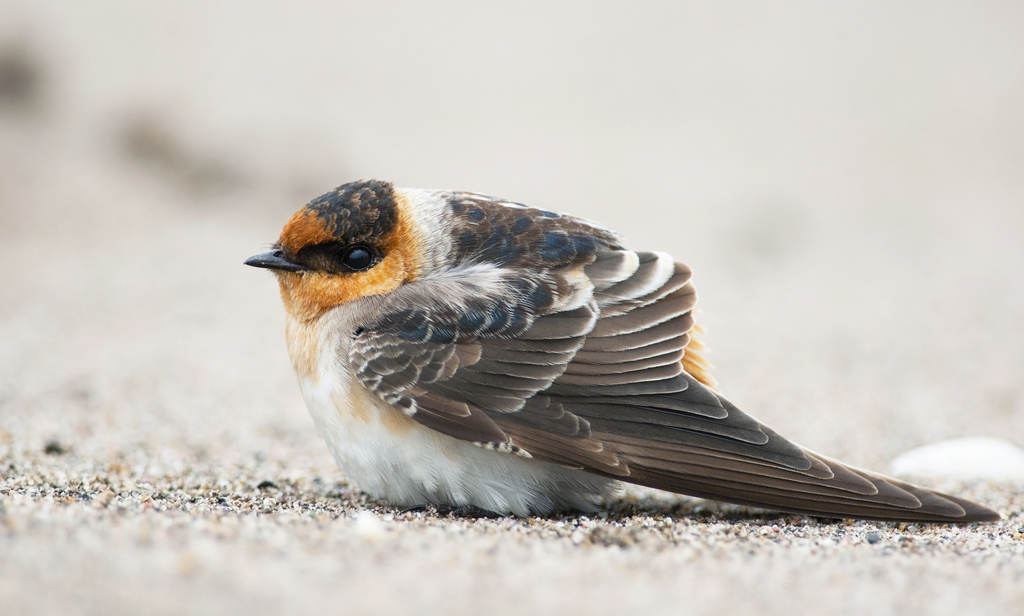
The cave swallow measures 12 to 14 cm in length and weighs 19 g on average. The largest of the five subspecies, P. f. pallida, has an average wing length between 107.0 and 112.3 mm; the smallest subspecies, P. f. aequatorialis, has an average wing length between 93.0 and 93.5 mm. Differences between the sexes are minimal, both are similar in size and weight and are difficult to distinguish from their plumage. It has grey-blue upperparts and brown-tangerine forefront and throat.
Range & habitat
During the breeding season, P. f. fulva, P. f. pallida, and P. f. citata, the North American subspecies of the cave swallow, will usually nest in a caves, sinkholes, and sometimes in man-made structures offering similar habitat, such as highway culverts. P. f. aequatorialis and P. f. rufocollaris, the South American subspecies, prefer to nest in open areas such as on cliff faces and the sides of buildings. All subspecies of the cave swallow forage for insects over open areas and water nearby their roosting sites. Their spring and fall migrations are poorly known; however, P. f. citata, P. f. aequatorialis and P. f. rufocollaris are considered resident species and winter in their breeding range.
Distribution. P. f. pallida is found farther west in the south-western United States and into north-eastern Mexico. P. f. citata has the southernmost range of the North American subspecies and is found on the Yucatán Peninsula of Mexico. P. f. aequatorialis is found in Ecuador, and it is speculated that it may extend its range into Peru. P. f. rufocollaris occurs in north-western Peru. Breeding is known to occur in Mexico, south-eastern New Mexico, southern Florida, Greater Antilles and in areas of Texas. The South American populations, as well as most Mexican and Caribbean populations, are considered resident populations which breed and overwinter in the same geographic range. …
Wikipedia: “Habitat”
What it does
Cave swallows feed on small to medium-sized flying insects throughout the day. They forage in loose flocks over open areas, on open vegetation, and against cliff-faces. During the nesting season, adult cave swallows preferentially forage in the early hours of the morning and in the late afternoon. They capture a wide variety of insects during the nesting season, included species from the families Acrididae, Lygaeidae, Reduviidae, and others. They drink while in flight by skimming the surface of pools and rivers. A benefit to nesting in colonies could be the ability to share and procure information about food sources from neighbouring birds while raising chicks. While research has not been conducted on cave swallows themselves, some studies have been done on the closely related cliff and bank swallows. Cliff swallow nesting colonies have been suggested to serve as "information centres", where swallows can gather and glean information from one another regarding how well they are foraging. Cliff swallows have been observed to follow, or be followed by, other birds within the nesting colony to food sources; birds that were unsuccessful foraging will return to the colony to find a fellow roost-mate that has been successful, and which they will then follow to a food source. …
Wikipedia: “Diet and foraging behaviour”
Listen
Looking for field recordings…
Where it lives
Recorded sightings
—
geo-referenced records in GBIF, from museums, herbaria and field observers.
Drag the globe to turn it. Dots are where records exist, not a range map; darker means more records.
In the stacks
Searching the stacks…
Every page naming Petrochelidon fulva in the Biodiversity Heritage Library →
This page is assembled live from iNaturalist, GBIF, Wikipedia, the Source Library and the Internet Archive. It is not yet part of the hand-edited codex. iNaturalist taxon 11855.