- Animals
- ›Chordates
- ›Vertebrates
- ›Ray-finned Fishes
- ›Spiny-rayed fishes
- ›Pipefishes and Allies
- ›Syngnathoidei
- ›Pipefishes, Seahorses, and Seadragons
- ›Tail-brooding Pipefishes
- ›Syngnathus
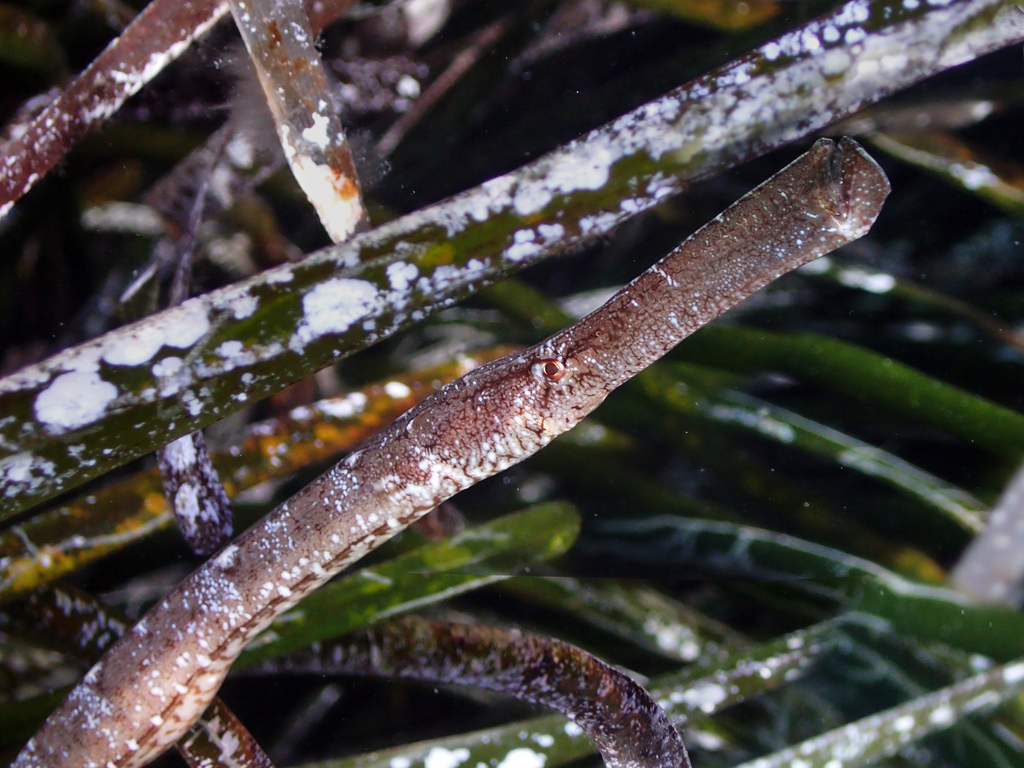
Broadnosed Pipefish
Syngnathus typhle
The broadnosed pipefish or deepnosed pipefish (Syngnathus typhle) is a fish of the family Syngnathidae (seahorses and pipefishes). It is native to the Eastern Atlantic ocean from Vardø in Norway, the Baltic Sea (north to the Gulf of Finland) and the British Isles in the north all the way to Morocco at south. It is also found in the Mediterranean Sea, Black Sea and Sea of Azov. It is common in the coastal shallow waters, usually on reefs with seagrasses. This species is notable for its "broad" snout, which is as deep as its body.
From the article Broadnosed pipefish on Wikipedia (CC BY-SA), quoted section by section
Description
The broadnosed pipefish is a slender, elongated fish with a hexagonal cross-section which distinguishes it from its even more threadlike relation the straightnose pipefish (Nerophis ophidion), which has a circular cross-section. The body surface is covered by small bony plates. The head resembles that of a seahorse with a long, laterally flattened snout and obliquely sloping mouth. Unlike the straightnose pipefish, it has a fan-shaped caudal fin. The general colour is greenish, often with various darker mottling, and the belly is yellow. The average size is about 15 to 20 cm (6 to 8 in) with a maximum of 25 cm (10 in).
Range & habitat
The broadnosed pipefish is native to the Eastern Atlantic, the Mediterranean Sea, the Black Sea and the Sea of Azov. Its range extends from Vardø, Norway to Morocco. It is found at depths to about 20 m (66 ft).
Wikipedia: “Distribution”
Where it lives
Recorded sightings
—
geo-referenced records in GBIF, from museums, herbaria and field observers.
Drag the globe to turn it. Dots are where records exist, not a range map; darker means more records.
In the stacks
Searching the stacks…
Every page naming Syngnathus typhle in the Biodiversity Heritage Library →
This page is assembled live from iNaturalist, GBIF, Wikipedia, the Source Library and the Internet Archive. It is not yet part of the hand-edited codex. iNaturalist taxon 118625.