- Plants
- ›Vascular Plants
- ›flowering plants
- ›monocots
- ›lilies, supplejacks, and allies
- ›lily family
- ›true lily subfamily
- ›bead lilies and cucumber roots
- ›Clintonia
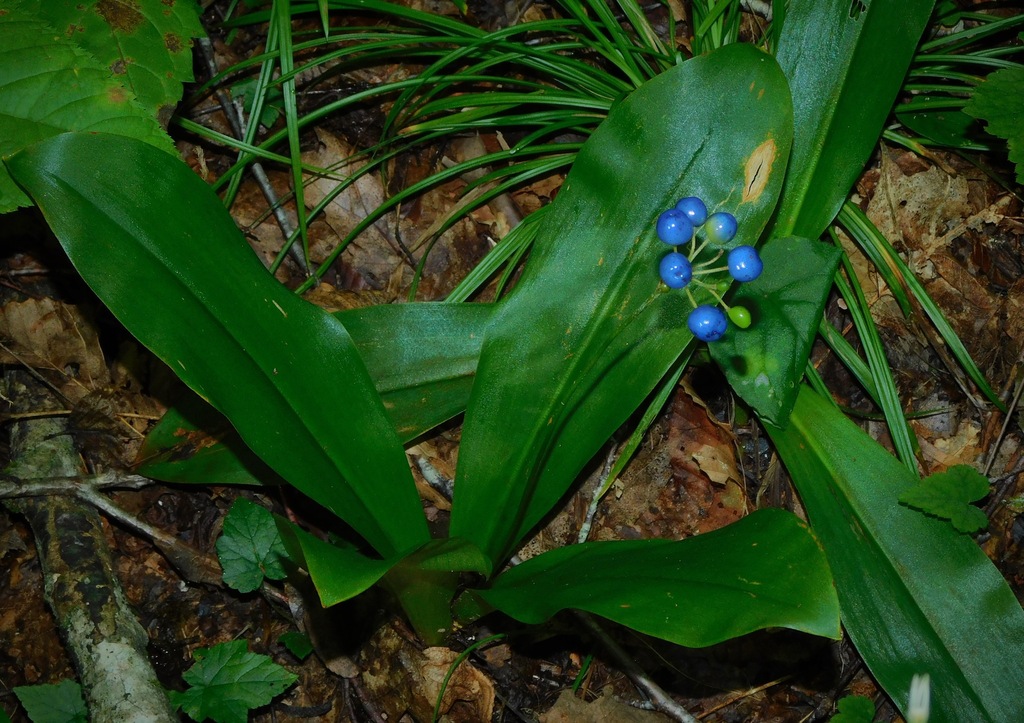
white clintonia
Clintonia umbellulata
Clintonia umbellulata (white clintonia, Clinton's lilly, speckled wood lily) is a perennial herb in the lily family. It is found in the deciduous forests of the Appalachian Mountains of the eastern United States (NY, OH, PA, WV, GA, KY, MD, TN, VA, NC and SC). It blooms in late spring.
From the article Clintonia umbellulata on Wikipedia (CC BY-SA), quoted section by section
Description
Clintonia umbellulata is a perennial herbaceous plant that spreads by means of underground rhizomes. A plant stands 27 to 60 cm (11 to 24 in) tall with 2–4 dark green leaves, each 18 to 30 cm (7 to 12 in) long and 4.5 to 8 cm (2 to 3 in) wide. The inflorescence is a single terminal umbel with 10–25(–30) outward-facing flowers on a flowering stalk up to 50 cm (20 in) high. Each flower has six tepals and six stamens. The tepals are white or greenish white, often marked with purplish brown or green speckles, each tepal being 5.5 to 8 mm (0.2 to 0.3 in) long and 2.7 to 4 mm (0.1 to 0.2 in) wide. The stamens are 60% longer than the tepals. The fruits are black (occasionally ultramarine blue) berries, each 6 to 8 mm (0.2 to 0.3 in) long with 2–4 seeds per berry. Each seed is approximately 3.5 mm (0.1 in) long.
Similar species. Because of their proximity, Clintonia umbellulata and C. borealis are often confused. The following table compares the two species character by character (with diagnostic characters emphasized):
Based on morphological characters alone, bare-leaved plants may be difficult to identify. In this case, Clintonia umbellulata is distinguished from C. borealis by the presence of hairs longer than 1 millimeter on the underside midvein. C. umbellulata has numerous look-alikes. …
Range & habitat
Clintonia umbellulata is endemic to the Appalachian Mountains in the eastern United States, from New York to Georgia. Counties where the species is known to occur are listed below:
New York: Allegany, Cattaraugus, Chautauqua, Erie, Livingston, Wyoming Ohio: Ashland, Ashtabula, Columbiana, Coshocton, Harrison, Holmes, Jefferson, Mahoning, Portage, Summit, Trumbull, Tuscarawas, Wayne Pennsylvania: Allegheny, Armstrong, Beaver, Bedford, Blair, Butler, Cambria, Centre, Clarion, Clearfield, Crawford, Elk, Erie, Fayette, Forest, Franklin, Fulton, Greene, Huntingdon, Indiana, Jefferson, Lawrence, Mercer, Somerset, Venango, Warren, Washington, Westmoreland Maryland: Allegany, Garrett West Virginia: Barbour, Braxton, Fayette, Grant, Greenbrier, Hampshire, Hardy, Kanawha, Lincoln, Logan, Marion, McDowell, Mercer, Mineral, Mingo, Monongalia, Monroe, Morgan, Nicholas, Pocahontas, Preston, Randolph, Ritchie, Summers, Tucker, Upshur, Wayne, Webster, Wetzel, Wyoming Virginia: Albemarle, Alleghany, Amherst, Augusta, Bath, Bedford, Bland, Botetourt, Buchanan, Carroll, Craig, Dickenson, Floyd, Franklin, Giles, Grayson, Greene, Henry, Highland, Lee, Madison, Montgomery, Nelson, Page, Patrick, Pulaski, Rappahannock, Roanoke, Rockbridge, Rockingham, Russell, Scott, Smyth, Tazewell, Warren, Washington, Wise, Wythe Kentucky: Bell, Breathitt, Clay, Harlan, Jackson, Laurel, Lee, Letcher, Menifee, Morg …
Wikipedia: “Distribution”
Where it lives
Recorded sightings
—
geo-referenced records in GBIF, from museums, herbaria and field observers.
Drag the globe to turn it. Dots are where records exist, not a range map; darker means more records.
In the stacks
Searching the stacks…
Every page naming Clintonia umbellulata in the Biodiversity Heritage Library →
This page is assembled live from iNaturalist, GBIF, Wikipedia, the Source Library and the Internet Archive. It is not yet part of the hand-edited codex. iNaturalist taxon 118725.