- Animals
- ›Arthropods
- ›Hexapods
- ›Insects
- ›Winged and Once-winged Insects
- ›Ants, Bees, Wasps, and Sawflies
- ›Narrow-waisted Wasps, Ants, and Bees
- ›Ants, Bees, and Stinging Wasps
- ›Vespoid Wasps
- ›Hornets, Paper Wasps, Potter Wasps, and Allies
- ›Hornets and Yellowjackets
- ›Dolichovespula
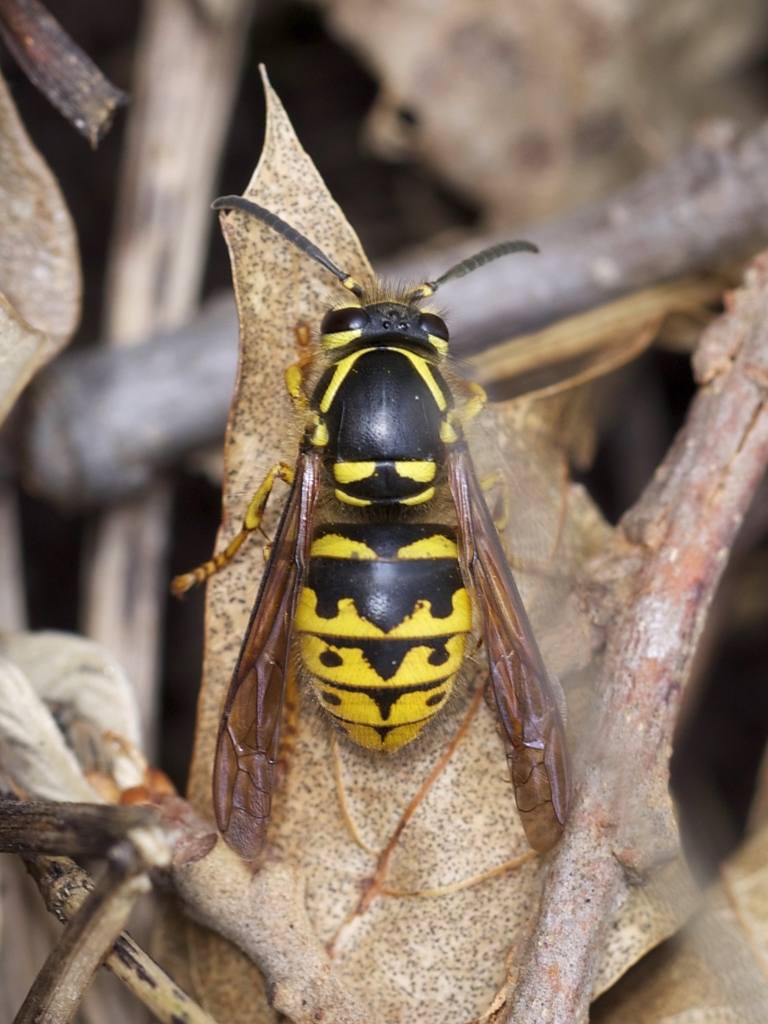
Common Aerial Yellowjacket
Dolichovespula arenaria
Dolichovespula arenaria, also known as the common aerial yellowjacket (common aerial yellow jacket), sandhills hornet, and common yellow hornet, is a species of wasp within the genus Dolichovespula widely distributed in the North American continent.
From the article Dolichovespula arenaria on Wikipedia (CC BY-SA), quoted section by section
Description
D. arenaria can be identified by the medially interrupted or incised apical fasciae of terga 1 and 2. They are yellow in color and can be differentiated from the other yellow-colored wasps, such as D. adulterina, in its genus by the lack of black markings in the ocular sinus. In the majority of the population, the ocular sinus is yellow, but some melanic males have a black area that reaches the lower margin of the sinus. The queen has large black discal spots on terga 4 and 5, and smaller ones on terga 2 and 3. Males can be identified by the larger antenna, spots on their basal band on terga 4 and 5 as well as an abdomen that ends with a flat "fuzzy butt" instead of a pointed stinger. Nest size ranges from 1-6 combs, and are made out of dull grey paper. However, color variations do occasionally occur due to available materials.
Wikipedia: “Description and identification”
Range & habitat
The common aerial yellowjacket lives across Canada and the United States. It occurs from northcentral Alaska to as far south as New Mexico and Arizona. D. arenaria is in fact one of the most common aerial yellowjackets found in eastern North America, and nests can be found in arboreal to subterranean habitats. Its nests are made from paper-like material and are usually found in trees and shrubs. In urban settings, nests are frequently found on buildings.
Wikipedia: “Distribution and habitat”
What it does
D. arenaria workers are known to mostly prey on live arthropods of a wide variety such as grasshoppers, crickets, caterpillars, spiders, flies, lacewings, and even lady beetles (which are generally avoided by Vespula species). They also prey on larvae of the fall webworm, as well as young hummingbirds. In general, they are not attracted to protein baits. Occasionally, however, Dolichovespula spp. may feed on animal carcasses— such feeding has been observed on carcasses of a dog, pig, and snake. They are commonly seen to prey in higher trees (2–4 m).
Wikipedia: “Diet”
Toxicity
Unique to D. arenaria is the observed spraying of venom out of their stings that has been seen from workers in large colonies. The "spray sting type", the term given to the venom-ejecting mechanism of these wasps, involves the contraction of the venom reservoir muscles. This venom spraying mechanism allows for a greater release of alarm pheromone in the venom, which is key to elicit the attack behavior of yellowjackets.
Wikipedia: “Venom spraying”
Listen
Looking for field recordings…
Where it lives
Recorded sightings
—
geo-referenced records in GBIF, from museums, herbaria and field observers.
Drag the globe to turn it. Dots are where records exist, not a range map; darker means more records.
In the stacks
Searching the stacks…
Every page naming Dolichovespula arenaria in the Biodiversity Heritage Library →
This page is assembled live from iNaturalist, GBIF, Wikipedia, the Source Library and the Internet Archive. It is not yet part of the hand-edited codex. iNaturalist taxon 118913.