- Animals
- ›Arthropods
- ›Hexapods
- ›Insects
- ›Winged and Once-winged Insects
- ›Beetles
- ›Water, Rove, Scarab, Long-horned, Leaf, and Snout Beetles
- ›Cucujiform Beetles
- ›Lady, Fungus, Scavenger, and Bark Beetles
- ›Lady Beetles
- ›Common Lady Beetles
- ›Black-spotted Lady Beetles
- ›Psyllobora
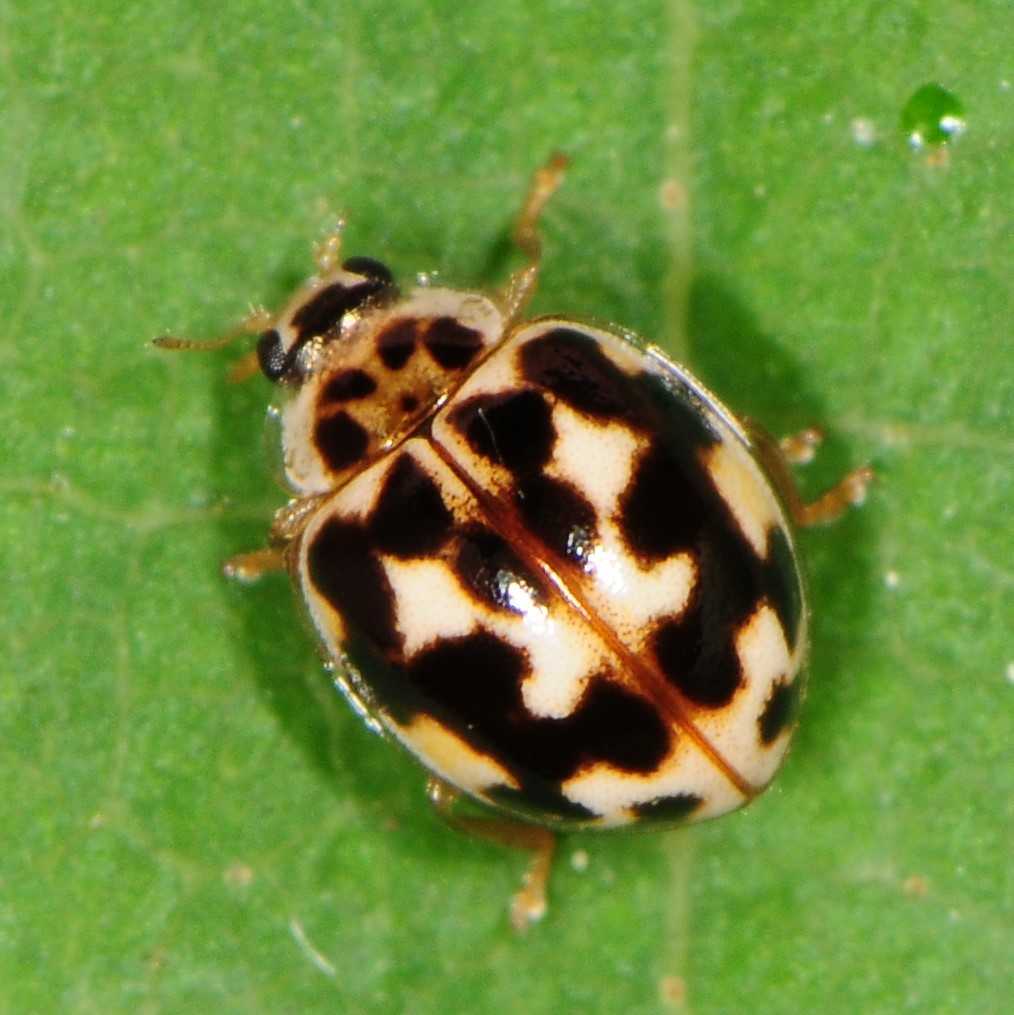
Twenty-spotted Lady Beetle
Psyllobora vigintimaculata
Psyllobora vigintimaculata, the twenty-spotted lady beetle, is a species of lady beetle in the family Coccinellidae. It is found in North America, where it has been recorded from Newfoundland to Alaska in the north and from Virginia to Tennessee and Louisiana, west to southern California.
From the article Psyllobora vigintimaculata on Wikipedia (CC BY-SA), quoted section by section
Description
P. vigintimaculata is about 1.75–3.0 mm in length, lives 1-2 years, and has four or five distinctive dark spots on the pronotum in an "M" shape. The elytra have dark, orange or bicolored spots on a white background. Although it is sometimes confused with the fourteen-spotted lady beetle (Propylea quatuordecimpunctata) and the Asian lady beetle (Harmonia axyridis), its unique pattern helps to distinguish it from other lady beetle species found in North America.
Wikipedia: “Appearance”
What it does
In a laboratory setting, the subspecies P. vigintimaculata taedata undergoes four larval instars, molting and then pupation. The timing of life cycle varies according to rearing conditions.
Instars and pupation. The first instar larvae has a white oval body with small hairs projecting from the thorax. The larvae of the second instar have a stripe and a much darker color that gradually turns lighter with each subsequent instar. During the end of the fourth instar, the larva attaches itself to a leaf or a petiole to molt. Pupae emerge with wing pads as well as black spots.
Duration. When eggs were deposited in 20°C it took about 32 days for adults to emerge. At 25°C it took about 20 days.
Wikipedia: “Life cycle”
Listen
Looking for field recordings…
Where it lives
Recorded sightings
—
geo-referenced records in GBIF, from museums, herbaria and field observers.
Drag the globe to turn it. Dots are where records exist, not a range map; darker means more records.
In the stacks
Searching the stacks…
Every page naming Psyllobora vigintimaculata in the Biodiversity Heritage Library →
This page is assembled live from iNaturalist, GBIF, Wikipedia, the Source Library and the Internet Archive. It is not yet part of the hand-edited codex. iNaturalist taxon 118967.