- Plants
- ›Vascular Plants
- ›flowering plants
- ›Dicots
- ›Gentians, Dogbanes, Madders, and Allies
- ›logania family
- ›Spigelia
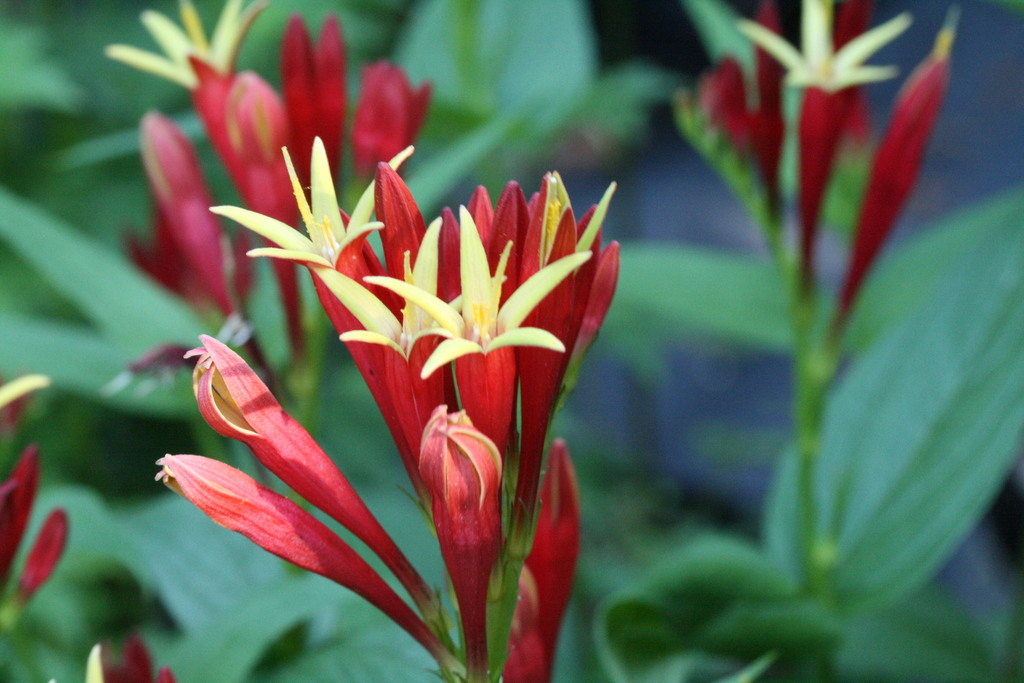
woodland pinkroot
Spigelia marilandica
Spigelia marilandica, the woodland pinkroot or Indian pink is a herbacious perennial wildflower in the Loganiaceae family native to inland areas of the Southeastern and Midwestern United States.
It flowers in late spring and early summer and tends to be found in low moist woods, ravines, or stream banks in partial or full shade. The flowers are red, erect, tubes with a star-shaped yellow center at the tip. It will grow 30–61 cm (1–2 ft) high with a spread of 15–46 cm (0.5–1.5 ft).
From the article Spigelia marilandica on Wikipedia (CC BY-SA), quoted section by section
Description
Spigelia marilandica is an upright perennial herbaceous plant growing from 30 to 60 cm in height. Corollas are colored bright red on the outside and yellow to greenish yellow on the inside. Spigelia marilandica produces flowers in late spring and early summer with sporadic blooms in the fall, and it tends to be found in low moist woods, ravines, or stream banks in partial or full shade. The flowers are red and erect, and has tubes with a star-shaped yellow center at the tip. It will grow 30–61 cm (1–2 ft) high with a spread of 15–46 cm long (0.5–1.5 ft). Leaf proximals 3 or 4 pairs per stem, sessile, blade usually ovate to lanceolate, sometimes elliptic, 4–12 × 1–5 centimeters long, base rounded to cuneate; distals opposite. The seed is found in a two sided capsule, and grouped into balls of 4-7 and are separately spread when ready to be dispersed.
Range & habitat
Native to inland areas of the Southeastern and Midwestern United States. Spigelia marilandica is not known to occur in Maryland. Most typically found in moist to dry woodlands and forests, usually on circumneutral soils. Found in South Carolina, southwestern North Carolina, Tennessee and Illinois, Oklahoma, south to Panhandle Florida and Texas; some floras allege its occurrence north to Virginia, New Jersey, and Pennsylvania, Alabama. Spigelia marilandica grows in USDA zones 5b-9.
Wikipedia: “Distribution and habitat”
At the table
It is used as an ornamental plant, more popular in the UK and Europe than its native U.S. It is used to treat hypertension and heart disease. Commercial availability in the plant trade is limited in the U.S., nursery propagation is primarily vegetative. Spigelia marilandica has medicinal uses, dried roots are used as an anthelmintic (dewormer), and are followed by a saline aperient to avoid unpleasant side effects and ensure that the toxic root is expelled along with the worms.
Wikipedia: “Uses”
Where it lives
Recorded sightings
—
geo-referenced records in GBIF, from museums, herbaria and field observers.
Drag the globe to turn it. Dots are where records exist, not a range map; darker means more records.
In the stacks
Searching the stacks…
Every page naming Spigelia marilandica in the Biodiversity Heritage Library →
This page is assembled live from iNaturalist, GBIF, Wikipedia, the Source Library and the Internet Archive. It is not yet part of the hand-edited codex. iNaturalist taxon 119146.