- Fungi Including Lichens
- ›Basidiomycete Fungi
- ›Higher Basidiomycetes
- ›Mushrooms, Bracket Fungi, Puffballs, and Allies
- ›Agaricomycetidae
- ›Common Gilled Mushrooms and Allies
- ›Agaricineae
- ›Strophariaceae
- ›Stropharia
- ›Mundae
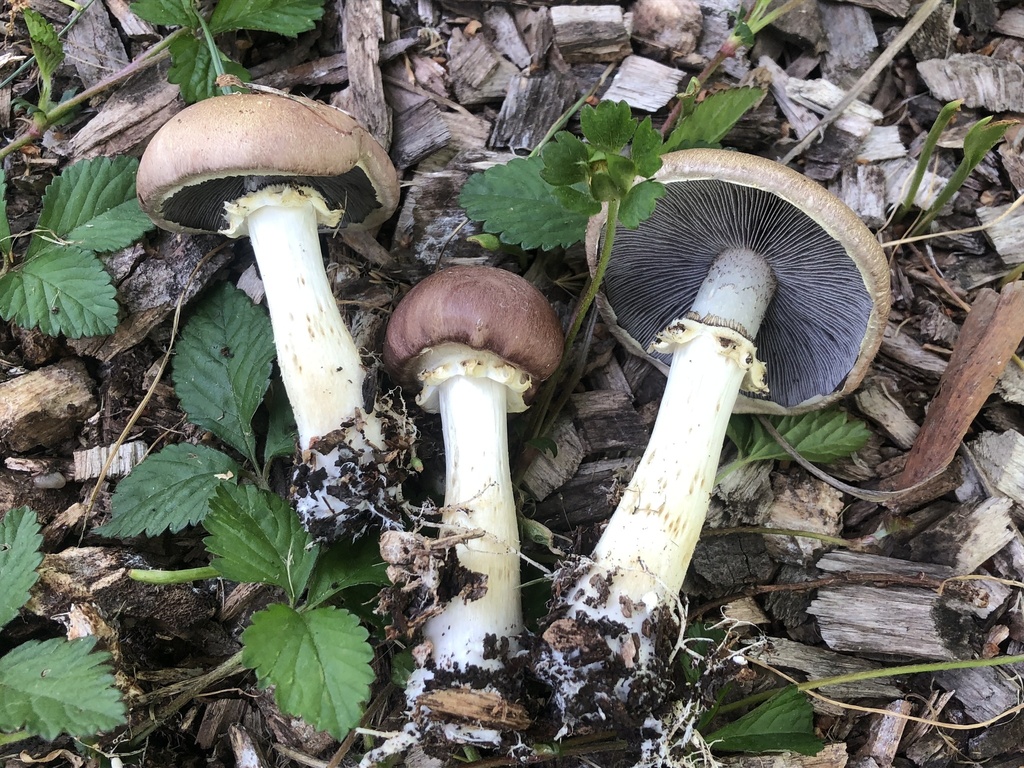
Wine-cap Stropharia
Stropharia rugosoannulata
Stropharia rugosoannulata, commonly known as the wine cap, wine-red stropharia, wine cap stropharia, garden giant, burgundy mushroom, or king stropharia, is a species of agaric mushroom in the family Strophariaceae found in North America. It is regarded as a choice edible.
From the article Stropharia rugosoannulata on Wikipedia (CC BY-SA), quoted section by section
Description
The mushroom can grow to 20 centimetres (8 inches) high with a reddish-brown convex to flattening cap up to 30 cm (12 in) across, the size leading to another colloquial name godzilla mushroom. The gills are typically adnate, initially pale, then grey and finally dark purple-brown in colour. The spore print is dark purple-brown to black. The firm flesh is white, as is the tall stem, which bears a wrinkled ring.
Similar species. It can resemble some members of its genus, such as S. hornemannii, as well as Agaricus (the gills of which are usually more pink).
Range & habitat
The species is found on wood chips across North America in summer and autumn. It is also found in Europe, and has been introduced to Australia and New Zealand.
Wikipedia: “Distribution and habitat”
What it does
Paul Stamets's book Mycelium Running cites a study by Christiane Pischl showing that the species makes an excellent garden companion to corn. The fungus also has a history of being grown with corn in Europe. A 2006 study, published in the journal Applied and Environmental Microbiology, found the species to have the ability to attack the nematode Panagrellus redivivus; the fungus produces spiny cells called acanthocytes, which are able to immobilise and digest the nematodes.
Wikipedia: “Ecology”
At the table
Described as a very tasty edible mushroom by some authors, it is easily cultivated on a medium similar to that on which it grows naturally. Antonio Carluccio recommends sautéeing them in butter or grilling them.
Wikipedia: “Uses”
In human culture
The specific epithet, which means "wrinkled-ringed", is a reference to the wrinkled annulus of the fruiting body.
Wikipedia: “Etymology”
Where it lives
Recorded sightings
—
geo-referenced records in GBIF, from museums, herbaria and field observers.
Drag the globe to turn it. Dots are where records exist, not a range map; darker means more records.
In the stacks
Searching the stacks…
Every page naming Stropharia rugosoannulata in the Biodiversity Heritage Library →
This page is assembled live from iNaturalist, GBIF, Wikipedia, the Source Library and the Internet Archive. It is not yet part of the hand-edited codex. iNaturalist taxon 119151.