- Plants
- ›Vascular Plants
- ›flowering plants
- ›monocots
- ›Agaves, Orchids, Irises, and Allies
- ›iris family
- ›Iridoideae
- ›Irideae
- ›Moraea
- ›Vieusseuxia
- ›Villosae
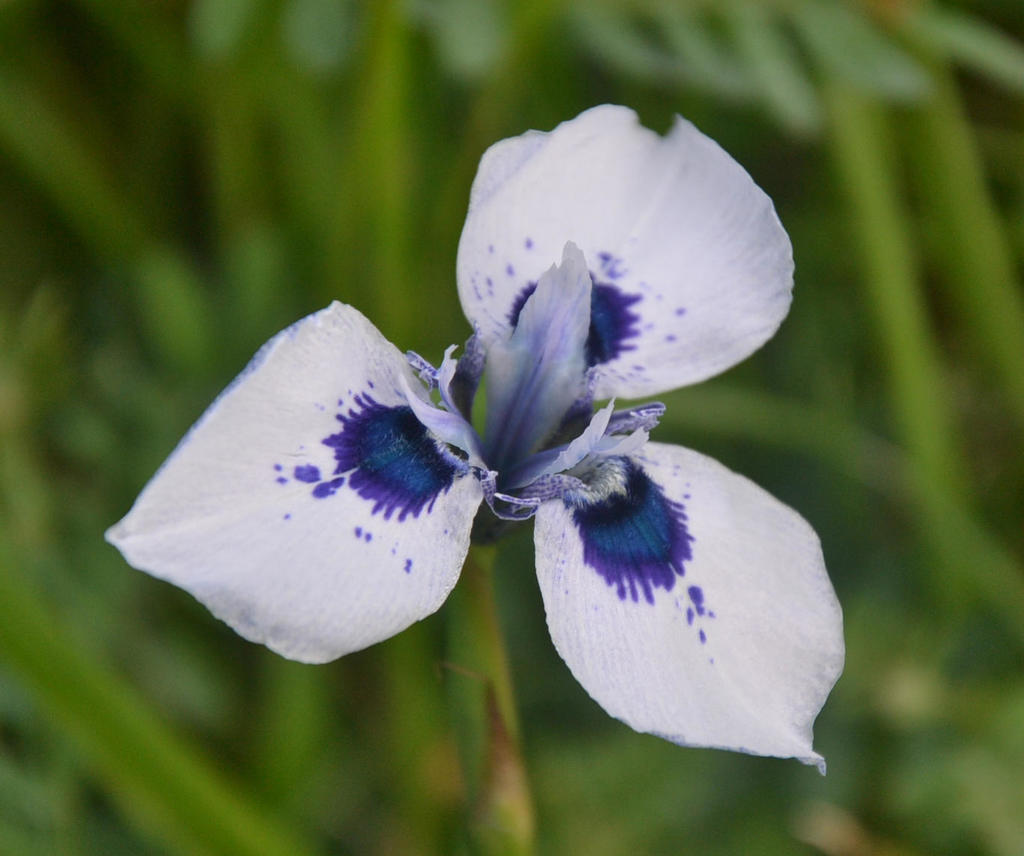
Blue-eyed moraea
Moraea aristata
Moraea aristata is a species of flowering plant in the family Iridaceae. It is referred to by the common names blue-eyed uintjie or Blouooguintjie in Afrikaans and is a critically endangered species of plant in the genus Moraea, that is endemic to the city of Cape Town and is now restricted to the grounds of the Observatory in the Cape Town suburb of Observatory.
From the article Moraea aristata on Wikipedia (CC BY-SA), quoted section by section
Description
Moraea aristata is a winter-flowering bulb (geophyte) that produces large and striking flowers. It grows 25–35 cm (9.8–13.8 in) tall and sometimes branches once. It has one linear leaf growing from the base. It is usually longer than the stem, and often trails on the ground. The stem and leaf are hairless. The corms have a diameter of around 15 mm (0.59 in) and are covered in pale fibers. Flowers are present in September. They grow on the end of the stem, or sometimes on short side branches. The outer petals are white, with a large spot of iridescent blue at the base of each one. The blue patches are outlined in violet, or sometimes yellow and have a broad, black, hairy base. The tepal claws are yellow and speckled with black or violet. The inner petals split into three lobes, with a long, straight central cusp. While each flower lasts only three days, several flowers are produced over a period of three to four weeks. The seed capsules have an oblong shape and split open from the top. They contain light brown, angular seeds.
Range & habitat
This plant naturally only occurs in Peninsula Shale Renosterveld vegetation in northern Cape Town. Due to the growth of the city, its habitat now mostly lies under urban sprawl. Until recently, it only naturally survived in the grounds of the South African Astronomical Observatory in the suburb of Observatory near the foot of Devil's Peak. This tiny, isolated population is not sustainable in the long term due to low genetic diversity and ongoing human disturbance. In 2017 and 2018, it was reintroduced to the Rondebosch Common, providing new hope for its survival in the wild. The species has also become naturalised in Australia.
Wikipedia: “Distribution and habitat”
What it does
The blue-eyed uintjie is pollinated by monkey beetles, which are drawn to the center of the flowers by the blue nectar guides on the petals. Seed dispersal occurs through wind. Seeds are released when the seed capsules split open in summer.
Wikipedia: “Ecology”
Where it lives
Recorded sightings
—
geo-referenced records in GBIF, from museums, herbaria and field observers.
Drag the globe to turn it. Dots are where records exist, not a range map; darker means more records.
In the stacks
Searching the stacks…
Every page naming Moraea aristata in the Biodiversity Heritage Library →
This page is assembled live from iNaturalist, GBIF, Wikipedia, the Source Library and the Internet Archive. It is not yet part of the hand-edited codex. iNaturalist taxon 119176.