- Animals
- ›Arthropods
- ›Hexapods
- ›Insects
- ›Winged and Once-winged Insects
- ›Ants, Bees, Wasps, and Sawflies
- ›Narrow-waisted Wasps, Ants, and Bees
- ›Ants, Bees, and Stinging Wasps
- ›Bees and Apoid Wasps
- ›Bees
- ›Honey Bees, Bumble Bees, and Allies
- ›Apine Bees
- ›Bombini
- ›Bombus
- ›Pyrobombus
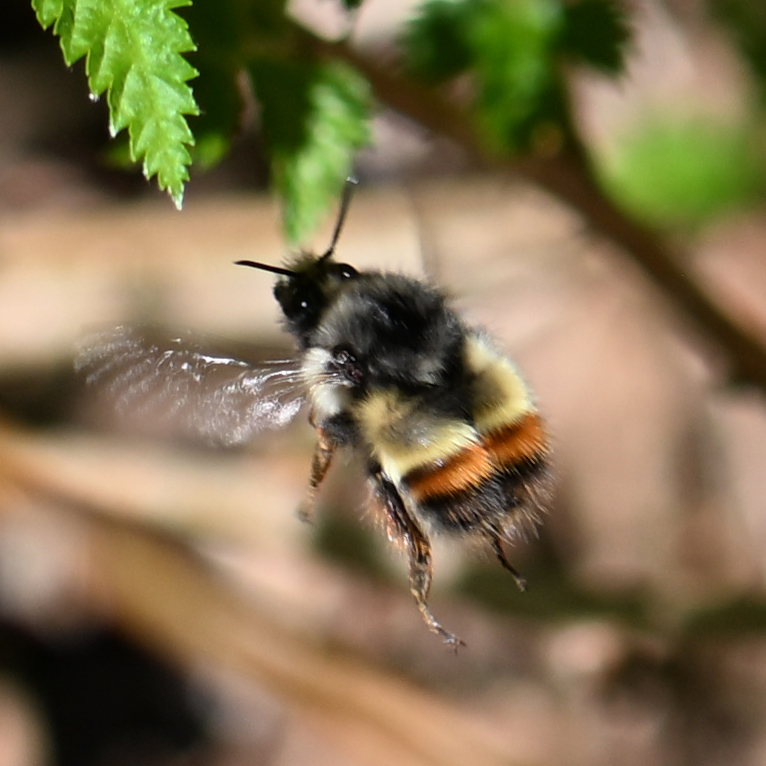
Yellow-fronted Bumble Bee
Bombus flavifrons
Bombus flavifrons, the yellow-fronted bumble bee or yellowhead bumblebee, is a species of bumblebee. It is native to North America, where it is distributed across much of Canada, Alaska, and the western contiguous United States.
From the article Bombus flavifrons on Wikipedia (CC BY-SA), quoted section by section
Description
This is a robust bumblebee; the queen has a body length between 13 and 16 mm (0.51 and 0.63 in) and a wingspan of 27 to 34 mm (1.1 to 1.3 in), the male is 11 to 12 mm (0.43 to 0.47 in) in length with a wingspan of 25 to 26 mm (0.98 to 1.02 in), and the workers are 9 to 12 mm (0.35 to 0.47 in) in length and 19 to 27 mm (0.75 to 1.06 in) in wingspan. The yellow-fronted bumble bee has a dense, untidy fur. The head is yellow with black hairs intermixed on the posterior part, the thorax has a mixed black and yellow colouration, often (always with the queen) with a black, central field. The first two terga (abdominal segments) are yellow, on the females often with a black, central field on terga 1 to 2. Terga 3 and 4 are red, and the tail black, sometimes with yellow fields.
Subspecies Subspecies include:
B. f. dimidiatus — with the red fur more or less entirely replaced with black B. f. flavifrons
What it does
The queen emerges from her hibernation at the end of March and often builds a nest in a disused mouse nest. The first workers appear about a month later. The nest declines at the end of August, and all the inhabitants die, except for the new queens, which hibernate in the earth. The bumblebee feeds on several flowering plants, most commonly those in Asteraceae, Fabaceae, Saxifragaceae, and Lamiaceae. This species is host to the parasitic indiscriminate cuckoo bumblebee (Bombus insularis). This bee occurs at high altitude and latitude, living in habitat such as tundra, taiga, and mountain forests and meadows.
== References ==
Wikipedia: “Ecology”
Listen
Looking for field recordings…
Where it lives
Recorded sightings
—
geo-referenced records in GBIF, from museums, herbaria and field observers.
Drag the globe to turn it. Dots are where records exist, not a range map; darker means more records.
In the stacks
Searching the stacks…
Every page naming Bombus flavifrons in the Biodiversity Heritage Library →
This page is assembled live from iNaturalist, GBIF, Wikipedia, the Source Library and the Internet Archive. It is not yet part of the hand-edited codex. iNaturalist taxon 119308.